Powered By Blogger
Showing posts with label Guayasamín. Show all posts

Monday, March 9, 2020

Now That I've Walked Uphill to Get Here, Let's Go in La Capilla Del Hombre

Let's sit a spell and enjoy us some of that modern art.
This is the artist Guayasamín's Piata, patterned after the more famous Piata of Avignon.
Time for the day's main event: Touring La Capilla Del Hombre.


This is the museum housing the main collection of Ecuadorian artist Oswaldo Guayasamín.

I like statues that look like stone totems.


This one has a name.


"Dandelion."

This one may have a name, but with no nearby placard, it's name shall remain a mystery.


And here is that same un-named work being desecrated by that most vile of species, Turista Americana.
 

Some people have no respect.

And speaking of no respect, let's go inside.


Guayasamín's work definitely has a dark quality.


This one looks like souls tormented in hell. But it's in a ceiling dome, which ordinarily would connote the heavenly. But it's black with pale white figures.


Heaven? Hell? You decide.


This one I liked. It has green in it.


Yes. I am that superficial in what art I choose to like.

Let's go down to the basement. And we find, in the stairwell, "El Guitarrista."


The name for that one was easy to remember.  And, once down in the basement, we see:


"Mujer Pajaro." She looks kind of Aztec, although the head is probably condor and not eagle. You can tell she's a lady because ... well, I don't really want to go into detail, but it's kind of obvious.

And then there was this one:


I call this one: "The Philadelphia Eagle Visits Guernica."

It kind of looks like a giant Philadelphia Eagle attacking a bull from Picasso's Guernica painting. In fact, a lot of Guayasamín's art has a Guernica feel to it. It's as if he looked at Picasso's masterpiece from the Spanish Civil War and said (to himself) (or maybe out loud, who knows): "I can do that. And I can make it even darker and more disturbing and more unsettling."

This one is not dark, however.
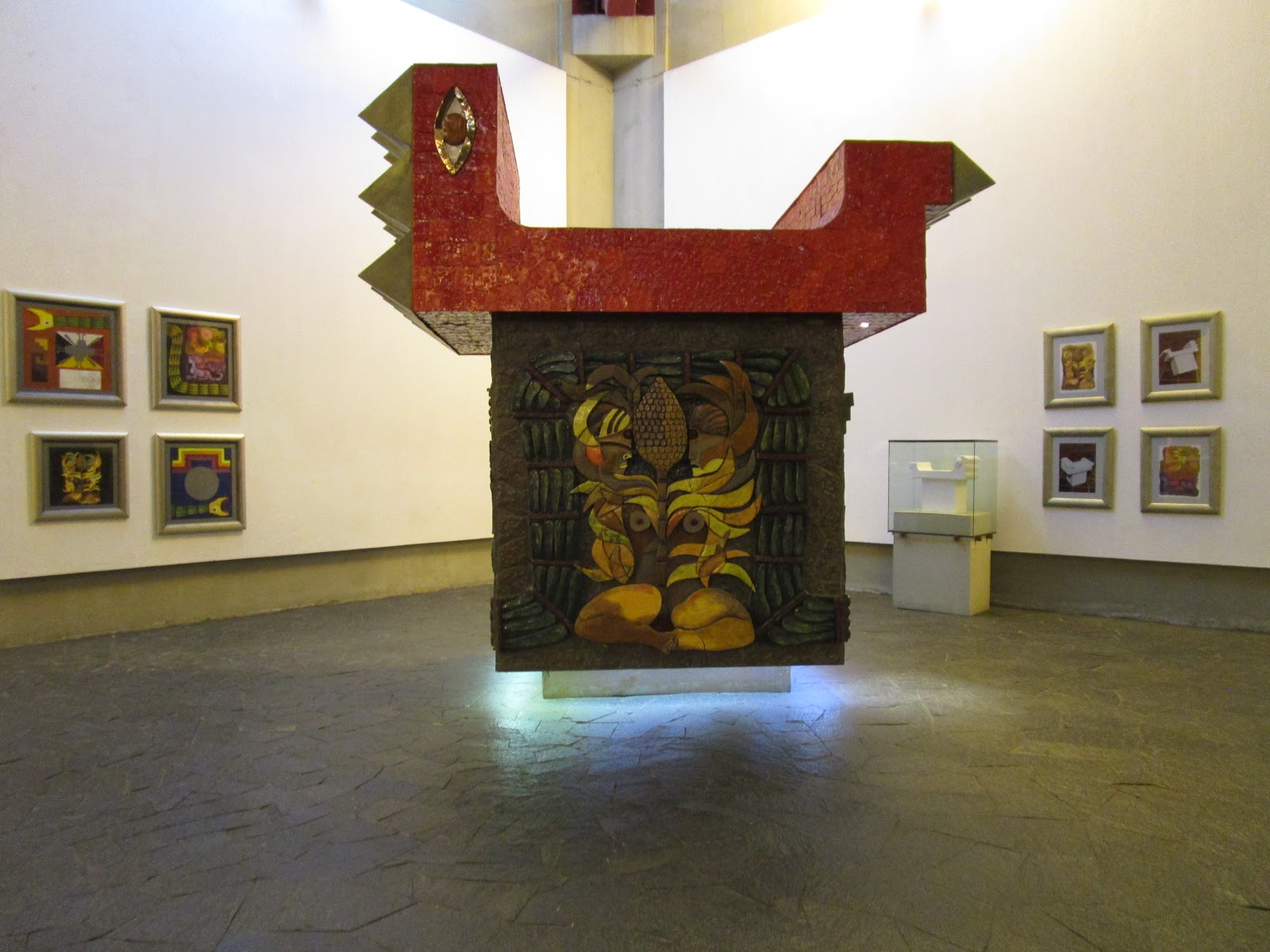

This one might be:


Who knows?


And here I am, enjoying the nice view of Quito from La Capilla Del Hombre.


On the walk back (yes, it was uphill, too) (I told you all walks in Quito were straight uphill, both ways), I visited Plaza Argentina, featuring some lovely distinctly non-modern statuary.

Way up high on the horse, in classic style, is Jose de San Martin.


San Martin is known as "El Libertador de Argentina." Shorthand: He was the Simon Bolivar of Argentina.

This is ... well, I don't know what this is ...


It must have something to do with Argentina, as this is as a plaza featuring things Argentine.


And here is a man, an Argentine man, who must have been a scholar, since his statuary involves lots of books.


And, with that, I am back in my hotel room. Enjoying the view when the sun came back out after the afternoon thunder.


Slow day in Quito for me. Lots of things were closed for the Monday and my legs had not fully recovered. So a slow day was a good day.

Walking to the Capilla Del Hombre

The artist's living room. That's his painting of the City of Quito on the wall, at the left.
Today I walked from my hotel to the Capilla Del Hombre. It was a 3.5 km walk, which translates to a little over two miles.

It was nice sunny late morning/early afternoon. I walked past what I call "Calle de Pollo," the "Street of Chicken."


Three chicken restaurants all in a row. First was KFC, which they still call Kentucky Fried Chicken because Ecuadorians love both chicken and fried. Then, next to it, was Texas Chicken. Which was strange because in the USA, we don't associate Texas with chicken. Then next to that was Campero Pollo, Campero Chicken. This is most definitely chicken-eating country.


I walked past Plaza Argentina, which looked like it had some interesting statuary.


Then I started to climb.


All walks in Quito are uphill.


Both ways.

Finally, I received a sign that I was heading in the right direction to Capilla Del Hombre, the Chapel of Man:


Actually, it was a street sign. But task accomplished. After a major uphill climb, I learned that I still knew how to read a paper map and that I was heading in the right direction.

And here it is, La Capilla del Hombre.


It's not a chapel as in a church-chapel. It is a museum housing the works of the most renowned Ecuadorian artist of the 20th Century: Oswaldo Guayasamín. No. I do not know who were the other competitors for that title. I'm sure the competition was stiff. Like maybe that guy on the side of the road from the drive to Quilatoa yesterday:


Yeah, maybe him.

Anyway, before touring Capilla Del Hombre, I was shunted off to join the English language tour of the Fundación Guayasamín, the artist's home, which doubles as a museum. The tour had started about 10 seconds earlier, so I missed very little.


This is the formal dining room, where the tour began.

For a modern artist, whose politics seemed to run comfortably to the left of Bernie, maybe even bleeding over into full-bore communism, there was a surprising amount of religious art.


Is "full-bore" the right word to describe someone's communism? Having read Orwell's "Animal Farm," shouldn't that be "full boar"?


This is our guide. Guiding us through the collection.


An armless crucifix. Which raises the question: how did he stay up there if he had no arms? And the answer is: divinity.

And from one extreme to the other:


Guayasamín's collection of ancient, pornographic pottery. The third shelf is from Mexico. The fourth is from Peru. The fifth is from Ecuador. The top two were probably also Mexico, which surprised me, because I always thought Peru was the largest producer of ancient pornographic pottery.

The front room.


The guitar was from Spanish flamenco guitarist Paco de Lucia. We'll be seeing him again soon.

This is the artist's in-home studio.


This is his portrait of Paco de Lucia.


He elongated the face because he thought the guitarist's skull was like a cathedral. Seriously. There is a video of him saying exactly that. Well, not exactly. He said it in Spanish.

This is the head of Oswaldo Guayasamín himself.


His skull is not elongated. I guess he didn't see himself as a cathedral.

This is seven women. The theme is the horrors of war.


Seven women for the seven days of the week, according to the guide. But let's take a closer look at the one I will call "Wednesday":


She has man hands! In fact, all of the women in the art of Guayasamín have huge elongated bear claws for hands. He must see those hands as cathedrals, which each finger a soaring bell tower.


Here is the artist himself, well his sculpted un-elongated head, looking at another multi-piece mostly black and white work of his art:


And that concludes the tour of the interior.


Let's have a look-see at the exterior.


The swimming pool with a fabulous view of Quito.


For a friend of Castro and Salvador Allende, and an acquaintance of Mao, he sure did live the high life.


Four legs good. Two legs better.