Powered By Blogger
Showing posts with label ancient astronauts. Show all posts

Saturday, December 13, 2025

Perusing Peru II: The Caral Tour

Pirámide Mayor and Anfiteatro within the Caral Archaeological Site

Caral is older than pyramids in Egypt. Let that sink in.


Today's agenda item was an organized tour of the Caral Archaeological Site. It is about 140 miles north of Lima, but it's a three to four drive because of traffic, Peruano drivers, and terrible road conditions.

While this may be an ancient site, it was discovered only 31 years ago in the barren desert of Northern Peru.


How ancient? The Great Pyramid of Giza in Egypt is believed to be 4,600 years old, dating back to around 2600 B.C. Caral has it beat by the same amount of time between when the Pilgrims stepped on Plymouth Rock and today. Caral is about 5,000 years old. In other words, when ancient astronauts were still whizzing their way to earth with the plans and levitation technology to build the pyramids in the Nile Valley -- hey, do you have a better theory on how the Egyptian pyramids were built? -- Caral was thriving.

And, yet, old as it is, it was discovered only back in A.D. 1994, lost in the dry barren desert of Coastal Peru.


This is a re-creation of how someone imagined Caral looked.


Those bamboo chairs did not survive five millennia.

This is a re-creation of a stone at the center of Caral that is believed to have been a timekeeping sundial. Or maybe not. The people of Caral left no written records of any sort. Not even petroglyphs. And definitely not the sophisticated hieroglyphics of ancient Egypt.


So there's no one to ask.


Five thousands of history discovered only 31 years ago.

Let's walk around the site, But be sure to stay within the well-marked trails. It is an active archaeological site. A very lightly-visited archaeological site.


Noticing a theme with the "31 years" motif?

This is the Fuego Sagrado, believed to be the community hearth maintained by the priestly class of Caral.


It's a hole in the ground with evidence of ancient charring. The sacred hearth thing is an educated guess. Again: no written records and, even if there were, who could read it since the language that was used is likely to be extinct.

This is the main amphitheater, or Anfiteatro in Spanish. There were enough intact stones to make the call on this being an amphitheater a very educated guess.


The expensive seats were believed to be in the back.


The Peruvian desert holds a lot of secrets, only some of which have been revealed in the modern era. The Nazca Lines, for example, weren't really known until manned flight about 100 years ago. And not just Peru's desert coast. Machu Picchu was discovered (re-discovered, to be more accurate) only about 110 years ago. And it's new construction, likely dating back only to the 1450's.


Hey! It's me! I'm in Caral!

Back to our regular programming:


Another of the pyramids of Caral. What's interesting, again comparing these to the pyramids of Giza in Egypt, is the extreme degradation of the only-slightly-older pyramids of Caral compared to the relatively-pristine pyramids of Egypt. So not only were the sloped pyramids of Egypt more advanced technologically, more difficult to build, and more aesthetically pleasing than the stepped pyramids throughout the New World, with those of Caral being far and away the oldest, the more sophisticated Egyptian pyramids have proven to be much much much more durable. That is not to slight Caral. A building surviving 5,000 years in any sort of shape is absolutely amazing. It's just shows how extraordinary and without peer are those pyramids of Egypt. This definitely is moving Egypt up on my list of places I need to go.


Enough about Egypt. This is supposed to be about Caral. Which is impressive and which is older.


More pyramid power.


This is the sundial stone.


It looked decidedly less phallic in person that it does in photo.


This is the Pirámide Menor:


It's smaller than the Pirámide Mayor. Hence the name. Is it smaller because it the last pyramid constructed, abandoned as Caral past its peak, and poverty and famine took hold? Oit was older and the people of Caral were only figuring out pyramid-building by trial-and-error? That was the approach taken in building the Gothic cathedrals of medieval Europe, where kept increasing the size until they built one too big, too tall, and it collapsed. (Beauvais Cathedral in France in 1284, if you're nerdy like me and need to know those things).

And the answer is: We don't know. Yet another something shrouded in mystery.


Above is the Pirámide Mayor:


The Big Kahuna on the Caral Pyramid scene.


It has an amphitheater, but smaller than the main amphitheater from close to the entrance.

These are the middle class residence halls:


The upper crust of Caral society lived in the shadows of the pyramids. That was the prime Caral real estate. The laboring class is believed to have lived closer to the river, which is dry during the dry season and filled with water in the wet season. This is the dry season on the Peruvian Coast which, interestingly enough, is the exact opposite of the Andean highlands of Cusco and Machu Picchu. This is wet season in the Andes.


Interestingly enough, while we know (generally) where people lived in Caral, we don't know where they ended up after they died. That is not a spiritual question, interesting as that may be. They have been no cemeteries or burial plots found yet in the Caral excavations which have been going on for how many years?


Oh, that's right. Thirty-one years.

Did Caral buried its dead? No evidence of that. There is evidence of mummification being practiced in other tribes in Coastal Peru starting in the early years of the A.D. period, but no evidence of it in Caral. Did they cremate their dead? Well, even creation leaves bone fragments. Jaw bones are especially resilient to cremation. No bone fragments consistent with that theory have been found? Were they whisked away by the aliens like what happened to the senior citizens at the end of the movie "Cocoon"? There's as much evidence to support that theory as any other. We simply have no clue as to what happened to the dead in Caral.


We do know what happened to me. I proceeded to lunch in the nearby beach town of Barranca.

One last look at Caral:


Caral. Very fascinating. So old and yet so new. It's only recently been discovered. And it has given up very few of its secrets in those 31 years.

Sunday, April 22, 2018

The Nazca Lines Post

The Lizard, the Hands, the Trees, and the Viewing Platform

I have wanted to see Peru's enigmatic Nazca Lines ever since I first heard about them, which was probably from the now-debunked Erich von Daniken's awesome pseudo-documentary "Chariots of the Gods?".  But all of the people I know who have done an overflight of Peru's enigmatic Nazca Lines have had the exact same reaction: underwhelmed. Still, I'm a contrarian. One man's underwhelming is another man's most awesome thing ever.

So which would it be for me?

It all started with a van ride three hours south to beautiful, brand new Pisco International Airport:


It's so new that they haven't even unwrapped all of the counters:


The only flights that depart from, and arrive at, this airport, are Nazca overflights.  There are plan to expand service to actual destinations rather than simply literal round trips.


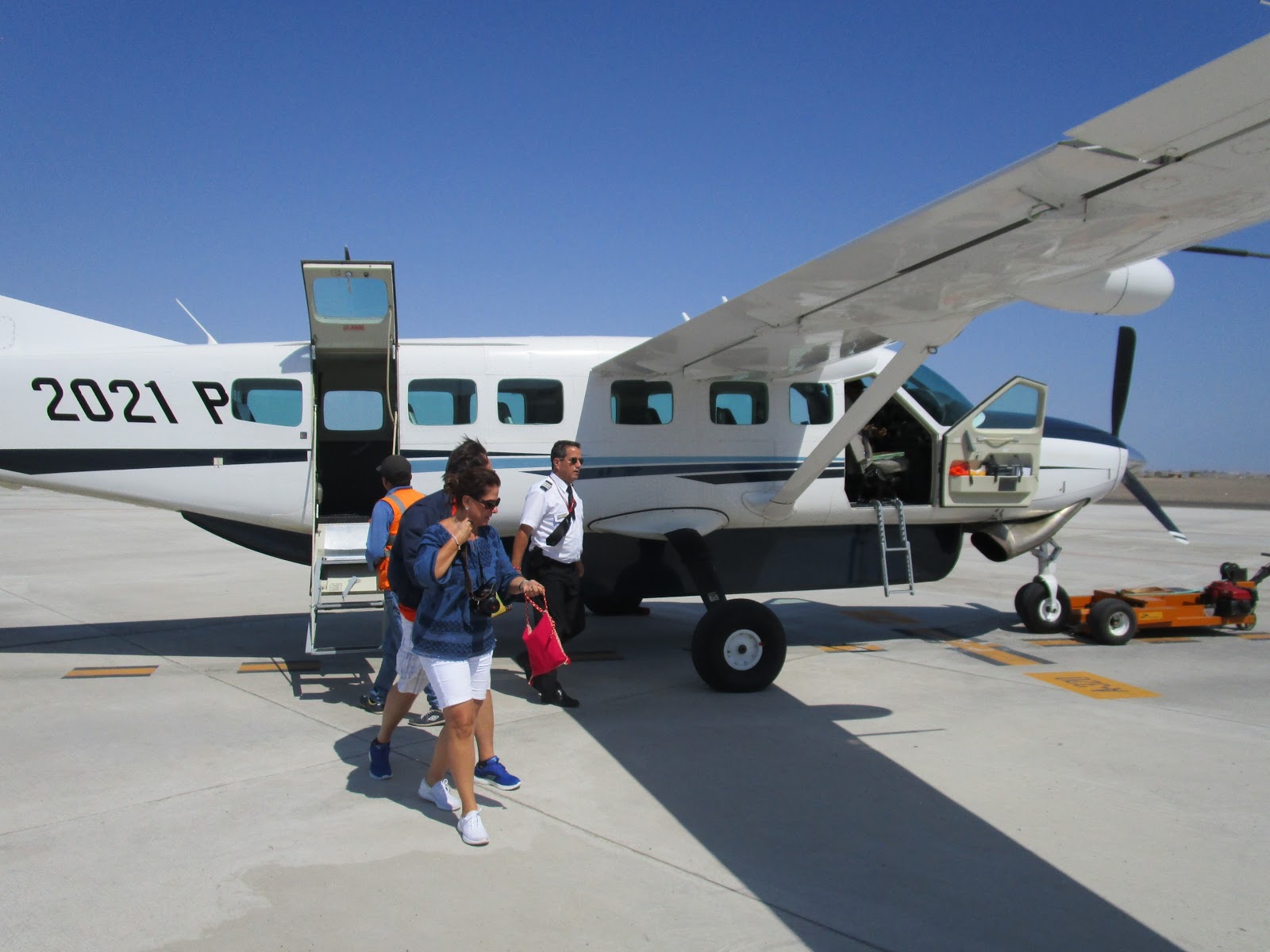
But, for now, it's Cessnas and overflights of the Nazca Lines.


And away we go.


I definitely look like I'm about to have the time of my life.  I've also just remembered that a significant number of people who do these Nazca Lines overflights get air sickness, from the banking left and right so each side of the plane can see the lines, and the tight turns.

Spoiler alert: queasy, starting about midway through the run through the lines, but not close to any breakfast loss.


It took about 35 or 40 minutes of smooth flying, but soon we were at the lines.  Those, by the way, aren't the lines.  Those are lines.  This is Nazca.  But those aren't the Nazca Lines.

Maybe these are:


And that's the thing.  This might be part of the Triangles.  Or the Compass.  These lines are difficult to see.  I completely missed "the Whale," although our guide later told me that's a tough one to decipher.

Using the "Zeke" filter on picture editing function seems to bring out lines nicely.  This, definitely, is the Triangles:


This is the "Astronaut":


This is believed to be the oldest of the Lines.  It is the only one that is carved onto a hillside and not on flat desert.  The enigmatic part about this one is that it looks like, well, not an atronaut, but a space alien.  E.T.  But, weirdly, it's more primitive, both in appearance and methodology compared to the lines carved on the flat earth.  It's not quite as enigmatic to carve a drawing into a mountainside when everyone on the flat ground can see what it is.  Carving a drawing on flat ground when it can only be seen in it's entirety from above the air, that definitely meets any definition of "enigmatic."

Here is an enhanced version of the viewing platform at the top, bring out the Lizard, the Tree, and the Hands more clearly:


Another view:


This one was my favorite.  The Parrot:


I was queasy.  I missed a bunch of the drawings.  The pictures aren't great.  The Spider was the clearest, most distinct of the line drawings, but my picture of it is fuzzy. Trying to take pictures from a plane banking left then right ain't easy.


So what's the verdict?


It was good to be on solid ground again.  That's the verdict.

In all seriousness, what was my opinion?  It was an expensive trip.  The lines were smaller than I thought they'd be (or maybe we were flying higher than what it looks like from photos).  It was, as I was led to believe, underwhelming.  But ...

It was an awesome experience.  It was a once-in-a-lifetime trip to a nowhere-else-in-the-world-like-it place.  The lines are still enigmatic.  But one thing I did figure out about them is this:

They were small to see from the flying height of the Cessna.  If I were to guess what reason they were carved here, I would lean to the theory that they were an ancient calendar because everything cool in the ancient world was a calendar, just about.  But one thing I did learn from seeing these with my own eyeballs, whatever reason these were carved into the Nazca desert, these were never landing strips for ancient astronauts.  Sorry, Mr. von Daniken. No way could they be seen from a space ship.