Powered By Blogger
Showing posts with label angel of independence. Show all posts

Sunday, December 12, 2021

Walking the Paseo de la Reforma (with a Detour to See a Diego Rivera Mural)

The intersection of Av. Juarez and Paseo de la Reforma (and a few other streets to make it all confusing)

Out with the old. In with the new. It is a 5km walk from the Metropolitan Cathedral back to my hotel. Only 4km from the Palacio del Bellas Artes. 5km is about 3 miles. That's the length of a morning dog walk. So let's hoof it!

First a walk through a park. This is the Alameda Central, the city's oldest municipal park:


Kids playing in one of those fountains where the water shoots straight up is always a good photo. The only way the picture gets better is if there is a dog in there.

This is the monument to Benito Juarez, which is fitting since we are still on Av. Juarez and, on the long march home, are not yet on Paseo de la Reforma.


I'm not sure why it's all boarded up like that. Probably the COVID.

I'm not sure what this is supposed to be representing, other than, maybe, perhaps, woman on top.


And this is a fountain of Poseidon/Neptune, and yet it is dry as a bone. Double the irony.


The next stop on the walk was a building repurposed to house a Diego Rivera mural. And this is the mural inside the building:


And this is the bust of Diego Rivera:


I actually am a big fan of Sr. Rivera. Even though he was a communist! Hey, most artists seem to have abhorrent politics. It goes with the craft. Let's look at the mural in a little more detail.


This side, generally, is the good life. The bourgeoisie, to use the lingo of Sr. Rivera's politics. There's an image of an American embedded in there. Do you see him?


Old Fuss and Feathers himself! General Winfield Scott, one of two hero-generals of the United States' Mexican War in the late 1840s (well, heroic generals to those of us in the United States) (less so, in the eyes of Mexico). Gen. Scott was the losing candidate in the 1852 presidential election, losing to the racist drunkard failed president (and ancestor of another failed president, W. Bush), Franklin Pierce. Yes, I never miss an opportunity to explain my intense dislike of the failure that is Franklin Pierce.

The standout image in the middle section is death:


Mexican culture is far more comfortable with death than is U.S. culture. And who is that holding hands with Death?


Our artist, himself, Diego Rivera, along with his wife Frida Kahlo. Rivera and Kahlo were kind of the John and Yoko of their day. (I will not elaborate on which I feel played which role. YMMV.) Kahlo for some unfathomable reason has become the more prominent of the two in recent times, thank you Salma Hayek. This despite the fact that Rivera is the one who had all the artist talent in the relationship. Oops. Did I just say that? We'll see them both later in the mural as we move left to right.

Finally, in the third section:


This is definitely the more "loaded" politically, with images of violence, revolution, peasants being evicted from their land, and a young Diego Rivera eating a sandwich (torta, in Spanish):


A plethora of torta. Not very communist there, Sr. Rivera.

There is a very interesting image buried in this picture that the guide to the mural does not explain. Do you see it, right above the peasant family being evicted from their land, and right below the horse's leg:


It is a man shooting another man in the head (left eye to be precise). There is no explanation as to who is the shooter and who is the shoot-ee. 

The mural is a fantastic example of Diego Rivera's work. And it was commissioned to be displayed in the dining room of a luxury hotel. The hotel was destroyed in a powerful earthquake (8.1) in 1985. The mural was saved and moved to a dedicated building. It does not look worse for the wear. Here's a photo of the earthquake damage that is in the museum:


Time to leave Av. Juarez for the long walk down Paseo de la Reforma. But a few blocks back from that intersection, down Avenida de la Republica, is this monument to the 1938 Revolution:


It is part of the Museo Nacional de la Revolución, which I did not go in.

This is a monument to women:


Please note that the female figure at the top is two-dimensional and too weak to stand on her own, needing support from behind. There is absolutely nothing metaphorical about it. Nothing. Banish such thoughts.

This is the Monumento a Cuauhtémoc, the Monument to Cuauhtémoc, for whom the neighborhood we are about to enter is named.


Here's a better view, although it is from behind.


For some reason, this bit of public art reminded me of home:


The cards look a bit distressed. Perhaps time for a new deck? Let's combine the two into one image:


Cuauhtémoc framed by a deck of cards.

These sofas (loveseats, actually, to be pedantically precise) are not as comfortable as they appear:


They are cast from metal. More durable that way.

The next traffic circle on the Paseo de la Reforma is Glorieta de La Palma. Glory of the Palm.


It's a palm tree. I guess they ran out of ideas for monuments at this point.

And finally we arrive at El Ángel de la Independencia.


Because this is one of the signature sites of Mexico City, it is a popular photo op. Given the young women in a billowy dresses and the young men in matching tuxedos, I assumed wedding photography:


I assumed wrong. The kids were too young.


This is the place in town to go for a photo shoot for your quinceañera. Apparently, in Mexican culture, for a young girl, her quinceañera is a more lavish celebration than her wedding. Not every girl has a wedding. But every girls turns 15.

And there were several photo shoots -- with professional photographers -- all lined up to get photos from the same spot.


Here is the view down Paseo de la Reforma from atop the Angel of Independence:


Another key thing about reaching El Ángel de la Independencia meant that I was almost back to my hotel. The next traffic circle was the Diana Fountain:


Diana and her bow, just a half of a block from my hotel.

At this point, I was parched and my feet were soar. I rested up before a hamburger supper at a local upscale eatery:


OK. Not so upscale, but that's what I wanted. Anton's Hamburguesas, a local's joint where I was the only one speaking English.


A huge "Texana" burger (BBQ sauce and onions), probably a half a pound of beef. A side order of french fries, which could have fed a family. The menu said only cerveza, and I got Corona. Not my first choice, but a light (very very light) beer was probably right to accompany the meal. Too much food to finish and only 200 pesos.

Friday, December 10, 2021

Teotihuacan Day

Looking down on the Avenue of the Dead, with the Pyramid of the Sun to the left

Today was the day for the other primary purpose of this trip to CDMX: Teotihuacan. (Aside: Can one have two primary purposes? Is that like arguing which of the two is "more unique"? Well, if a man can have two primary purposes for one vacation trip, Teotihuacan is the other.)

What is Teotihuacan? Teotihuacan, the tourist site, are archaeological remnants of the most important pre-Aztec city in all of Mexico and Meso-America. Teotihuacan, the pre-Aztec epicenter of Meso-American culture, was a city and religious center for 125,000 inhabitants at its peak, lasting through the first five centuries A.D. But, speaking of culture, the tourism day started with a trip to Plaza de Las Tres Culturas.


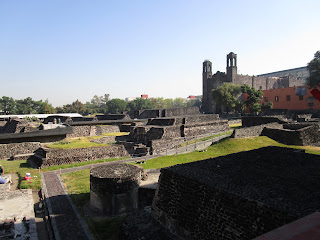
The Square of Three Cultures is an active archaeological site on the north side of Mexico City. The three cultures are the pre-hispanic (which we, on the English-speaking side of the border call "pre-Columbian), Spanish conquistador, and the modern city. All are visible in this picture. The ancient stone ruins represent the pre-hispanic. The cathedral, built from the stones of the destroyed ruins, represents Spanish culture. And, on the outskirts, is the modern culture.


In non-COVID times, you can walk among the stone ruins. Not so now. Out of fear of viral spread, the walking paths among the ruins are closed off. You may only look from a distance.

Teotihuacan is not far from the center of CDMX. But in the thick-as-a-brick Mexico City traffic it might as well be on the other side of the sun. And speaking of the sun ...


We eventually arrived at the Pyramid of the Sun, the largest structure in Teotihuacan.

Before we pulled into the Teotihuacan parking lot -- it's a new addition by the way -- the ancient cultures from 200 B.C. to 500 A.D. did not need parking lots -- we made the obligatory stop at a souvenir stand. This one, in a Mexican twist on the hard-sell souvenir store, before hard-selling you to buy the local souvenir product (here it was obsidian jewelry and decor), they ply with a tequila and pulque tasting (pulque is a pretty tasty adult beverage made from the fermented juice of the Century Plant). I bought some souvenir booze, but no obsidian.


We walked passed the enormous Pyramid of the Sun, heading for the smaller Pyramid of the Moon. And, as the hep cats used to say in the 90s,,whomp, there it is:


There were a lot of smaller buildings surrounding the two main pyramids. What were the purposes of these buildings? The pyramids were for religious ceremonies and sacrifices.  (There were no human sacrifices in Teotihuacan. What? You think these people were Aztecs or something?)


But there are many theories as the purposes of these smaller buildings, but no one really seems to know for certain. They were not housing for the general population, we know that much.


It is still an active archaeological and much of the "restoration" is really best-guess re-creation.
 

And here is one of the many stray dogs of Teotihuacan, lounging at the base of the Pyramid of the Moon.


This is looking toward the Pyramid of the Sun:


But, first, a picture of me at the base of the Pyramid of the Moon:


One more look at the Pyramid of the Moon, from a distance this time:


And a carved serpent head:


Serpents have always played an important role in Meso-American religions. They are the symbol of the god Quetzalcoatl.
 

And, once again, I pose with the Pyramid of the Moon:


This is a surviving mural. The Mural of the Puma. Once upon a time murals decorated the interiors of these structures, but, for the most part, they are lost to time. The red is cinnabar.


This is along the misnamed "Avenue of the Dead." It was misnamed by the Aztecs who assumed all these structures were necropolises. They weren't. The Aztecs were wrong. It was just a long and wide boulevard. Sort of the Champs Elysees of Meso-America.

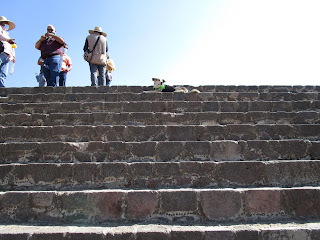
And another stray dog of Teotihuacan lounging in the sun:


This is the view of the main entrance to the Pyramid of the Sun:


The Pyramid of the Sun is largest pyramid in the New World. It is not the largest pyramid in the world. That would be the Great Pyramid of Giza in Egypt. It wins only because it is taller. The dimensions of the base are exactly the same, 230m.

Next stop in Teotihuacan was the area of the "visitor's entrance" into Teotihuacan, the Citadel, or La Citadela (that was easy). They didn't call "the visitor's entrance" back in the day, but, functionally, that is what it was. The way into the fortified site.


Greeting me was a reproduction of a carving that I saw in the National Museum of Anthropology the day before. The whole is where the heart should be, if the heart were there. And the heart ... what is it made of? The most precious material at that time in all of Meso-America. Jade.


The purpose of going to the Citadel area is to visit the Temple of Quetzalcoatl.


And what is Quetzalcoatl known for? Snakes!  Lots and lots of extremely well-preserved serpent heads protruding from the building like gargoyles of a Gothic cathedral.


Alas, because of COVID restrictions you can't get any closer to the carved snake heads than this.


And that concludes Teotihuacan. My verdict on Teotihuacan? It was awesome. It was spectacular. It was well-worth the trip. BUT. There is always a "but." I thought Tikal in Guatemala was even more spectacular, even more awesome, and even more of an absolute must-see. But, then again, Tikal is probably the most awesome, most spectacular surviving site of pre-hispanic culture in all of the Americas. And, yes, Machu Picchu, that includes you! (I think. I still do want to go to Machu Picchu at some point.)

I had a buffet lunch at a nearby restaurant. As did this little birdie:


The tour was supposed to include a visit to the Basilica of Our Lady of Guadalupe. But that had to be cancelled. This Sunday is the feast day of Our Lady of Guadalupe and all roads heading to the Basilica (and there are not many) were gridlock. Basically, Teotihuacan -- 40km away -- was probably the closest parking.

So I got back to the city. Rested a spell. Then explored the neighborhood, looking for a place to eat (and there are plenty in this neighborhood).  This is the night time view of Paseo de la Reforma, the street on which my hotel is found:


And I learned something very important, walking this neighborhood after dark:


El Angel de la Independencia, the Angel of Independence, located a few blocks down the street from my hotel, is even more spectacular lit up at night.