Powered By Blogger
Showing posts with label cevapcici. Show all posts

Tuesday, October 15, 2019

Split Tour: Under the Palace

Hanging out in Diocletian's Basement
The most interesting thing about Split, Croatia, is the fact that the core of the Old City is Diocletian's Palace, the estate built by the Roman Emperor Diocletian for his retirement years after his abdication in A.D. 305. It continuously has been part of the city since then, but not in a reverent "leave only footprints, take only pictures" sort of way. Building stones from the palace were taken to build other structures about town. Homes, shops, restaurants, churches, synagogues, have all been built into the walls of the palace. It's a living, functioning city. It's not a static museum. It's been that way for over 1700 years.

So today was the day to take a walking tour of the Old City, which meant a walking tour of Diocletian's Palace and the area outside the walls.


The walking tour of Split begins on the Riva, the waterfront pedestrian promenade. What does the Riva have to do with Diocletian? After all, that picture doesn't look very Roman.


The south gate into Diocletian's Palace was from the water. Thus, the promenade in front of the south walls is built on reclaimed land.


The southern entrance being from the sea was important strategically.

Below is the Split of today, with Diocletian's Palace occupying the area in the foreground.


And this is an artistic rendering of the old Diocletian's Palace:


It looked more palace-y back then. And while much of the core palace remains, much has been lost.

But the basement is relatively intact, so let's take a look-see.


I toured Diocletian's Palace when I visited Split in 2014. But I did not tour the palace's basement because it was closed to visitors back then,

They were using it to film "Game of Thrones."


We had a tour guide that was explaining the development of Split and why it was a strategic location. Although the palace was Emperor Diocletian's retirement home, he still cared about home security.


Into the basement.


Here is the tour guide explaining to us the history of the building. This room was for storage. Perhaps grain. Perhaps furniture that Diocletian replaced with newer, trendier stuff but couldn't throw away because it still was perfectly good. The true reason is lost to history.


I believe that this room was the room in Diocletian's Palace that the guide told us was used as the Dragon Room in "Game of Thrones." Not ever having watched "Game of Thrones" -- yes, I am the one -- I do not know what a Dragon Room is and if this particular elongated chamber could be used for such purposes. But let's call this the G-O-T Dragon Room.

Here is a sphinx carted back from Egypt.


Yes, that is too a Sphinx. Diocletian loved Egyptian artifacts because he made himself a name as a military leader from his Egyptian campaigns. So, yes, I am comfortable calling this chamber "the Sphinx Room."

Here are people taking a picture of a modern plaster bust based on an assumption of what Diocletian looked like.


They used coins from the era to make a guess.

Some of the basement is now exposed.


Looking back into the basement:


Cats in the basement:


Children on the balcony.


People in front of the Cathedral outside the entrance to the core palace:


Bored children being forced to draw something on the other side of the plaza. The cathedral? Diocletian himself? Maybe the d*mn dragon who lives in the Dragon Room.


I did not look over the shoulders of the djeca to see for certain,

And this is the cathedral they would have / should have been looking at:


Off to the north gate, the gate to which barbarian hordes would come looking for some pillaging.


This is the statue of Grgur Ninski, Gregory of Nin:


The statue is by noted Croatian sculptor Ivan Mestrovic, or, to use the local spelling, Ivan Meštrović. He, Mr. Nimski, not Mr. Mestrovic, was one of the ones who wanted to preach and say mass in the local vernicular and not Latin.


And there is a dog sleeping in the sun at Voćni Trg, or, in English, Fruit Square:


The tour ended and it was time for lunch. Lunch again was cevapcici.


Not nearly as good as the cevapcici in Montenegro. In fact, this cevapcici tasted a little like Jimmy Dean's. But it was all washed down with a good radler.


A radler because I was parched after all that walking. This particular radler was barely beer, with an alcohol content of 2%. Your body would process that before it would affect you.

Saturday, October 12, 2019

Montenegro Day

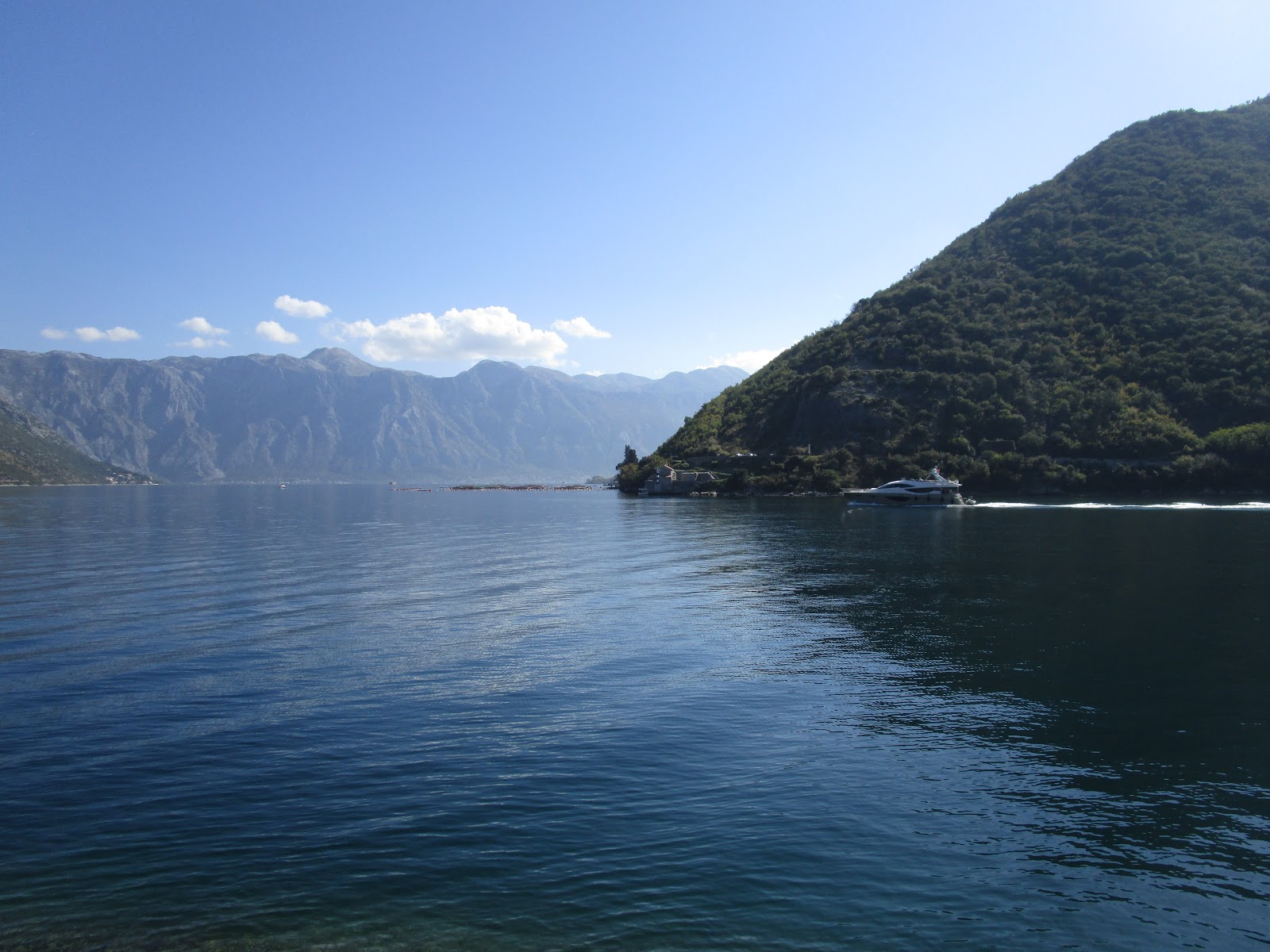
Bay of Kotor
You call it Montenegro. We call it Crna Gora.


Actually, we call it Montenegro, too, us Turistas Americanas, although "Crna Gora" is the translation of Montenegro, "Black Mountain" into Serbo-Croatian from Italian (I'm guessing those wily Venetians had a little something to do with a Slavic country having an Italian name).

The main tourist sight to see in Montenegro/Crna Gora is the Bay of Kotor.


So we saw it.  Here we are, bayside, at a popular local photo point.


Also popular with cruise ship tourists, too.


The first "all tourists must do" thing that we did was to take a speedboat out to the Our Lady of the Rocks from the docks in the bayside town of Perast.


Popular with tourists of all ages!


And away we go.


The boat ride is very brief.


And soon we are on the island on which the orthodox church sits.


An on which yachts are docked.  This is the church.


Exterior, of course, but you probably figured that out.

Artsy framed shot of a sailboat docked on the church island.


And this, and I'm guessing you would figure this out also without prompting, is a shot of the church interior.


Ceiling:


Votive candles. A bargain at one-half of a euro a piece.


Montenegro uses the euro for its currency for some reason.  I guess they really don't need a reason. But whether you call it Montenegro, or Crna Gora, or Mountain of Black, it is not an E.U. member state.  It might be at some point in the near future.


But it's not now. Above is the art photography contest entrant, with the blue of the kayak, the blue of the Bay of Kotor, and the blue of the Our Lady domes, all together in a single frame.


Well, all good things come to an end. The speedboat operator gave us 30 minutes on the Our Lady of the Rocks Island and we got 35. Time to head to the exits and motor back to town.


In the foreground is Saint George Island, which houses a Catholic Church. Or once did. I'm not sure, it's not open to the public as is the orthodox island.

Next stop: the City of Kotor. And the cruise ships are in town.


But this is not peak season, so that one mega-ship is all alone.


The old city walls can be seen in this picture. It is a long steep hike up the walls to the top of the hill. Which is not black at all. It's more Monte-beige than Montenegro, if you want my opinion.


And what's for lunch?  For me, it was cevapcici! I love cevapcici.


Refueled, it now was time to enter the city walls.


First stop was the Katedrala Svetog Tripuna, or Cathedral of Saint Tryphon, the Catholic Cathedral in orthodox Kotor City.


Interior. Simple.


This is the view of the square from the second floor balcony.


Time's a-wastin'. Another church. Did not go in.


And then it was time to exit the walls for the drive back to Dubrovnik. Nice juxtaposition of the ancient city walls and big ol' palm trees.


Twenty-nine countries now visited with Montenegro becoming the latest.

And then we were back in Dubrovnik for the night.


Laku noć, Little Onofrio's Fountain. Laku noć.