Powered By Blogger
Showing posts with label lake yellowstone. Show all posts

Thursday, September 5, 2019

Smoke on the Water: the West Thumb Geyser Basin

Boiling steam rising from the midst of an ice cold lake.
Yellowstone is weirder than you can imagine.
The West Thumb Geyser Basin is a geyser basin ... along the shore of a thumb ... off to the west side of Lake Yellowstone.  Some of the steaming vents are even in the water of the icy cold lake.

But first ...


I go to load up my car with my luggage and there is a buffalo grazing out behind the hotel.  This is why when I asked the front desk clerk the other night how safe it was to walk in the dark outside the hotel at 2:00 a.m., I was referring strictly to wildlife.

Anyway, last day in Yellowstone.  Off to the West Thumb Geyser Basin.  Driving along the shore of Lake Yellowstone, you start to see smoke along the shoreline.  My first thought was:  Are these small fires?  My second thought:  Wait, I'm in Yellowstone.  Probably geysers or fumaroles.


And, sure enough, it was the West Thumb Geyser Basin that I saw.  It has the pools of steaming water:
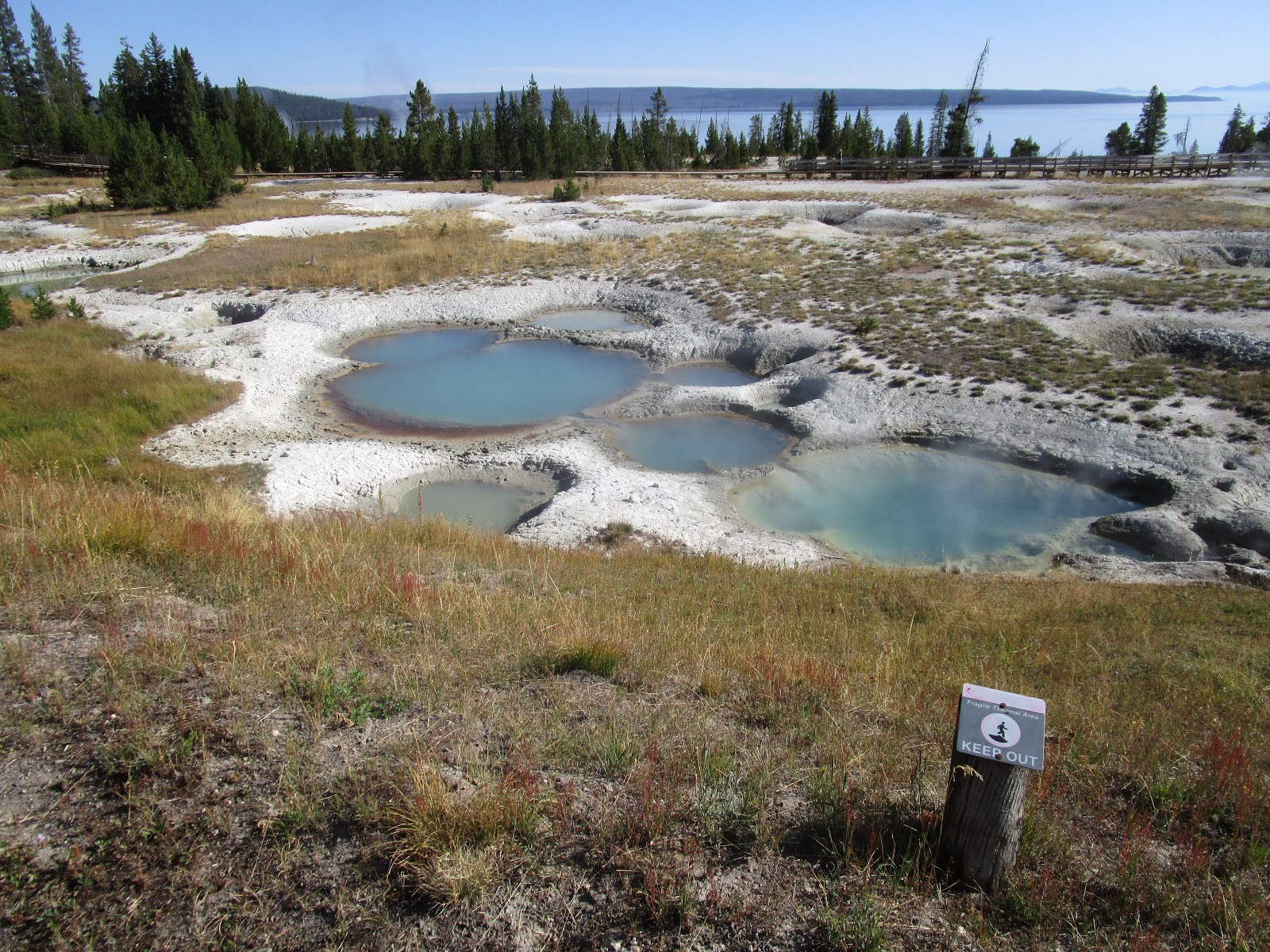

You can see the steam more clearly from this angle:


And when you see the steam and smoke rising along the shoreline, this is one geyser walk loop that should come with its own soundtrack.


I think you know what song that should be.


That is not morning fog.  That is steam.  From boiling water welling up from deep underneath ... an icy cold lake.


Just a hint of hydrogen sulfide in the air, but not nearly as much as the Mud Volcano area.


This may be the Black Pool.  It was named the "black pool" because ... and they are quite the literalists here at West Thumb Geyser Basin ... it was a pool.  That was black.  This was the case from the founding of Yellowstone for several decades.  Then there was a minor earthquake, which changed the temperature of the pool just enough that the bacteria living in the pool that gave it its black color were killed off.


And then it was just an ordinary blue pool.  But a name is a name.  So let's now say it was named for former U.S. Supreme Court Justice Hugo Black.

Some of the area have retained their color:


This is the Big Cone:


And this is the famous Fishing Cone:


It got its name, the Fishing Cone, because, once upon a time ... true story ... people would fish in Lake Yellowstone.  Well, what are you going to do with a raw fish.  You can't do sushi with a freshwater fish.  Well, with the fish still on the line, they would dunk it in the boiling hot Fishing Cone and ... voila ... cooked fresh fish.

Lakeshore Geyser:


Which, despite its close proximity to the lake, apparently was not used as a cooking pot.  I'm guessing that's because, being a working geyser, you'd be cooking your fish and, suddenly, it would be ejected from the cooking pot high into the air.  And, in the meantime, you would get seriously scalded.  Geysers are bad for cooking fish.

Bluebell Pool in the foreground, with Seismograph Spring behind it.


This made me think of pizza:


But, in actuality, the whole of the caldera area sits on a thin crust about the earth's magma.  It's just that in spots like this, the crust is incredibly, ridiculously thin.  Walk on it and you likely will fall through into the earth.  And, possibly, be boiled alive.

This is the Surging Spring:


This is the Collapsing Pool:


I'm guessing it's collapsing, but if it is, and I'm taking them at their literal word on this, it is collapsing so slowly that I did not see it happen in my hour at West Thumb Geyser Basin.


The weird juxtaposition of boiling springs and geysers against the backdrop of any icy cold alpine lake is probably why West Thumb Geyser Basin is my favorite part of Yellowstone.  And how was the West Thumb formed?  Probably from a massive volcanic eruption about 160,000 years ago (which is significantly more recent than the last eruption of the Yellowstone super-volcano).  West Thumb is much deeper than the rest of Lake Yellowstone and the experts think this is the reason.

We will end the walking tour of West Thumb Geyser Basin with Percolating Spring:


So named because it percolates.  I told you they were literalists in the West Thumb Geyser Basin.

Wednesday, September 4, 2019

Driving the Figure 8: the Lake, LeHardy's Rapids

LeHardy's Rapids along the Yellowstone
One of the problems with Yellowstone is that there are so many extremely spectacular sights that are completely unlike anything else you've seen on earth, that a lot of the absolutely beautiful sights get lost.

(Poor Grand Teton National Park has this problem.  It's beautiful.  It's amazing.  But it's right next door to Yellowstone so the overall impression is a relative "eh."  Put it almost anywhere else in the Lower 48 and it would breath-taking.  It's like a concert performer having to take the stage right after James Brown or Graham Parker in their prime.  How do you top that?  It's a whole lot easier to follow Blondie or A Flock of Seagulls.)


But first, Lake Yellowstone, which is right outside the front door of my hotel.


It's enormous.


The water is supposed to so cold that if you even dip a toe in, you freeze solid.  I think I used that line before.  I'm old.  Repetition happens.  Repeatedly.

The Lake Village area is kind of small, with one giant hotel, a general store, and a medical clinic (perfect for us old people in danger of having our feet chopped off).  And this.


It appears to be an abandoned gas station.


My car is getting outrageously good mileage at the high elevation, so there's no need to fuel up for the drive around the Figure 8.  All of the sights you want to see in Yellowstone, for the most part, are along two circular loops that touch, forming basically a Figure 8  Lake Village would be the southeast corner of the Figure 8.  So we head north to the Mud Volcano and the Grand Canyon of the Yellowstone.

The problem is that you can't just drive from place to place.  You'll be toddling along and see something you didn't know was worth seeing and you immediately make a hard right turn into the parking area. 


First stop:  A brief walk through the trees and then to LeHardy's Rapids.


This is the Yellowstone River, having come from the lake and, at this point, heading north.


And here be rapids:


It's no Mud Volcano, I know, but it is beautiful.


I liked this place so much that, at the end of the day, when on the same segment of the Figure 8 heading south back to the Lake Yellowstone Hotel, I stopped again:


Even more spectacular with the evening light.  I saw a duck going through the rapids:


He's a tiny spec so you can't make him out.  But seeing him shoot through the rapids was hilarious fun.  Laugh out loud, as the kids would say.  I hope the duck enjoyed it.  I did.


Yellowstone Stinks: Upper Geyser Basin Walk

The walk to Grotto Geyser. It was especially stinky
After the Old Faithful show, it was time to stroll around the Upper Geyser Basin.  This is the landscape that really lets you know that you are sitting on top of an active super-volcano with molten lava churning below your feet.


The first pool looked innocuous enough, the Blue Star Spring.  Very blue, indeed.


This bubbling caldron, however, looked less inviting.  Unless you brought some hot dogs, or maybe spaghetti.  Then the water was perfect for cooking,

You can see the aptly-named Firehole River in these pictures.  This feature was more of a pustule on the face of earth:


Looking out over the Upper Geyser Basin:


This is the Beehive Geyser, with its nice, clean beehive shape:


It erupts at very irregular and unpredictable intervals, so it's not a star attraction.  Apparently, however, when it does erupt, it is spectacular.

This is the sadly-named Depression Geyser:


So many other geysers get really cool name.  How sad to be the one that gets named for a psychological malady.

This is the Heart Spring.


So named because it is in the shape of a heart.  If you use your imagination.  And you really have to use some imagination to figure out why this is the Lion Group of Geysers:


Here is an awesome one.  Spasmodic Geyser.  I don't know if this counts as a full bore eruption, but it was fun to watch:


I'm not sure of the name of this one, but, again, wandering out here you really do get the sense that the landscape is not of this earth:


On to the Grand Geyser:


When you see dead trees in the background in Yellowstone, especially within the caldera, it does not necessarily mean a disease or a fire.  Often, it just means that the magma underneath shifted, usually from some earthquake, and suddenly the ground got a lot warmer where that tree had been comfortably standing before.
 

In other words, those trees are probably cooked.  Grand Geyser does have a few benches for viewing its eruptions, but it's nothing like Old Faithful.  Its eruptions are somewhat regularly, but they're usually within a window of hours, not minutes, like Old Faithful.


And people are content to just watch the show.  No one (except me) viewing it only through the camera.


Water drainage from the eruption:


Colorful pool:


This is Giant Geyser:


Not sure why this one is called "Giant."  Perhaps marketing.  Old Faithful looked more "giant" if you ask me.


Giant Geyser erupted earlier in 2019.  The frequency is way insufficient to sit around waiting for the new spout.


Giant may refer to the height of that cone.  All those mineral deposits from the eruptions leave a trace.

And now we come to the geyser that caused me to observe "Yellowstone stinks":


Grotto Geyser.  You can smell the sulphur all throughout Upper Geyser Basin (and many many other areas of the park).  But the steam emanating from Grotto Geyser was particularly thick with the sulphurous stench:


And the hour and one-half loop walk is done.  Just in time to miss the next scheduled explosion of Old Faithful.


Back to the hotel, which is along the shores of Lake Yellowstone.  Lake Yellowstone is the highest altitude lake in North America.  Higher than Tahoe!  It sits in the caldera.


It's huge.  I'm staying at the historic Lake Yellowstone.


It was a clear night so I got up in the middle of it to go out and see the stars.  Oh.  My.  Gawd.  I have never seen a night sky so thick with stars in my life.  The Milky Way was very visible.  No pictures because no pictures could do it justice.  But the stars in the night sky is definitely one of the pluses of being far away from the lights of the nighttime.