Powered By Blogger
Showing posts with label wedding of cana. Show all posts

Friday, August 6, 2021

Today's Agenda Item 1: the Salt Mine


Lot's wife portrays Princess Kinga, allegedly the mine's original 13th Century owner.

It was another rainy day in Krakow. Yesterday was so rainy that the Vistula River has (very slightly) overflowed its banks. This means it is a good day to down into the salt mine.


The Wieliczka Salt Mine is about a half hour southeast of the City of Krakow. It is considered to be one of the absolute must-see/must-do things in Krakow. For one thing, it is freakin' huge. For another, it has all this stuff inside made out of salt. Let's have a look:


I elected for an English language tour because what other language do I understand sufficiently to safely take a tour over 400 feet below the surface of the earth.


The Wieliczka Salt Mine produced good ol' NaCl, sodium chloride, since Neolithic times. It was a working mine from the 13th Century right up until 1996, when mining ceased due to commodity prices dropping.

And here's our first item carved entirely of salt:


Copernicus. As portrayed by Lot's wife. (Please tell me you are getting the Lot's wife / Sodom and Gomorrah / pillar of salt references.) Copernicus actually visited this mine in his human days.

Here is a display showing the working of the mine back in the day.


The horse was not made of salt.


I believe that everywhere you see a large "room" on the guided walking tour is where a huge quantity of pure white sodium chloride was mined out of the mine. 

Here is a carving of a king:


And, like nearly everything else (only one exception) (and that is coming up soon) (spoiler alert), he was carved by the salt miners, not fancy high-fallutin sculpture professional with MFA's.

This is a small chapel: 


And this is the view over the very large main chapel:


And this is the one exception to the rule about the sculptures being done over the years by the miners. But there is a very good reason for this exception:


It's Saint John Paul, the local Pope. This statute was added after the Wieliczka Mine stopped being a working mine and became a full-time tourist attraction. In other words, there were no more miners to carve out the local boy-made-good.

What's most interesting about this main chapel is that it has so much of the standard religious art, only it is carved from the salt:


Here is the da Vinci-esque Last Supper:


Let's see the Maestro Leonardo work in rock salt like this!

The altar looks like the altar in any ornate cathedral.
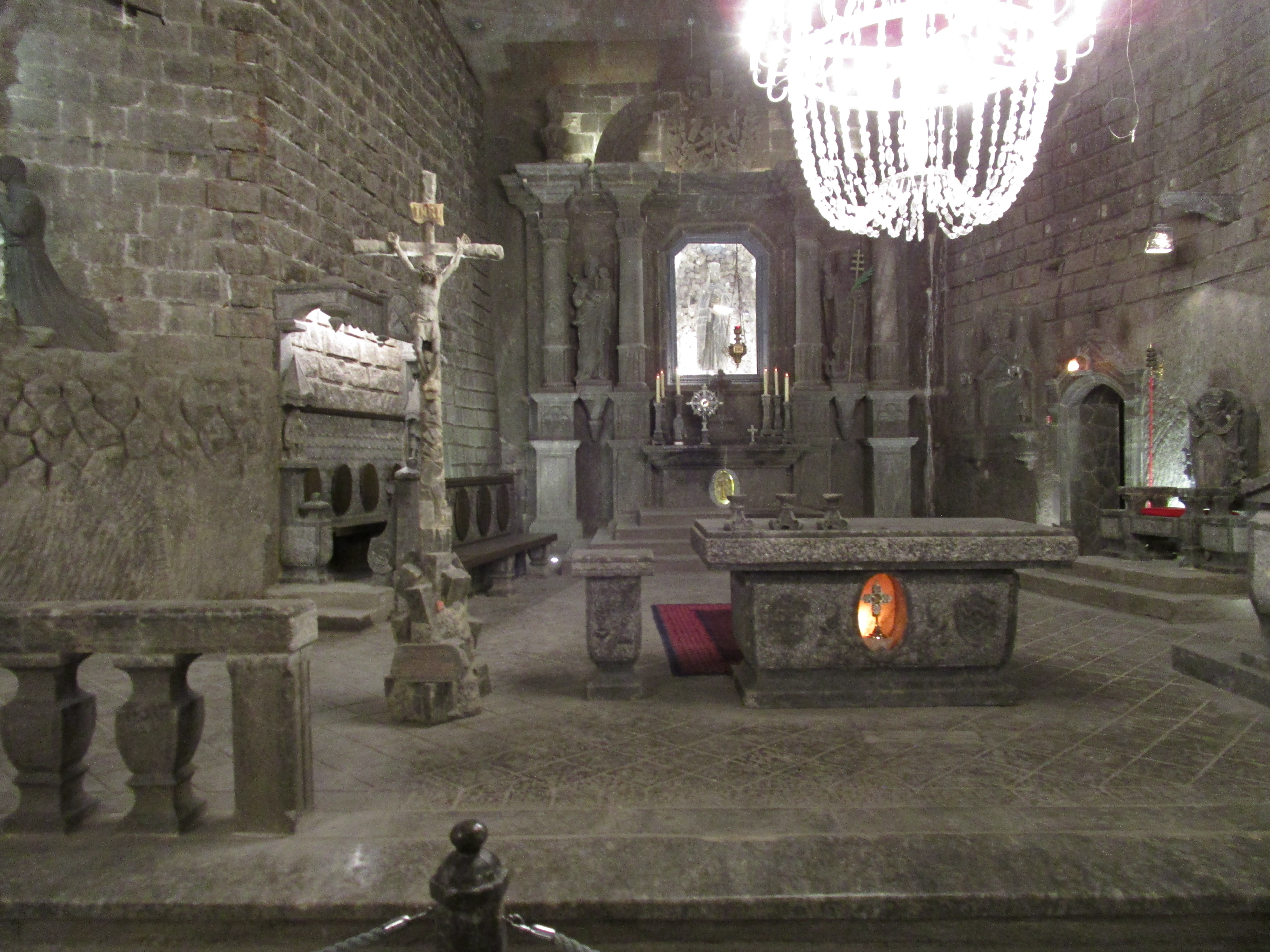

Except, again, carved out of salt.

Wedding of Cana:


Only in this one Jesus makes the wine out of salt water.

And, way up high on the wall, it's a Nativity:


The Baby Jesus is carved out of salt, too, but not from the salt of this mine. He's from an orange-ish salt that had been brought in from elsewhere.

How would I rate the two and one-half walk through the Wieliczka Salt Mine? I'm not sure I would've willingly given up a sunny afternoon for this, but it was definitely worth touring while the rain poured down hard on the surface a few hundred feet up.

Wednesday, November 22, 2017

The $150,000 Tour of Villa De Leyva: Parte Dos: Viñedo Ain Karim

A photo shoot about to happen in the merlot field.
It's always the merlot field, never the shiraz.
The $150,000 COP tour of the surrounding environs of Villa De Leyva continue with a trip to a real, actual working vineyard and winery that produces drinkable wine:  the Viñedo Ain Karim in nearby Sutamarchán.

Joining me for the tour were these four ladies all originally from Cartagena de Indias, Colombia:


Actually, I joined them.  They volunteered to serve as my translators for the Spanish language-only winery tour.  They also bought me wine and cheese.  How could I say "no," or, to use the Spanish, "no."  Mil gracias!
 

This leg of the tour around Villa Del Leyva started with a drive up the winery driveway.


The tour started promptly because a big bus load of tourists was scheduled to arrive soon.  This bus tourism seems to have caught on big here in Colombia.


Our tour guide provided lots of information on the history of the winery, which my translators (on the left, above) were able to tell me about.

We saw the processing room where the grapes are crushed, using machinery instead of women's feet.  Women were the preferred grape crushers in years past because women weigh less and, therefore, were less likely to crush the seeds.


We visited the wine cellar:


The scale is much much smaller than those giant Port cellars I saw in September.

It was a short tour, even with the translating happening for me, maybe because of the impending deluge of bus tourists.  Soon we reached the point that is the highlight of every winery tour everywhere.


Tasting.  It was not bad.  The white had a nice tartness to it.  The cabernet was as good as any Three Buck Chuck cabernet, maybe better.  It won an award.  In Israel.  I know.  Israel hasn't been much of a player in the winemaking field since the Wedding of Cana.  But it was an award.  The white did win a silver medal in Brussels, which may be a little more prestigious.  Although Belgium is beer country.  Just sayin'.


Cheers!