|
| The artiest art photo in the history of art-dom: the Financial District viewed through reconstruction in Casco Viejo |
One full day in Panama City to soak in as much Panama City as I can soak in. And the soaking-in starts with a walk through Casco Viejo, the surviving Old Town section of Panama City. (FOOTNOTE: There apparently is an even older Old Town on the other side of the Downtown, called Panama Vieja. Apparently it so old it's in ruins and there's not really much to see unless you have a really vivid imagination. Which I don't.)
Panamanian guidebooks will compare the streets of Casco Viejo to New Orleans's Vieux Carré, known to us less-pretentious people as "The French Quarter."
 |
| The streets of Casco Viejo. |
While there are surface similarities, similar low-rise architecture with balconies and the like, Casco Viejo lacks one of the most distinguishing characteristics of New Orleans's Vieux Carré: that overwhelming stench of garbage, stale beer and fresh urine. Also, in a major sign that there are great gobs of cash pouring into Panama right now, there is a massive restoration/refurbishment project going on throughout Casco Viejo. It seems like there are more older buildings sheathed in construction scaffolding than there are just out and open. This really is going to be something to see in a few years. And apparently a restaurant and nightlife scene is developing here, too, but there's plenty of that elsewhere in Panama City (which, overall, has a "Miami meets Las Vegas" personality vibe feel to it).
There are churches a-plenty in Casco Viejo:
 |
| The Altar de Oro of the Iglesia San Jose |
This is the famous Iglesia San Jose, famous for its "Altar de Oro," or golden altar. A clever, quick-thinking priest back in the old days painted it black when Panama City was under attack from pirate marauders, to disguise the value of the golden altar. It worked. Eventually the pain faded. And the "Altar de Oro" is publicly visible in its golden splendor.
 |
| Off to the side of the main altar |
The whole church is beautiful and ornate, perfect to accompany the Altar de Oro. This is a convent in a state of beautiful pre-development:
 |
| Abandoned convent in Casco Viejo |
I am sure it will be restored to bustling splendor by the next time I visit Panama City.
 |
| Rude tourist trying to tear down these convent walls |
Next on the walking tour of Casco Viejo was Plaza de Francia:
 |
| Bust of a rather Gallic looking fellow |
Why Plaza de Francia? The only thing I could come up with was that the French were the first to try to build a canal across the Isthmus of Panama. Maybe that's the reason for a Plaza de Francia. Probably not.
Plaza de Francia occupies the southern tip of Casco Viejo, jutting out into the sea:
 |
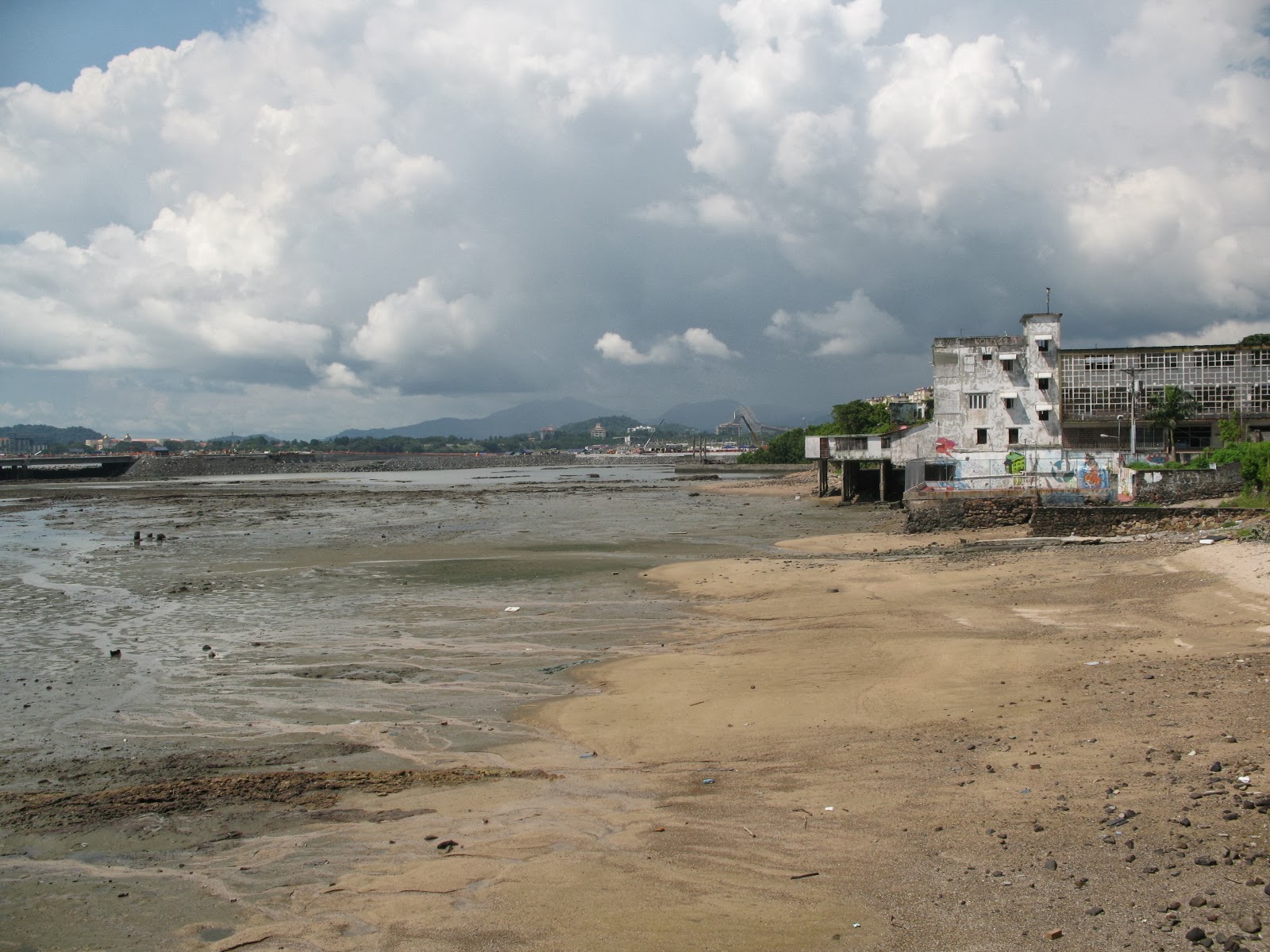
| Sea view at low tide from Plaza de Francia |
Tidal variation is rather extreme, so at low tide (which is when I was there), the sea view isn't much if you look straight down. It's muddy and ugly. The extreme tidal variations on the Pacific side of the canal were a major problem that had to be accounted for in constructing the first set of locks on the Pacific side. (The Atlantic/Caribbean side is not subject to major tidal variations.) Betcha didn't know that. Now you do.
This is the obelisk at the center of Plaza de Francia:
 |
| Plaza de Francia obelisk |
There's a rooster at the top of the obelisk in Plaza de Francia. Why? A salute to Coq Au Vin, perhaps? I like to think of it as a salute to Tottenham Hotspur, the English Premier league team I randomly adopted as my team when I decided awhile back that I needed to have an English Premier league team to cheer for. So that's not a mere rooster atop that obelisk, but a cockerel.
There was some sort of fashion photo shoot going on along one of the walls of Plaza de Francia:
 |
| Fashion photo shoot in Plaza de Francia |
Interestingly enough, at least according to my tour guide, behind these walls was a prison with a secret entrance:
 |
| And yet it all looks so peaceful now |
The prisoners were taken in at low tide. Shackled to the walls. OK, now remember what I said about extreme tidal variations? Let's just say they didn't have to worry about feeding them breakfast the next morning.
Here's more of that fashion photo shoot at Plaza de Francia:
 |
| There ought be a law against fat guys wearing Under Armour out in public |
Such a bold artistic statement there, with the "plus size" model in the foreground and the Financial District behind him. Can we see more?
 |
| Same model. Casual. This time with the canal side of Panama City over his shoulder. |
Why yes I think we can. OK. One more, but this is the last:
 |
| Same model. Same skyline. Different part of Casco Viejo. |
Man. The clouds are getting awfully dark there. Hope it doesn't rain! (This, aspiring novelists and screenwriters, is what us professionals of the written word call: foreshadowing.)
Walking north from Plaza de Francia, along the bay side of Casco Viejo, we get to the Great Metaphor statement photo site (seeing the future through the fragments of the past -- get it?)
 |
| This could be Plaza Medio Baluarte. But, then again, it might not. |
Over to the Iglesia de San Francisco de Asis:
 |
| Iglesia de San Francisco de Asis |
In that same neighborhood, here's the Hotel Colombia:
 |
| Hotel Colombia |
I don't think it has any particular historic or architectural significance. I just thought it was a beautiful building. Apparently it's not a hotel anymore, but apartments.
And then onto what is THE most important site in any town in the former Gran Colombia:
 |
| I finally found a Simon Bolivar in Panama |
Simon Bolivar standing in Plaza Bolivar. In Colombia, every town has a Plaza Bolivar. And every Plza Bolivar has a Simon Bolivar. Sometimes he's astride a horse. Sometimes, as here in Panama, he's standing. But he's always there. But not always flanked by nudes.
 |
| Simon, his nude friends, Iglesia de San Francisco de Asis, and that same fashion model we saw earlier |
Don't you just hate it when people get into a photo of beautiful iconic statuary?