Powered By Blogger
Showing posts with label columbia. Show all posts

Thursday, June 25, 2020

Audubon Exhibit at the James K. Polk Home

Audubon's "Pileated Woodpecker"
As luck would have it, at the exhibit hall just down for the James K. Polk Home & Museum, was a traveling exhibit that is now locked down at the Polk Presidential Hall, just down from the Polk home.


A collection of first edition prints printed from the watercolor portraits of American birds painted by the naturalist John James Audubon.

It's just a short walk down High Street from the Polk home.


And in about 60 seconds, here we are:


The collection of Audubon prints is "quarantined" here at the Polk Presidential Hall. It cannot be shipped to its next destination because of the cholera, I mean, coronavirus. The cholera has been eradicated in these parts.

The collection is beautiful, but not that big, so here they all are:


"White-Crowned Pigeon." You can see the bald eagle-like head (but not a bald eagle-like body).


"Blue Grosbeak." What is the connection with Polk? Manifest destiny!


"Pinnated Grouse." Polk expanded the country in the early middle of the 19th Century and a naturalist such as Audubon explored the interior, cataloging the new bird species to be found in the American interior.

The description on this one, taken from Audubon's writings, shows some political correctness from the era. In detailing how the pinnated grouse has been hunted nearly to extinction within Kentucky, Audubon wrote: "The Grouse have abandoned the State of Kentucky, and removed (like the Indians) farther to the westward, to escape from the murderous white man." Such sentiment is perfectly appropriate in this context. It is Audubon's own thoughts from that time. It's not current-era P.C. grafted onto the past for the sake of P.C. It is the historical record. And sometimes we deserve the kick in the pants for what we did.


"Zenaida Dove." Audubon was particularly fond of this species.


"Tyrant Fly-Catcher." Audubon, again in his own writing, was incensed at the slaughter of this species in the 1830's. Farmers eradicated this bird because it ate honeybees and farmers wanted to preserve the honeybee.

Yes, I know honeybees are crucial to the ecosystem and crops would fail without them, but ... I'm on the side of the Tyrant Fly-Catcher (and Audubon) on this one: eat those dang bees.


"Pine Creeping Warbler." Audubon painted watercolors of the birds that he saw on his journey through the new lands of the South Central United States.


"Brown-Headed Nuthatch." The watercolors were turned into prints, which were published in book form, and sold to the wealthy elite. The man who Polk beat for the presidency, Henry Clay, was one of those wealthy elite who bought a subscription to Audubon's books of birds.


And, finally, the "Whip-Poor-Will," another of Audubon's favorites. Audubon, writing about the call of the whip-poor-will, wrote: "Only think, kind Reader, how grateful to me must have been the cheering voice of this my only companion, when, fatigued and hungry, after a day of unremitted toil, I have planted my camp in the wilderness, as the darkness of night put a stop to my labours!"

This exhibit was in a single room:


This was definitely not something I was expecting, but it definitely was welcome. And it was appropriate for the Polk era.

There also was a collection of drawings done by children who have seen the exhibit. Most looked like what you would expect children to draw. Cute, but something you keep only if it were your child. Except for two on the bottom row:


Enlarge the picture to see. Look at the middle and the far right birds on the bottom row. Those are very well done. Can't see. I will do the enlarging for you, although I think some of the detail will be lost.


The center one is very well done, but that bottom right corner?


Amazing detail. The kid who did this one is a ringer. And I don't mean a ring-necked pheasant.


A Visit to the Home of One of America's Greatest Presidents

Across the street from the James K. Polk Home & Museum in Columbia, Tennessee
Naming America's greatest president is difficult. I would argue in favor of George Washington, but if you believed it has been Abraham Lincoln, or even Thomas Jefferson, you would be on very solid ground. So let's qualify this. Who was America's Greatest President, before my lifetime, who is not on Mount Rushmore or U.S. coins or currency?


James Knox Polk.

When the convention I was going to attend in Philadelphia was cancelled, and I had some open time in schedule, I decided to take a trip to somewhere in the USA I had not yet visited: Nashville, Tennessee. And what was my top priority to see in Nashville? The James Knox Polk Home & Museum, 50 miles to the south, in Columbia, Tennessee.

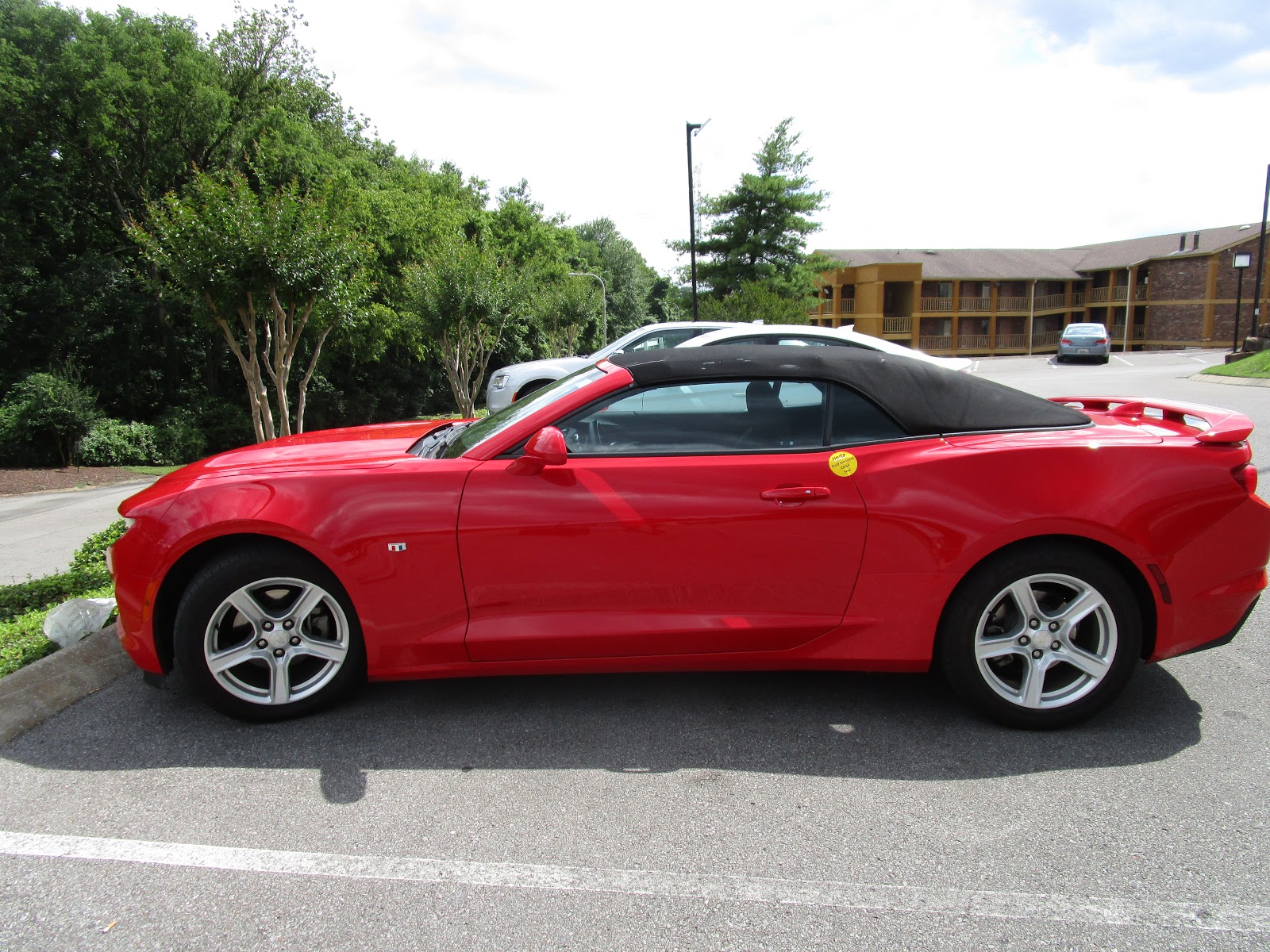
That meant I had to rent a car:


A red Camaro convertible. It actually was the cheapest car available on the Hertz lot (which might explain why they went bankrupt). It will be a lot more fun once I figure out how to get the top down.


Polk is my favorite president. He was elected promising to do three things (settle the western border disputes north and south, establish an independent treasury, and settle the tariff issue). He accomplished all three. He retired after one term. He promptly died. He was a role model for all future presidents, all of whom fell short.

This is the house in which the future President Polk grew up.


Polk's wife, Sarah, lived here with his mother during times in his political career. The tour started with a 10-minute film filled to the brim with political correctness, castigating Polk for owning slaves on a plantation in Mississippi (he was an absentee landowner) and for starting the Mexican War which the film insinuated was unpopular (so unpopular that Polk's elected successor was the leading general of the Mexican War, Zachary Taylor). Political correctness is as compatible with Polk as dancing and booze is with his strict Presbyterianism. So let's tour the home.


This is the entrance. You can't go up those stairs. Those are the Polk's private bedrooms, I guess.

This is the front parlor:


Let's take a close look at the portrait of a younger Polk:


As you can see from the presidential portrait that is the second photo on this post, workaholic Polk aged in office significantly. Worse than Jimmy Carter.

This table was made in Tunisia (from marble from ancient Carthage!) specifically as a gift for President Polk. It was his pride and joy.


Note, however, that the bird that is part of the presidential seal design is not a bald eagle. It might be a very young bald eagle (they are not born bald) (they turn white when they get older) (sound familiar?). It might be a different species of eagle that they have on the African coast. Polk loved it, regardless.

A wide angle view of the Polk parlor:


We next move to the formal dining area:


That is a portrait of Polk's mother above the hearth. Polk's father died when Polk was a young man.

And here are portraits of James and Sarah Polk, which look nothing like James or Sarah Polk:


They were painted by Andrew Jackson's portraitist. So either that's all the artist knew how to paint. Or his "style" was to make people look like Andrew Jackson (sort of like the Colombian artist Botero painted everybody to look morbidly obese). My take? The artist is making a statement about how much of Andrew Jackson, "Old Hickory," was in Jackson's protegee, "Young Hickory" Polk.

Apparently this portrait of Sarah was Polk's favorite portrait of his wife. Again, she looks very Andrew Jackson-y here. I don't want to psychoanalyze that dynamic.


Above is the interior grounds of the property. This is the home of someone of some wealth (Polk's father was a surveyor, a lucrative trade back in the day), but not someone fabulously wealthy.

And here is the view down Seventh Street to the Maury County Courthouse.


The Polk home has been on my "before they chop off my feet" list (also known as my "before they chop my feet off" list) for some time, It is so fitting to visit the home of our only president to die of infectious disease in this year, the year of the global pandemic. I brought my mask along just to be safe, but apparently they've not had the cholera in the Polk home since his passing less than two months after his presidency ended. (Still on record for the shortest ex-presidency in American history.)