I saved the main reason for me to visit Poland for my last day in Poland. Today was the day that I booked a tour to see the main Saint John Paul II sites in the Krakow area.
First stop: Wadowice. The town where Karol Wojtyla lived the first 18 years of his life.
There are two main sights to see in Wadowice. First is the Bazylika Wadowice, or the Basilica of the Presentation of the Blessed Virgin Mary. This was built on the site of the much more modest church that young future pope (and saint) attended.
Once outside the Basilica, in the town square, which I believe is called Plac Jana Pawla II, the thing to do is to look for your country.
And, of course, there is a bronze statue outside. The appointed time for me to tour the museum was coming up.
It moved relatively fast, however. This is the childhood home of Saint John Paul II, which has been turned into a museum, the Muzeum Dom Rodzinny Ojca Świętego Jana Pawła II w Wadowicach, which you may know better as the Family House of the Holy Father John Paul II Museum in Wadowice.
The museum covers the lifespan of Saint John Paul II, from his childhood through the completion of his papacy.
Here are the Pope's skis.
Remember, at the beginning of his papacy, John Paul II was quite the athlete and outdoorsman. This is a great picture of him high atop a snowy mountain, in his dress uniform.
The second floor of the museum is a recreation of the childhood home.
This was the boy's bedroom.
After the walk through the childhood home comes the display concerning one of the key elements of his papacy.
The assassination attempt. It does not say if this is the actual gun (which leads me to believe it's the actual gun used in the assassination attempt because why else display a gun embedded in the floor like that). It is very interesting that the two great evils active in the world during John Paul II's papacy -- communism and radical Islam -- united to try to kill this pope. And failed. It's tremendous, powerful symbolism that was very real.
The statue on the ground floor is, as would be expected, a popular photo spot.
And what do you do when your tour of the museum is done? You go for a pope cake!
During his papacy, Pope John Paul II spoke very highly of the cream cakes served in Wadowice. So how could I not indulge? The pope commanded me thus. (Truth be told, and it's a sin to tell a lie, these were a lot like the cream cakes I've eaten in Lake Bled, Slovenia. Only the ones in Slovenia were flakier, crispier, and (this last point is strictly a matter of taste) a little less sweet. The Wadowice version did have a more pronounced vanilla, however.)
I did not ride on the pope train, however.
Having exhausted all things to do in Wadowice, the next stop on the Saint John Paul II tour was the monastery at Kalwaria. And look who's here to welcome us!
Kalwaria is a very important pilgrimage site in Poland. It is common to visit here en route to the Black Madonna of Częstochowa about 100 miles (or so) to the north. Poland's Black Madonna is probably the single most venerated pilgrimage site in Poland.
Don't let these quite looking grounds fool you.
Although no ceremony was going on, the chapel was full. I seemed to be the only one wandering around taking pictures. Everyone else was in a much more quiet, meditative, prayerful state.
But not me. I'm running around (respectfully) snappy shots of everything shiny.
This is the side view of the Sanktuarium Pasyjno-Maryjne.
The parking lots were overflowing.
I decided to take a walk up the hill to see the smaller chapels up top.
I could hear music coming from a large brass band, with speakers broadcasting the prayers that were being said (in Polish) (this is Poland after all) (why would they pray in English for the benefit of the one lone Yankee tourist running around snapping pictures of everything shiny).
And then I saw this procession coming down the hill.
I'm guessing a couple hundred.
Once the procession passed, the hill was much quieter (and much less crowded).
The main building up here is the Church of the Crucifixion. But there are interesting smaller chapel buildings, too. Like this!
This is the Biblical crown of thorns scene. With actual crowns of thorns in the foreground.
This is the Church of the Crucifixion:
And another smaller building:
But I walked the steep ascent for the main church:
Of the three chapels, this is the one I liked the best:
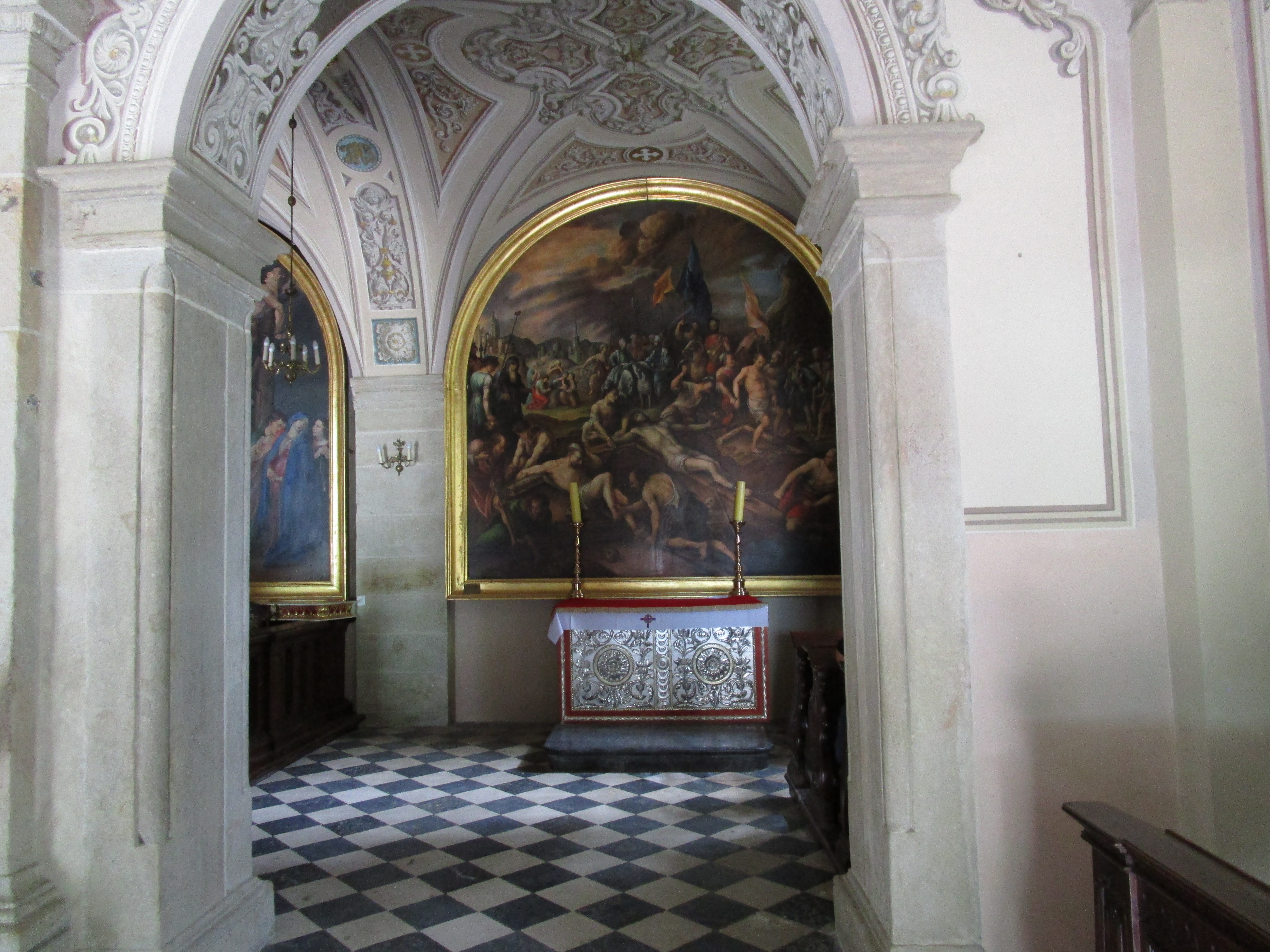
This is the nailing of Christ to the cross. This is the Church of the Crucifixion, after all.
The walk down the hill was just as steep as the walk up. Now it was time for the third stop on the Saint John Paul II tour.
This is the John Paul II Center in Krakow.
You can ride the elevator to the top for a nice view of Krakow:
The final stop on the day's tour, the Sanktuarium Bożego Miłosierdzia, is visible dead ahead.
The Center has a replica of John Paul II's tomb.
The real one is in the Vatican. Controversially (to the Poles at least), Saint John Paul II is buried in Rome, not in his native country.
The mosaics on the ground floor are interesting. Here is the one from Croatia:
I would say that I am not trying to be critical with my next comment ...
But I am. The architectural design is very "contemporary," which means it was dated before it began.
The biblical scenes depicted in the main church are cartoonish. There is no majesty to this church.
But there is majesty to this:
The pope's bloody vestments from his assassination attempt.
I guess I should take solace in the fact that the statue of Saint John Paul II outside the Center is not "stylized."
There is a reason that this was the only religious site I visited this day that was not absolutely mobbed. I guess I am not the only one left cold by this "contemporary" church that would fit comfortably in any fast-growing American mega-suburb.
On to the final stop of the Saint John Paul II tour, Divine Mercy.
Part of the complex is modern.
But the grounds are quite nice.
And a very nice Stations of the Cross. This is "VI," Veronica's Veil.
I spare you the other stations. And even though the interior is modern, it is less sterile than the John Paul II Center,
Which could be a reason why it's more crowded.
And the Divine Mercy grounds were crowded. Not here, at a Divine Mercy prayer site.
But here, at the main chapel. There were prayers being said, and a crowd listening to them, so I could not get into the Divine Mercy chapel to snap some pictures of the various shiny objects inside.
And, right besides were panels honoring, to the left, Pope John Paul II, and, to the right, Pope Benedict XVI. This is the only honoring of Pope Benedict XVI I've seen. Anywhere. Ever.
The grounds here are a convent for the Congregation of the Sisters of the Our Lady of Mercy. And, to cap off the day, here is a statue of Divine Mercy.
I've not seen this before in 3-D statuary. I like it.