The web-housed thoughts and statements of an attorney practicing employment law, fighting for justice for all Nevada workers, in Las Vegas, Nevada USA, the best city in America in which to practice law and the most exciting city in the Milky Way Galaxy. This was going to be a law blog, but it turned into a travel blog. A blog of my travels. And that's a better use of a blog in everybody's estimation.
Showing posts with label huaca. Show all posts
Saturday, May 16, 2020
Phot-o' the Day: Alpaca at the Huaca Pucllana; Lima, Peru
Today's photo is an alpaca at a huaca. And not just any huaca. This is the Huaca Pucllana in the upscale Miraflores neighborhood in Lima, Peru. The Huaca Pucllana is a giant pyramid that was buried in plain site in the City of Lima for several centuries, until it was discovered in the 1970s. It is an active archaeological site.
And it has alpacas. Because why not?
Visited April 2018.
Labels:
alpaca,
huaca,
huaca pucllana,
lima,
photo of the day
Wednesday, April 1, 2020
Landscape Phot-o' the Day: Huaca del Sol, Trujillo, Peru
Today's landscape photo is from the desert around Trujillo, Peru. Landscape? Did I say landscape? As in natural with no buildings?
April Fools!
This is not a landscape. It is a pyramid, albeit severely degraded, built by the Moche civilization, with major construction having been completed around 450 A.D. Again, this is the Moche civilization. They built pyramids. They did not build chewy rice cakes with ice cream in the middle. That was the Mochi civilization.
Visited April 2018.
Labels:
huaca,
landscape week,
moche,
photo of the day,
trujillo
Saturday, April 21, 2018
Walking to Two Huacas
| Huaca Pucllana. The second of two huacas I walked to. |
I've only scheduled one full day in Lima. Most American tourists to Peru schedule zero, as they immediately head off to Cusco and Machu Picchu. Neither of which I am visiting this trip. So I'm visiting Lima for an infinite percentage of days more than the average Turista Americano.
Huaca Huallamarca.
What's a huaca? (What I just typed is hilariously funny if you sound it out.)
A huaca is a giant adobe pyramid built by various pre-Incan cultures up and down Peru.
This was built by the Lima culture, who lived in this area from about 100 to 650 AD. (Yes. I still use "AD" and not the P.C. "CE" because I'm, as Gaga would say, born that way.)
They were here almost a millenia and a half ago. Several hundred years before the Inca. They were forced to move out because of gentrification of the San Isidro neighborhood.
See for yourself on this handy chart.
The only tours offered were in Spanish, but it was not a problem. The displays were bilingual. And the group of Argentines on the tour translated the interesting stuff for me.
Such as, por ejemplo, there is a person inside this anthropomorphic burlap sack:
This is still an active archaeological site.
Right in the middle of an urban residential neighborhood. Soon we were at the top of the pyramid.
And from the top, there's no place to go but down and watch someone else climbing the pyramid to take your place:
Every picture a metaphor.
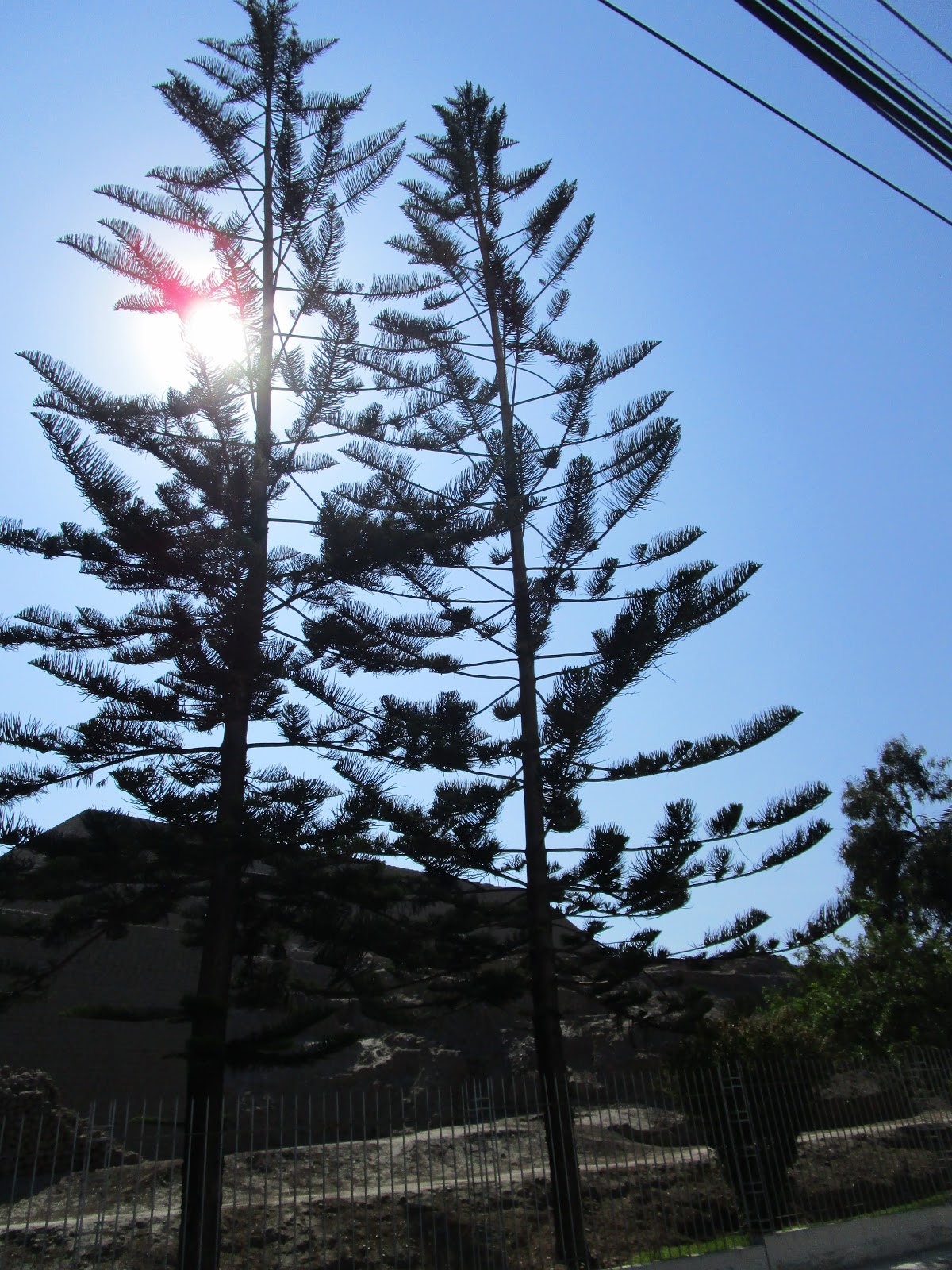
These are pine trees:
Time to walk to Huaca #2.
I don't think this statue is supposed to honor valet car parkers.
I asked for walking directions from Huaca #1 to Huaca #2 and I was told to make a turn at the "church." The woman at the museum did not know the name. I thought I might have a problem figuring out which church. Until I saw this:
It was somebody's wedding day.
This is the statue of the Archangel Michael is on the circular Ovalo Gutierrez. Here is a view of San Miguel and the Church with No Name.
But right behind the Ovalo, I spied:
The back side of Huaca Pucllana.
But first:
This cactus is a tree.
Walking around the huaca.
Huaca Pucllana.
The cover charge is slightly higher, too, but the fare is fair.
Tucked within the walls of the main grounds were these guys:
Representations of men from the priestly caste. And speaking of representatives from the priestly caste:
Me.
You can see the spaces between the abode bricks. What's the purpose? Ventilation? No. Earthquake proofing. This is a seismologically active part of the world.
And it has llamas:
And alpacas!
Live plants and animals that would've been on these grounds 1400 years ago here at present.
Well, except for this guy:
He wouldn't have been present back then. In fact, this is so long ago, that the Slavs may not have even arrived in Croatia at that point.
View from the top:
Again, this is right in a residential suburban neighborhood.
This is a tomb. And the dead guy brought snacks from the afterlife:
And, once again, when you reach the top of the pyramid, there's no place yadda yadda yadda.
But this is an excellent view of the state of degradation of the pyramid. The excavation started in the 1980s and is only about half-way completed.
This being the completed side:
Soon it was time to take a long walk back from the huaca and to the hotel. I didn't see this when I got there at 1:00AM the night before, but there's a nice little park across the street.
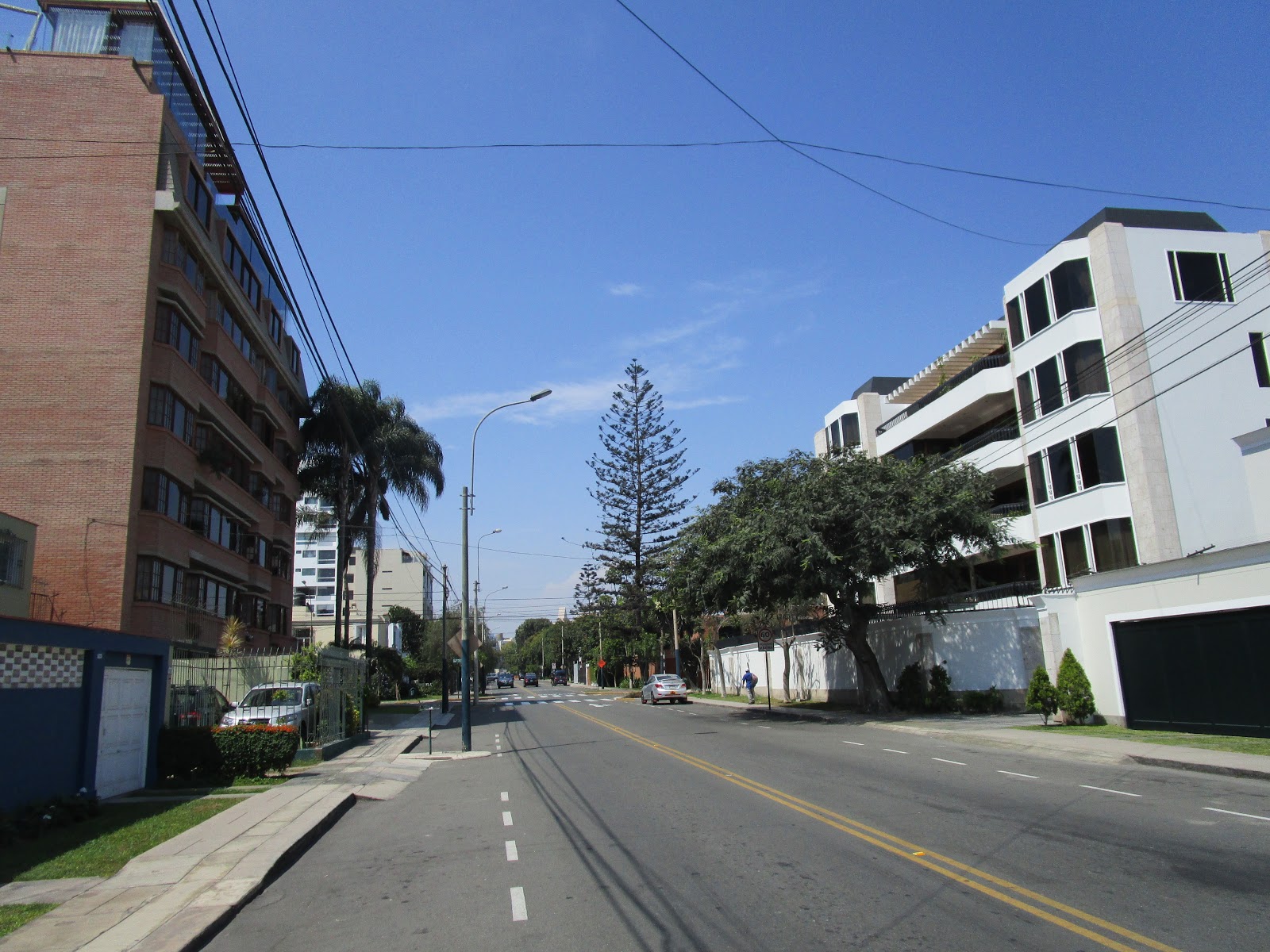
My hotel is in the lovely upscale "suburban" neighborhood of San Isidro, which is the financial and ambassadorial district of Lima.
It is a short walk to the first of two huacas (pronounced walk-ah, hence my fascination with repeating the phrase "walking to huacas").
Huaca Huallamarca.
What's a huaca? (What I just typed is hilariously funny if you sound it out.)
A huaca is a giant adobe pyramid built by various pre-Incan cultures up and down Peru.
This was built by the Lima culture, who lived in this area from about 100 to 650 AD. (Yes. I still use "AD" and not the P.C. "CE" because I'm, as Gaga would say, born that way.)
They were here almost a millenia and a half ago. Several hundred years before the Inca. They were forced to move out because of gentrification of the San Isidro neighborhood.
See for yourself on this handy chart.
The only tours offered were in Spanish, but it was not a problem. The displays were bilingual. And the group of Argentines on the tour translated the interesting stuff for me.
Such as, por ejemplo, there is a person inside this anthropomorphic burlap sack:
Seriously. Looks like a cute children's toy. And it would be, but for the mummy inside.
I don't think there was a particularly cute story associated with the above, since the Argentines never translated the story behind the above artifact.
The museum was muy pequeño, so soon it was time to ascend the pyramid. Conveniently, there was a ramp.
This is still an active archaeological site.
Right in the middle of an urban residential neighborhood. Soon we were at the top of the pyramid.
And from the top, there's no place to go but down and watch someone else climbing the pyramid to take your place:
Every picture a metaphor.
These are pine trees:
I love these trees because they look cheap Christmas trees. And, apparently, they are used as Christmas trees here. The ornaments certainly don't get hidden in the greenery with one of these.
Time to walk to Huaca #2.
I don't think this statue is supposed to honor valet car parkers.
I asked for walking directions from Huaca #1 to Huaca #2 and I was told to make a turn at the "church." The woman at the museum did not know the name. I thought I might have a problem figuring out which church. Until I saw this:
Distinctive enough to serve as a landmark.
It was somebody's wedding day.
This is the statue of the Archangel Michael is on the circular Ovalo Gutierrez. Here is a view of San Miguel and the Church with No Name.
But right behind the Ovalo, I spied:
The back side of Huaca Pucllana.
But first:
This cactus is a tree.
And I reach my destination:
Huaca Pucllana.
Apparently, for a long time, the pyramid was in such a state of degradation, people just thought this was a hill. In an otherwise flat area.
This huaca is bigger. It gets far more tourists. And, as such, English language tours are plentiful.
The cover charge is slightly higher, too, but the fare is fair.
Tucked within the walls of the main grounds were these guys:
Representations of men from the priestly caste. And speaking of representatives from the priestly caste:
Me.
You can see the spaces between the abode bricks. What's the purpose? Ventilation? No. Earthquake proofing. This is a seismologically active part of the world.
And it has llamas:
And alpacas!
Live plants and animals that would've been on these grounds 1400 years ago here at present.
Well, except for this guy:
He wouldn't have been present back then. In fact, this is so long ago, that the Slavs may not have even arrived in Croatia at that point.
View from the top:
Again, this is right in a residential suburban neighborhood.
This is a tomb. And the dead guy brought snacks from the afterlife:
And, once again, when you reach the top of the pyramid, there's no place yadda yadda yadda.
But this is an excellent view of the state of degradation of the pyramid. The excavation started in the 1980s and is only about half-way completed.
This being the completed side:
Soon it was time to take a long walk back from the huaca and to the hotel. I didn't see this when I got there at 1:00AM the night before, but there's a nice little park across the street.
Subscribe to:
Posts (Atom)