Powered By Blogger
Showing posts with label ivan mestrovic. Show all posts

Tuesday, October 15, 2019

Split Tour: Under the Palace

Hanging out in Diocletian's Basement
The most interesting thing about Split, Croatia, is the fact that the core of the Old City is Diocletian's Palace, the estate built by the Roman Emperor Diocletian for his retirement years after his abdication in A.D. 305. It continuously has been part of the city since then, but not in a reverent "leave only footprints, take only pictures" sort of way. Building stones from the palace were taken to build other structures about town. Homes, shops, restaurants, churches, synagogues, have all been built into the walls of the palace. It's a living, functioning city. It's not a static museum. It's been that way for over 1700 years.

So today was the day to take a walking tour of the Old City, which meant a walking tour of Diocletian's Palace and the area outside the walls.


The walking tour of Split begins on the Riva, the waterfront pedestrian promenade. What does the Riva have to do with Diocletian? After all, that picture doesn't look very Roman.


The south gate into Diocletian's Palace was from the water. Thus, the promenade in front of the south walls is built on reclaimed land.


The southern entrance being from the sea was important strategically.

Below is the Split of today, with Diocletian's Palace occupying the area in the foreground.


And this is an artistic rendering of the old Diocletian's Palace:


It looked more palace-y back then. And while much of the core palace remains, much has been lost.

But the basement is relatively intact, so let's take a look-see.


I toured Diocletian's Palace when I visited Split in 2014. But I did not tour the palace's basement because it was closed to visitors back then,

They were using it to film "Game of Thrones."


We had a tour guide that was explaining the development of Split and why it was a strategic location. Although the palace was Emperor Diocletian's retirement home, he still cared about home security.


Into the basement.


Here is the tour guide explaining to us the history of the building. This room was for storage. Perhaps grain. Perhaps furniture that Diocletian replaced with newer, trendier stuff but couldn't throw away because it still was perfectly good. The true reason is lost to history.


I believe that this room was the room in Diocletian's Palace that the guide told us was used as the Dragon Room in "Game of Thrones." Not ever having watched "Game of Thrones" -- yes, I am the one -- I do not know what a Dragon Room is and if this particular elongated chamber could be used for such purposes. But let's call this the G-O-T Dragon Room.

Here is a sphinx carted back from Egypt.


Yes, that is too a Sphinx. Diocletian loved Egyptian artifacts because he made himself a name as a military leader from his Egyptian campaigns. So, yes, I am comfortable calling this chamber "the Sphinx Room."

Here are people taking a picture of a modern plaster bust based on an assumption of what Diocletian looked like.


They used coins from the era to make a guess.

Some of the basement is now exposed.


Looking back into the basement:


Cats in the basement:


Children on the balcony.


People in front of the Cathedral outside the entrance to the core palace:


Bored children being forced to draw something on the other side of the plaza. The cathedral? Diocletian himself? Maybe the d*mn dragon who lives in the Dragon Room.


I did not look over the shoulders of the djeca to see for certain,

And this is the cathedral they would have / should have been looking at:


Off to the north gate, the gate to which barbarian hordes would come looking for some pillaging.


This is the statue of Grgur Ninski, Gregory of Nin:


The statue is by noted Croatian sculptor Ivan Mestrovic, or, to use the local spelling, Ivan Meštrović. He, Mr. Nimski, not Mr. Mestrovic, was one of the ones who wanted to preach and say mass in the local vernicular and not Latin.


And there is a dog sleeping in the sun at Voćni Trg, or, in English, Fruit Square:


The tour ended and it was time for lunch. Lunch again was cevapcici.


Not nearly as good as the cevapcici in Montenegro. In fact, this cevapcici tasted a little like Jimmy Dean's. But it was all washed down with a good radler.


A radler because I was parched after all that walking. This particular radler was barely beer, with an alcohol content of 2%. Your body would process that before it would affect you.

Wednesday, September 10, 2014

Another Croatian Town, Another Meštrović Museum

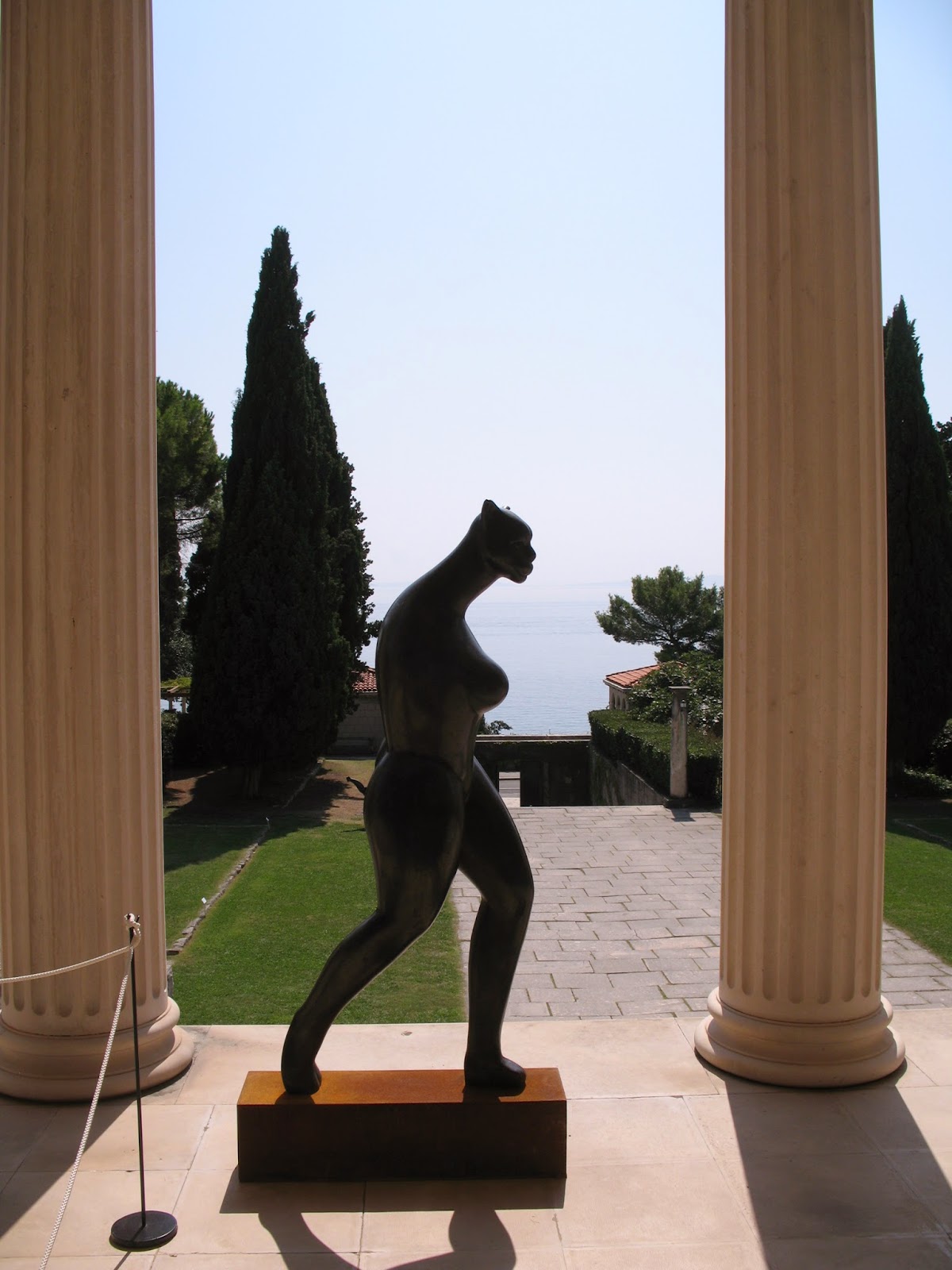
A cat with human hips and legs
Every time that I visit Croatia, I make sure to hit at least one museum dedicated to the art of Ivan Meštrović, internationally renowned sculpture and Croatia's greatest artist.

The Meštrović museum in Split is the second Meštrović museum I've visited. The first was the Meštrović Atelier in Zagreb back in 2010. Ivan Meštrović lived from 1883 to 1962. He is an actual big deal in the contemporary era of art. How big a deal? He was the first living person ever to have a one-man show at the Metropolitan Museum of Art in New York.

Let's have a look-see at the Ivan Meštrović museum of Split:

Entrance into the museum.
If you squint real closely, you can see the white cross at the top of Marjan Hill off to the right.
Through the door, up the stairs, looking back at the Adriatic


Let's tour the grounds first:


I don't know the names of these statues and I don't feel like pretending otherwise.

Here's the entryway into the actual museum:

Another variation on the whole cat/human theme 
View of a sailing ship on the Adriatic
Here are some of the highlights of the indoor galleries. I can't post too much or I will go beyond what's permissible under the fair use doctrine of intellectual property law. (And if I crossed a line, just let me know and I will correct.) (Don't sue me.)


Weirdly enough, probably demonstrative of my pedestrian tastes, this was my favorite. Straight up.
Boy with Pony
Boy with Pony. Seriously. There was something evocative about this piece that stands in stark contrast to the heavily-religious themes of many pieces, and the weird modernity of others.

Time for a museum selfie:
A beautiful sunny day and my friends all went out riding segways and here I am, in a museum

Friday, May 7, 2010

Zagreb, Croatia: Morning Walking Tour

I had one-half day to soak in as much of the Croatian capital as I could, before I boarded the 15:45 train to Budapest and concluded the Croatia portion of my vacation.

The central core of Zagreb is divided into two segments: Gornji Grad and Donji Grad. Upper Town and Lower Town. There are the only two sectors that any tourist will likely see -- other than those hopelessly lost trying to find the in-town Hertz rental-return location. Upper Town is the old, historic district, filled with old buildings, tourist-bait museums, andcafes. Lower Town is the business district. It's also where the hotels are. And, in between, is the place that the tourbooks call (derisively, perhaps), "The Times Square of Zagreb," Ban Jelačić Square (see above).

It's a very short walk to Gornji Grad from where I turned in the rental car. As far as turning in the rental car goes, let's just say this: Thank God I decided to opt for the full, no-deductible insurance coverage! I usually would've cheapened out and bought the cheaper coverage, given that I've never had a problem before with a rental car. Never say never! There was no place to park in front of the Hertz in-town location. So I parked about two blocks away. When the person finally opened the location, she directed me to park on the sidewalk in front. So I fetched the car. I was trying to maneuver the little Ford Fiesta through the two metal posts, the illegally-parked Renault making this difficult. Then. Yup. Crunch.

It was only a small scratch, but still.

And it would probably take the amount of the deductible to repair. But I bought the no-deductible policy. Life lesson learned: never never never ever never return a rental car to an in-town location in Europe. Rental cars and airports go to together like, as in the old Frank Sinatra song, a horse and carriage.

As I said, Lower Town is nothing special. It's a city. A European city, that is, with the narrow pre-automobile-era streets and trolley tracks.

This statue, I believe, is of Croatian poet and monk Andrija Kačić Miošić. More importantly, for purposes of this walking (for me) and photo (for you) tour is that his statue is right on the dividing line between Lower Town and Upper Town.

As you can see, the walk to Upper Town involves walking up, a hill.

The view of Zagreb from the south side of Gornji Grad. Actually, the view is more spectacular in person than it appears from the photo.

Does Gornji Grad have cathedrals? Does the old town section of any European city? Is the Pope, well, you know what religion? This is Crkva Sv. Katarinin (Church of St. Katherine), one of the more modest churches in this part of town.

A little less modest -- check out the roof! -- is Crkva Sv. Marka (Church of St. Mark). A nice square, "trg" in Croatian, surounds the church.

The view from the other side of Crkva Sv. Marka. Note the police officer in the picture. There is a very heavy police presence in the urban core of Zagreb. The policija are everywhere, usually hidden in small unmarked kiosks, such as the one visible in the bottom left of this photo. I am not complaining. After all, one of the discretely-hidden policija came to my rescue the day before, when I pulled into some random dirveway when engaged in that horrible activity "driving under the influence of being hopelessly lost." But it is a little strange for a city to have some police everywhere. It adds a kind of "Paraguay" feel to the place.

I found this fountain in Jezuitski Trg (Jesuit Square?) interesting. The statue doesn't look happy. He looks kind of P.O.'ed that his lot in life is to keep filling that basin with water.

Some of the buildings in Gornji Grad have been impressively restores. Others remain in a stay of beautiful decay.

On my walking tour of Gornji Grad, I visited two interesting museums. No photography allowed in either, so I've got nothing to share from either of them. But I will supply the links so you may visit them on line, if you choose.

First, I visited the Hrvatski Muzej Naivne Umjetnosti, the Croatian Museum of Naive Art, which bills itself as having been the first museum in the world dedicated to "naive art," art from the untrained artist. It has a small, but very collection, and gives a good feel for Croatia. This piece was my favorite: http://www.hmnu.org/en/vodic/_vBuktenica_Ribari.jpg. It reminded me of Pag!

Second, I visited the Mestrovic Atelier, the "studio," actually, a museum, of the work of noted (and prolific) Croatian sculptor Ivan Mestrovic. I got a guided tour from the women manning the desk, as it was not a busy day. (There is a famous Mestrovic piece in Pittsburgh, by the way. But it's not in a museum. It's in the Croatian club.) No links to the pieces to show you my favorites, sorry.

It was getting closer to the time that I would have to catch my train -- and I have an air traveler's mentality about needing to be there at the station a few hours in advance -- so I walked down out of the Gornji Grad. Obviously, these streets are meant for driving.

I thought the police "smart car" was kinda cute. Practical, given the parking issues in Zagreb. Those little kiosks are roomier though.

Back down in the Times Square of Zagreb. Here's Ban Jelačić himself, presiding over the Square That Bears his name.

My last stop in Zagreb was to the Dolac, a large market near Ban Jelačić Square. It was huge, with booth selling meat, produce (really really delicious, fresh looking produce -- the red peppers looked good enough to eat) and, sadly, nice smelling baked goods of all kinds, both breads and desserts. I especially loved the vats of sauerkraut where you could ladel out as much as you wanted.

Time to head back to the hotel to pick up my bags and head for the train station.