Powered By Blogger
Showing posts with label la pedrera. Show all posts

Friday, September 25, 2015

Gaudi, Part I: La Pedrera

La Pedrera
Catalan/Spanish modernist architect Antoni Gaudí second most famous structure is La Pedrera (translation: "the quarry"), an apartment house he built in the Eixample (eye-SHAMP-la) neighborhood of Barcelona.  We'll get to his most famous structure tomorrow.

But, first, walking down Passeig de Gràcia to La Pedrera, you pass Gaudi's third most famous project:  Casa Batlló.


It is easy to miss if you are not looking for it, as it is right in between standard-issue buildings on a regular city block.  That's because Gaudi merely renovated an existing structure by imposing a very modernist facade.  Under the skin of the facade, it's a normal building.

But walk farther down Passeig de Gràcia to La Pedrera, and you will find a building that is weird to its core.  How weird to the core?


These are miniatures of some of the furnishings he designed specifically for La Pedrera.  Note the "love seat" sofa in the top right corner.

This is the model for La Pedrera.


The building is open in the middle, as you can see.


The tour starts on the roof.  And this was no ordinary unadorned roof.


That view there is particularly disconcertingly weird.


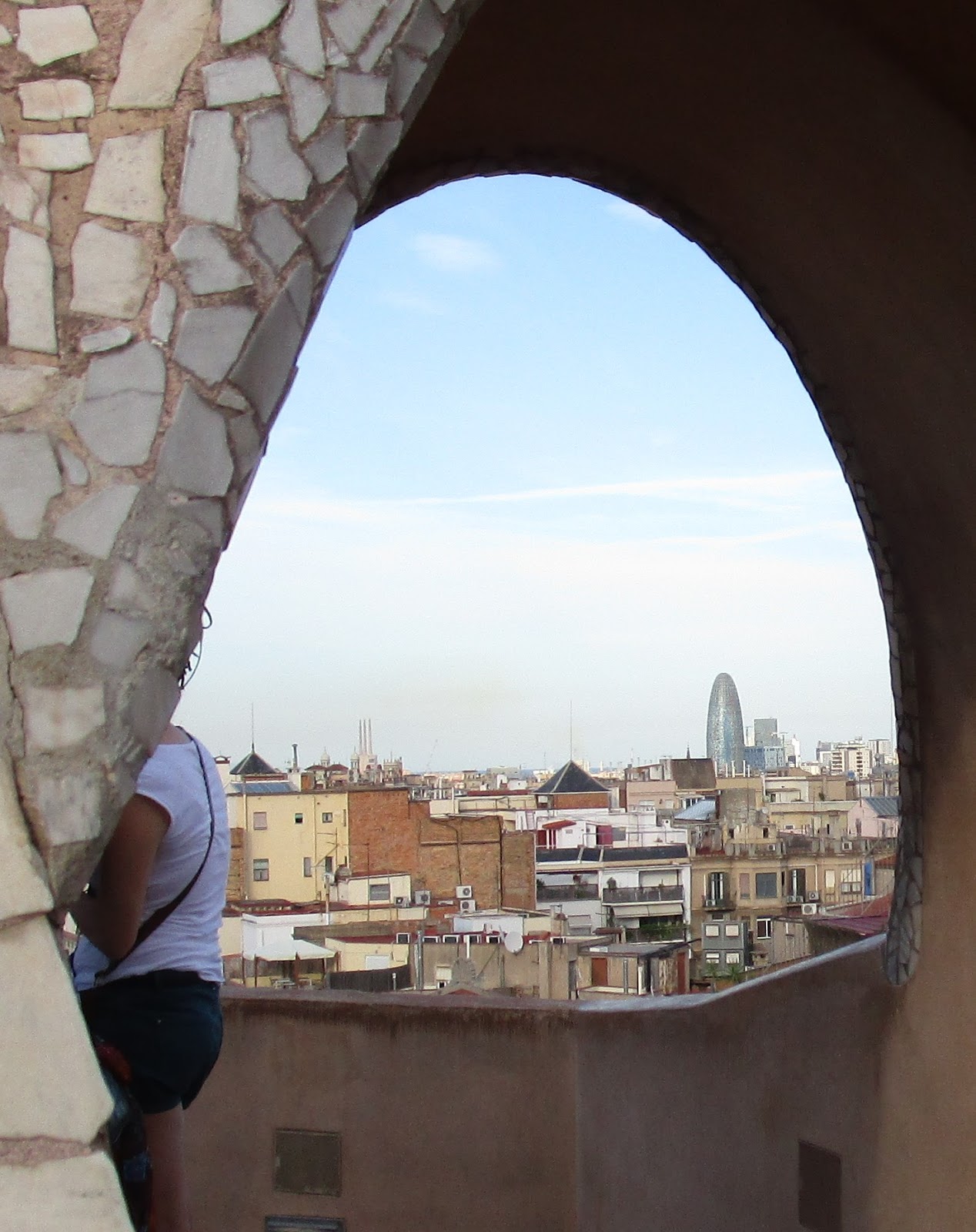
This arch frames a view of a mountaintop cathedral in Barcelona.  Intentionally.  Everything Gaudi did was planned and intentional.  Meticulously planned.  Let's zoom in a little to see it.


This arch frames these two attractive young ladies quite nicely.  But the reason they are taking the picture there is because it also frames Gaudi's masterpiece, La Sagrada Familia.

Closer?


Move a little to the left and this archway also frames a large cucumber shaped building off in the horizon, the Torre Agbar.


Is this gentleman shooting a picture of La Sagrada Familia?  Or the Giant Cucumber?  Let's zoom in on Torre Agbar.  For giggles.

From the roof, you move down to the attic.  And what do you find in the attic?


Old furniture!  This is the loveseat sofa we previously saw in miniature?  What else?


Built models.  Like this one of La Sagrada Familia.

From the attic, the new floor down may be toured.  It is the original Milà family apartment.  The Milà family originally had Gaudi build them this, which is why La Pedrera is alternately called "Casa Milà."


Note the typewriter in the "office" room.


It's an old Underwood.  I have one exactly like back in the office.

Carole types my letters and court pleading on it.  Using six sheets of carbon paper each time.

We have a bear of time electronically filing the documents she prepares that way.  I'm not keen on constantly updating my technology.  I used a computer with Windows XP up to last year.  And my cellphone is from 2011.  It may well be the smallest screen smartphone still in use in America.


I do not have a victrola, however, on which to play my hundreds of vinyl record albums.


You can't tour the other floors because people actually live there.


The end.  I would definitely recommend spending the 20 euro for this tour, with the audioguide.

Thursday, November 14, 2013

The Road to La Pedrera

Lighthouse themed house on Juno (or maybe Mercurio)
I got bored with the beach.  More importantly, I got hungry.  Tengo hambre!  So I had no choice but to leave la playa in search of lunch.  This not being a well-developed turista-town of a beach, there were no beachfront dining options.  There wouldn't have been even if this were the in-season.

So I decided to take a drive to eat lunch in the next beach town up the coast.  The guidebook I am using had much more nice things to say about the eating options in La Pedrera (translation: the Quarry), even though it seemed to be a bohemian surfer town.  It would only be a short drive.  I got there in no time.

The road into La Pedrera

Only to find that the TOWN was closed for the season.

They're rebuilding the whole place for the in-season, so the main road into town was closed.  There didn't seem to anyone anywhere else in the town parked elsewhere.  So I went back from whence I came.

Welcome to La Paloma
I had lunch at the Ballena, which means "whale," which is appropriate since it's near the old whale skeleton on the median of the main drag.

La Ballena
I had sandwich innards, fries and an agua mineral con gas.  "Con gas" isn't a reference to feeling flatulent.  It means I want my mineral water fizzy.  Lots of loose dogs, most looking appropriately fed, clean and health, wandering the streets of La Paloma.  This lass definitely wanted to dine with me.

Street pooch
Lunch filled me up enough that I decided to wander the city a little more.  I found this little plaza off to the side of the main drag, Avenida Solari.

Plaza de Lucho
I'm not sure why the guy in rain gear has an axe.  Weirder yet is the "mermaid."

Ugliest mermaid ever, statuary or non-statuary
There are just so many things wrong with this "mermaid."  First off, I have never seen a mermaid with her tail starting so low.  Shouldn't the fish part start at the waist or hips, so we don't see the mermaid lady-parts?  This mermaid, it's like she's "sagging".  See what I mean:

Sagging mermaid
And she's just plain homely.  Aren't mermaids supposed to be irresistably beautiful?  She looks like something out of a pornographic version of a Rev. Howard Finster painting.

You may be wondering why I did not do a beach day road trip to Cabo Polonio.   It's the isolated, undeveloped beach town about an hour or so northeast of here.  It is the beach of choice for ganja-fueled hippies whose VW microbus makes it to this corner of South America.  Sound like my scene?  Sounds like so not my scene.

The rich jet setters of Punta Del Este?  Also so not my scene.  So I picked the place pretty much equidistant from two things I can't abide:  hippies and rich jet setters (who are many times the same people).  That's why I'm in La Paloma.  For one more night.  Then it's a cross-country drive.

Since the country is Uruguay, the cross country drive is supposed to take eight to nine hours.

Artigas (founder of modern day Uruguay) at the head of Avenida Solari