Powered By Blogger
Showing posts with label penguin. Show all posts

Sunday, April 28, 2024

Pittsburgh Is for the Birds

Is that a Goura Victoria? Why, yes. It is.

Back on April 7, 2024, a few days before Total Eclipse Day in Western Pennsylvania, I took a trip to the National Aviary on the Northside of Pittsburgh.


The National Aviary is in Pittsburgh. That was not the surprise. The surprise was that the National Aviary not only is in Pittsburgh, but that it has been in Pittsburgh at the precise location since 1952. 


Longer than I've been alive. By the way, above, is an Athene Cunicularia. A burrowing owl. Which is ironic, since it is high up off the ground, in an enclosure, and not burrowed. As the old song goes: "Jumping Jesus on a pogo stick / Everyone knows a burrow owl lives in a hole / In the ground / Why the hell do you think they call it a 'burrow owl.'" Well, not this burrow owl. It lives up on a tree branch,.

Anyway. National Aviary. Pittsburgh. And here comes the first of two homages to Pittsburgh sports teams:


The Pittsburgh Condors! They played in the old ABA and disbanded well before the NBA-ABA merger. They now can be found at the National Aviary on Arch Street.

The male and female are kept in separate enclosures near the front entrance. Close up of the handsome male:
 

And this is the female with her baby condors:


Anyway, as I was saying, the National Aviary opened in 1952. I didn't know about it. We took no school field trips here. I only learned about a few months ago.
 

This could be a Cabot's Tragopan:


Apologies if I misidentified this.  This is the "Condor Court" part of the aviary. You can actually look in from outside the building. I don't recommend it. Pay the admission price. This price of birdfeed ain't birdfeed.

Not sure the bird species of this one. Could be one of the various ibises (ibes?) that live here.


This, of course, is the downside of waiting so long to post after a visit.

This one is definitely one of the vultures:


But which? The black head makes me think: Andean Condor, again. But I am guessing.

Perhaps this is the Amblyramphus holosericeus.


You know it better as the scarlet-headed blackbird. Or, perhaps, you don't.

Let's move out of "Condor Country" and into the Tropical Rainforest section and meet the star attraction:


This is a pigeon. Seriously. That's a pigeon. Goura victoria, or the Victoria-crowned pigeon. It may not look like the neighborhood winged rat, but it's a pigeon nonetheless.

And this is the real macaw:


Anodorhynchus hyacinthinus. The beautiful and always friendly-looking Hyacinth Macaw.

Let's have another look, shall we?


One of the interesting things about this section is that the birds run loose. These Victoria Crowned Pigeons frequently wander out from the confines of the Rain Forest Cafe into the neighboring sections because (a) they can and (b) they want to.


Quick. Somebody catch that Crown Vic.

Here are birds posing:


I believe those are a pair of Marbled Tral posing.

The problem with the Rain Forest section is that the birds are roaming free. If it's a recognizable species, such as the Hyacinth Macaw, I can label it as such. If it is a distinctive species, such as the Crown Victoria Pigeon -- I'm sorry -- Victoria Crowned Pigeon -- you can look it up easily. But this bird:


The bill makes me think "ibis," but the bird is not matching up with any birds listed on the aviary website.

And the identity of this fellow (or gal) (don't want to be misgendering anyone here) shall remain a mystery:


But this one is no mystery.


It's a penguin. Statue. A penguin statue. Which means we are entering the area where we will find the real deal:


The Pittsburgh Penguins!


Actually, these are African penguins. They live in the coastal area of South Africa, so they are used to a more temperate climate than other penguin species.

They actually look a lot like the Magellanic penguins, a.k.a. "Jackass penguins," that I met in Chilean Patagonia. Same size. Similar black and white pattern.


Not as oily of skin, which I am guessing is due to the climate difference between the southern tip of Africa and the southern tip of South America, which is much much closer to the Antarctic than Africa.


This section of the aviary is creatively named Penguin Point.

Moving on to the Wetlands section.


Muchos flamingos.

This one is known to be particularly aggressive at snatching shoe laces:


There were more birds than just flamingos in the wetlands area. Such as a lone pelican.


Pelecanus occidentalis. The brown pelican.

But I have some many photos of flamingos because (a) there were so many flamingos, and (b) they are so gosh-darn photogenic.
 

Not that these two aren't too.


I feel like every bird I cannot identify by species I'm just saying it's "a type of ibis." Maybe that pair are a type of ibis. I don't know. They didn't have name tags. Or species tags, as the case may be.

And this little boy loves fruit:


So let's conclude with another look at the Pittsburgh Penguin:

Life is good.

Saturday, November 18, 2023

Penguins!

Magellanic penguin getting in his morning stretches. Good for his health.

Friday I did the tour to Penguin Island.

We caught the boat to Penguin Island very early in the morning. Although, compared to the 5:15 a.m. departure for the full day trip to Torres del Paine -- and when they said "full day" they really meant "full day" -- the 6:00 a.m. start for the tour allowed me to sleep in, relatively speaking.


Luckily we had a sunny day and the winds were actually, by Punta Arenas, standards, quite calm.

I call this picture of walking on the dock to the ferry-boat: To the light!


The boat was ready to transport us to the penguins.


Technically, the place to which we were being ferried is known as Isla Magdalena. Not, in the official records, Penguin Island. But if you tell people around these parts that you are going to Penguin Island, they know where you are talking about.

The trip down the Straits of Magellan lasted about an hour, I guess. And soon we were disembarking on the shores of Penguin Island.


The penguins (disappointingly) did not rush to come greet us. But the place was packed with penguins and other sea birds.


I can pretend this is a penguin running down the beach to greet me.


It'd be a lie, but I'll stick to me pretend world.

A penguin and a lighthouse.


The lighthouse's official name Faro Isla Magdalena -- the Isla Magdalena lighthouse. We can call it the Penguin Island lighthouse and they'll know what we're taking about.

This is a penguin and a tern.
 

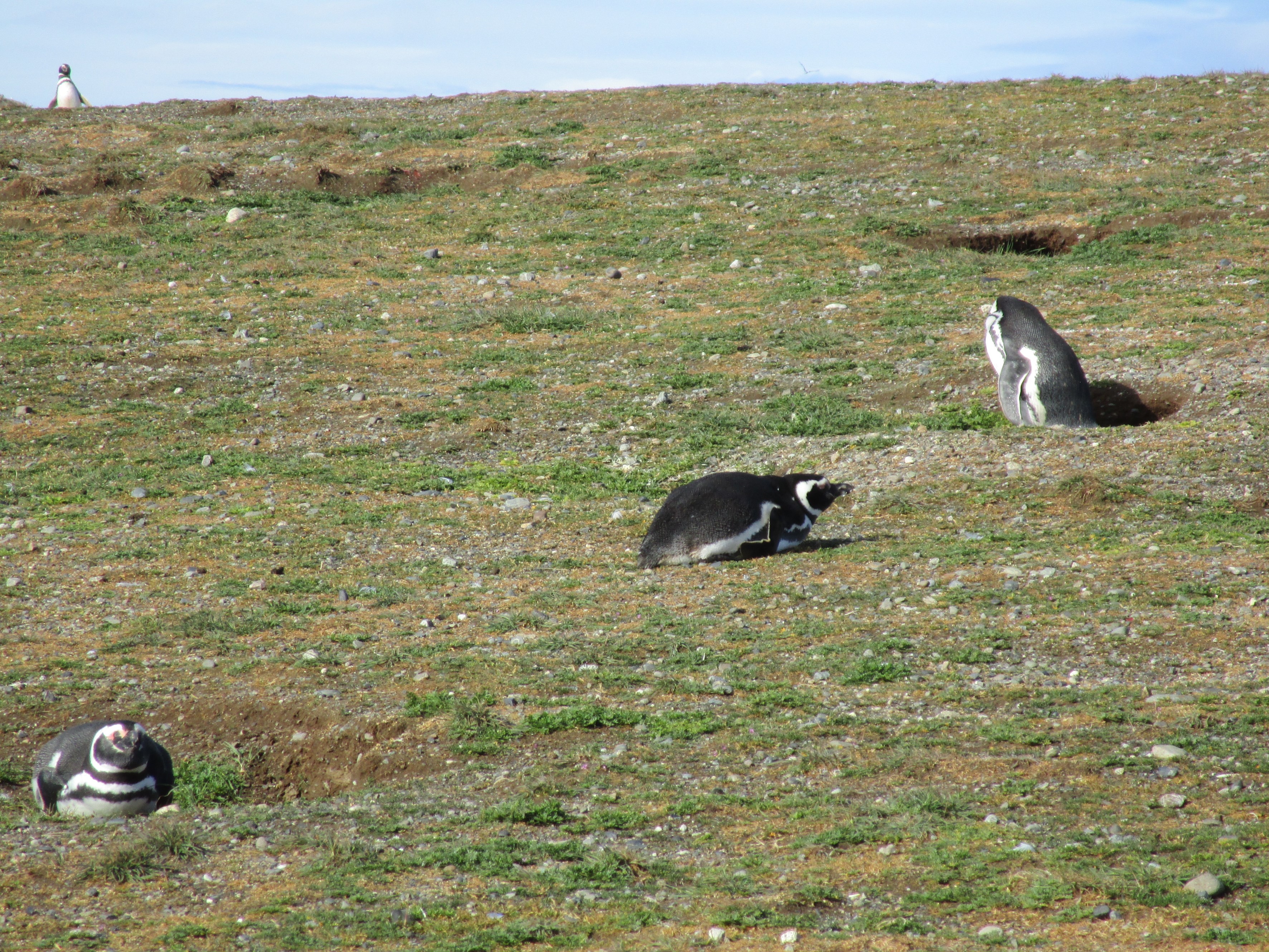
It is nesting season for the penguins. Penguins are known for mating for life. They pair-bond intensely. During nesting season, eggs are laid in burrows. One half of the penguin couple stays with the eggs in the nest. The other goes off to hunt (and eat) for a few days. The absentee parent-to-be then returns and the penguin that had been home on the nest then leaves on a four day bender, hunting and eating.


There are holes all over the island which were once burrows used by a penguin couple but the homestead has been vacated.

Penguins on the beach:


Penguins on the beach. Now with kelp.


So there were no penguin babies -- or baby penguins, if you prefer. The eggs hatch in late December. So the early months of the year are when you will see the cuddly penguin babies. That you are not allowed to cuddle.


I tried to take a selfie with a penguin at least somewhere in the background. I was not successful.


I'm guessing the gulls use the same burrows for nests, but they don't tell us these things. This was not a tour to Sea Gull Island. This is Penguin Island. Monumento Natural Los Pingüinos.


And, yes, penguins are so cool -- no pun intended -- that the Spanish name for penguins -- pengüinos -- is officially spelled with umlauts. Like the rock stars that they are.


Here is a sea of gulls:


Back to the star attraction of this island:


Well, I couldn't manage a selfie with a penguin, but I did manage one with the lighthouse.


The lighthouse not only was bigger, it was stationary. Much easier for selfie-taking.


Not sure what's going on in this mosh pit.


The gaviota can only stare at it, at a safe distance.


These penguins are officially known as Magellanic penguins. You may know them better by their less-flattering name: jackass penguins.


Yes, they also are known as jackass penguins, seriously. They make a braying sound like a donkey. The braying served many purposes. One of which is a trez romantic call out to its life-partner penguin, so that its mate-for-life can find its soulmate in the crowd of penguin lookalikes. 

Now come on. Does this guy (or gal) (hard to tell with penguins) look like a jackass to you?


Or this one?


He's not a jackass!

This is not a jackass either. It could be a kelp goose, but, again, we weren't focused on seeing and classifying any non-penguin birds.


Another boatload of tourists are heading for Isla Magdalena for their designated hour of cavorting with penguins.


THis one, however, looks in no mood to cavort.


Their eggs that need a-hatchin'.


And this is the penguin to do it.


Someone forgot to tell him that penguins were flightless birds.


But, then again, he's a jackass.


Yes, Isla Magdalena was lousy with penguins. They were everywhere.


The hour for cavorting with penguins is drawing to a close.


Time to scurry back to the ferry-boat.


The island was worth the visit. It didn't smell of fish. The all-you-can-eat sardine buffet is held out in the waters, not on the island, where the penguin staying at home is fasting. But Isla Magdalena was not the only boat adventure destination out here today on the Straits of Magellan.