Powered By Blogger
Showing posts with label statuary. Show all posts

Thursday, May 5, 2022

Giorno Tre, Seconda Parte: the Capitoline Museum

Emperor Marcus Aurelius rides his horse to the Capitoline Museum.

Sometimes when I am visiting a city, there is a specific museum that I want to see that is not one of the major sights. In Rome, that was the Capitoline Museum.

The Capitoline Museum is the world's first public museum. It was created in 1471 by the donation of Pope Sixtus IV of four ancient bronzes from the pope's private collection to the citizens of the City of Rome. You also may known Pope Sixtus IV as the one who started the construction of the Sistine Chapel. He did not hire Michelangelo to paint it. That was another pope. Julius II, in 1502. (The word "Sistine" in "Sistine Chapel" is just the adjective form of the name "Sixtus." Sixtus's Chapel.)


The museum has grown considerably since then. It is still primarily (but not exclusively) a museum for ancient statuary, whether stone or bronze. The museum also can be difficult to find. It is up a hill (the Capitoline Hill, one of those seven hills upon which Rome was built), behind the Victor Emmanuel, and not well-marked. Which kept the crowds down.

In the courtyard of the museum are various fragments of statues from ancient times. I believe these fragments from a colossal statue of the Emperor Constantine.


I know it's not politically correct anymore to use geography based terminology, but I remember that people used to refer to "the Roman nose." That, my friends, is the very definition of a "Roman nose" on Constantine.

And here's Constantine's Roman hand. Apparently he had amazingly long fingers, from the look of the proportion of the fingers relative to the palm.


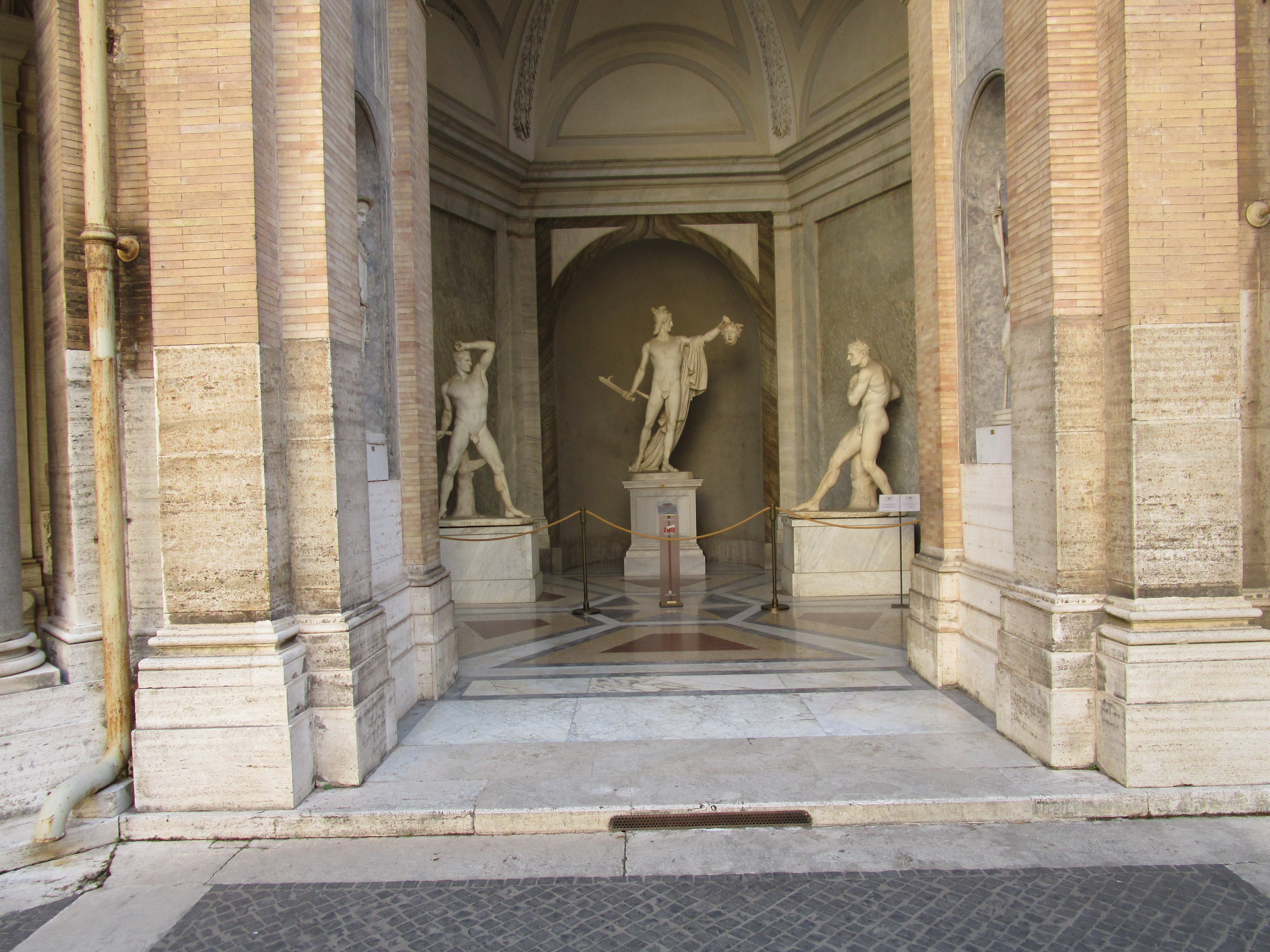
And here's an artsy shot of Emperor Marcus Aurelius astride his horse that is located outside the museum, framed by the museum's doors.


But this is not the original. It's a replica. The original was one of the four bronzes donated by Pope Sixtus IV to the people of Rome. It's inside, tucked safely away from the elements.

This one looks a little too intact to be an original from ancient Rome.


But I snapped a photo of it due to its sheer creepiness.

On the second floor of the museum, called the first floor in true European fashion, is a large room containing three of the four original Pope Sixtus IV donations. Including:


The original bronze of Emperor Marcus Aurelius on his horse. Weirdly enough, the one in the inside looks far more weather-beaten that the one outside in the elements.

And this is another of the original donations from the pope. A bronze casting of the she-wolf suckling Romulus and Remus, the legendary twin founders of Rome.


I've seen copies of this elsewhere. I'm not sure why the whole "suckled by a she-wolf" thing is so important to the legend of the legendary Romulus and Remus, but I'm not in the business of crafting the details of legends. I just report them as I hear them.

We'll come back to that room in a bit.


I photographed that one because, among all the athletic statuary, this one is the most intact. He's only missing his hands. That's a pretty good survival rate for body parts over two millennia.

This one is the personification of Teddy Roosevelt's dictum "speak softly and carry a big stick."


That is one huge stick. Barbed, too. It would not end well if you were clubbed by a barbed stick like that.

One the other hand, man's best friend:


Now here's an athlete in a bad state. One arm missing. No hands on the other. On a tree trunk. None of that can be comfortable.


A lot of the statuary fragments in the Capitoline are staged so that you can envisage what the statue actually looked like when it was whole. This must be a charioteer and his horse. His headless horse. Although in the Legend of Sleepy Hollow, the headless horseman. Remind me again, it was the horseman who was headless, right? It wasn't about a man on a headless horse, correct?


We're back to the room that is the core of the museum. This is a lion attacking a horse.


The horse does not appear to be enjoying the situation. Perhaps this is how he ended up a headless horse, no?

And this is one of the major pieces in the museum. Again, it was part of Pope Sixtus IV's original donation.


Boy pulling a thorn from his foot. For some reason, this reminds me of a Smiths/Morrissey song.

Let's look at the whole room.


And here I am.


I forgot to smile. The other selfies I took in here with me smiling look even worse.

And here's Emperor Constantine. In fragments.


Is this a funerary urn? Or just a firkin?


Either way, with the puppies on the corners, I want one.

This one definitely is funereal:


Has to be a sarcophagus. Has to be.

I think this is from the top of some ancient statue:


This riderless horse looks like it once had a rider.


A rider who was violently taken away from it.

This is an actual working functional chariot car:


It was found on the remains of some rich ancient Roman's estate. It's the real deal. Fully functional.

There was a section of the museum dedicated to pottery.


It looked good, but pottery is not my thing.

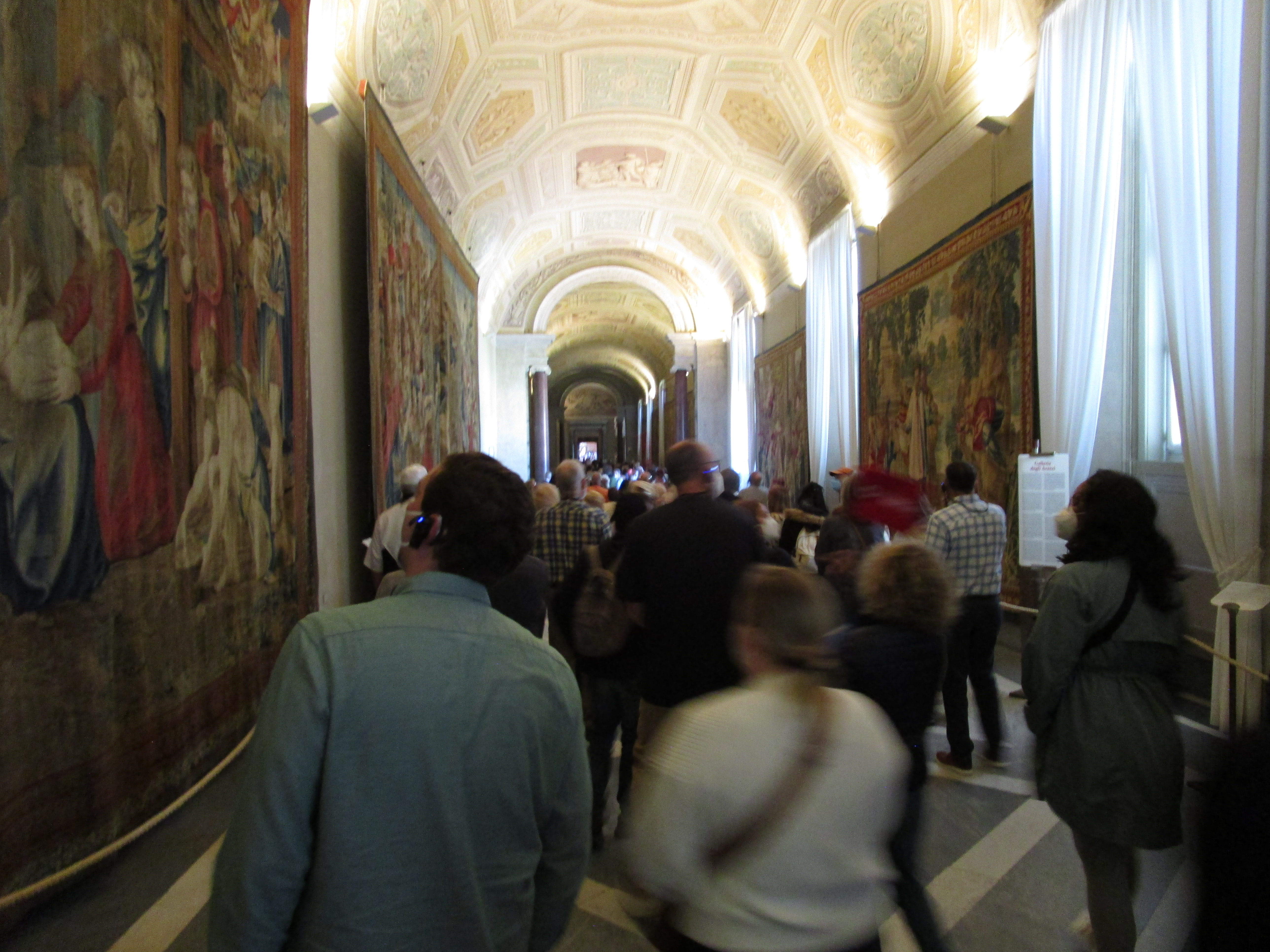
There also is a collection of tapestries in the museum. These cannot date back to Roman times because there is no way organic material could have survived this long. But this depicts a Roman looking scene.


This giant tapestry reminds me of Raphael's "School of Athens." Only this depicts Roman rulers giving the thumbs up/thumbs down to an ancient gladiator. (The gladiator on the right already was decapitated. The one on the left apparently is begging for his life. Not as peaceful as the collection of philosophers in "School of Athens.")


This is a giant room lined with tapestries, in case you need some ideas on decorating with massive tapestries.


This next one I really liked for the expression on the faces of the animals in the scene above the sarcophagus or storage chest or whatever.


The sheep looks amazingly surprised to find a tiger on its spine.

There also is a small collection of paintings. Again, as I have noted, painting does not photograph well. Sculpture does. Painting does not. But given I know nothing about the fine arts, I am always amazed when I go into a room full of paintings and one sticks out to me as being of way superior to quality to the others and that one is the one painted by one of the acknowledged masters. That was the case with this one below:


It is by Caravaggio. This is his St. John the Baptist. It jumped out at me because it was luminescent and almost three-dimensional.

And after walking through the area of paintings, my tour of the museum was complete.


Time to exit the museum and move on to my next destination for the day.


Once I figure out where that is going to be. Do I go north or do I go east southeast?

Tuesday, May 3, 2022

It's Vatican Day! Part Uno: Musei Vaticani


Maybe the premier piece of ancient statuary in the Vatican Museums: the Belvedere Torso.
This was the "model" for many male bodies in the Renaissance era,
especially the males Michelangelo painted in the Sistine Chapel.

Last night, I walked around St. Peter's Square. It was just a nibble of the Vatican experience. Today was the full-on, all-you-can-eat Vatican tourist banquet. We start with the Musei Vaticani, the Vatican Museums.

I signed up for one of those "before they open the doors to the public" tours of the Vatican grounds.


The tour literally met right outside my hotel window, as seen in the above picture.

As you can tell by the plural -- Vaticans Museums -- Musei Vaticani -- this is not a single museum.


It's a series of museums that flow from one "museum" to the next. You have to follow the guided path because of the crowds and because the place is so huge.


You go from the Museo Pio-Clementino, with its ancient statuary, to the Tapestry Room, to the Gallery of Maps, to the Raphael rooms, to the Borgia apartments, with the only clue that you've moved from one museum within the complex to another is the change of theme.

This part is outside. This is the Fontana della Pigna, a.k.a., the "Pinecone."


It's a Roman era statue found and moved to the Vatican grounds.

This, on the other hand, is modern ugliness:


"Sphere within a Sphere," Sfera con Sfera, by Italian artist Arnaldo Pomodoro. The artist is kind of a "one hit wonder," as he keeps installing these spheres in museums all over the world. Repetition does not detract from its modern hideousness.

Compare/contrast:


Michelangelo's "Last Judgment," which is on the back wall of the Sistine Chapel. Why photograph this posterboard instead of the real thing? Because no photography, even without a flash, is allowed in the Sistine Chapel.

The Sistine Chapel comes at the end of the Musei Vaticani tour for the same reason that Journey does not play "Don't Stop Believin'" to open its shows:  It's what everyone is there to see.

One interesting thing on the posterboard is the photo showing the effect of the restoration that was done about 30 years:


The dark areas of Adam (from the creation scene) -- the head and outstretched arm -- are what the art looked like by the 1980s, pre-restoration. Now, the colors are bright and beautiful.

This is the posterboard shot of the creation scene in its full restored glory. 


Or is it? Did I sneak a photo in the Sistine Chapel? Clue: we have not even begun the tour of the interior of the museums and I said the Sistine Chapel came at the end.

First stop is the statuary of the Museo Pio-Clementino.


Apparently there are 50,000 pieces of sculpture here. And "pieces" is an accurate description, since this includes fragments.


This is a nice view looking towards the main part of the City of Rome from the Museo Pio-Clementino.

More statuary:


I will interrupt the walk-through if I recognize any of the pieces. This is Roman statuary, from the Roman Republic and then the Roman Empire, found in Rome, usually sculpted by Greek artists.


The Greeks were the creative artists. The Romans were skilled engineers. I'm not valuing one more than the other. Both are important.


You don't have to go to the Sistine Chapel to see great ceiling art in the Vatican:


This one is the Emperor Claudius:


Claudius was one of the first Roman emperors, with the "Empire" period of Roman beginning (according to most historians) with the assassination of Julius Caesar in the 40s B.C. Claudius succeeded the notorious Caligula.

And here are some statutory fragments. Some with heads!


Heads and lower legs seems to be particularly difficult to hold on to if you are statuary.

I'm guessing this one is a fertility goddess:


And with that, we leave the statuary for the tapestry room.


My life has been a tapestry of rich and royal hue.  (Quoting a song here.) (I'm sorry. Someone says the word "tapestry" and I think Carole King 1971.)

Here's Mary and the Baby Jesus:


The craftsmanship, the skill, involved in creating these woven works of art is extraordinary.  I just wish I could appreciate it more. It's like certain types of music. Even when it is extraordinarily well done -- which these 400?, 500?, year old tapestries are -- my reaction is "that's nice."

On the other hand, I do love cartography, the art of mapmaking:


We enter the Vatican Museums' Gallery of Maps:

This is art that even I appreciate. This is a map of Sicily (foreshadowing the second half of this Italian trip). These extraordinarily accurate maps were drawn from several hundred years ago were crafted from the words of seaman, sailing around the boot of Italy.

From before Italy being a "thing."


This is a map of Rome and the surrounding Latium region (and the language of Latium? Latin! That's where that comes from.) Again, coastline and mountains accurately placed long before satellite imagery. At the bottom left is where the Tiber River flows into the Mediterranean. Well, technically (and I'm all about the technical accuracy when it comes to geography) the Tyrrhenian Sea.


No maps in that picture. We must be approaching the Vatican Museums' "Raphael Rooms".

This depicts the famous Battle of the Milvian Bridge. Legend has it that, before the battle, Constantine had a vision in a dream of a flaming cross. The next day, he painted crosses on the shields of his soldiers and defeated the Emperor Maxentius in a Roman civil war to become Emperor of Rome. This, again, according to legend, directly led Constantine to convert to Christianity and have Rome adopt Christianity as Rome's official state religion. Jupiter and the pantheon of Roman gods were now out of work.


Raphael died in his late 30s. He did not live to finish this epic piece that he started. It's a mix of Raphael original and the work of his acolytes.

And now we come to one of the stars of our show:


Raphael's masterpiece: the School of Athens.


The work depicts Plato (played here by Leonardo da Vinci, whose visage is used for that of Plato) and Aristotle debating whether the heavenly or the earthly are most important, surrounded by their disciples. The faces of two other prominent Renaissance artists can be seen in this work. Michelangelo is in the foreground. He's the only one wearing boots. Everyone else is barefoot or in sandals. Apparently this is a dig at Michelangelo. And the artist Raphael himself is on the far right side of the painting.

Sorry for the low quality. As I have said, when it comes to photographing art: sculpture photograph well, painting photographs poorly.

After the Raphael rooms and the Borgia apartments, you then walk through the "modern" section of the Vatican museums. They have multiple Chagalls and the other modern works from artists whose names were not worth noting.  With one exception:


They have a Dali!  Dali was very much a devout Catholic, so it's appropriate that he is represented here.

The museum tour ends with the Sistine Chapel. No photos from there because none were allowed. Here's my take. The Michelangelo art is extremely beautiful and impressive. I think "The Last Judgment" on the back wall is even more impressive than the ceiling (although how he managed to paint the ceiling lying on his back is extremely impressive). It also was a lot smaller than I expected. I mean, they hold the papal conclaves in here to vote on new popes! But given all the time if took for Michelangelo to create all this fantastic art in this space, he probably was very thankful that the room was not any bigger.