|
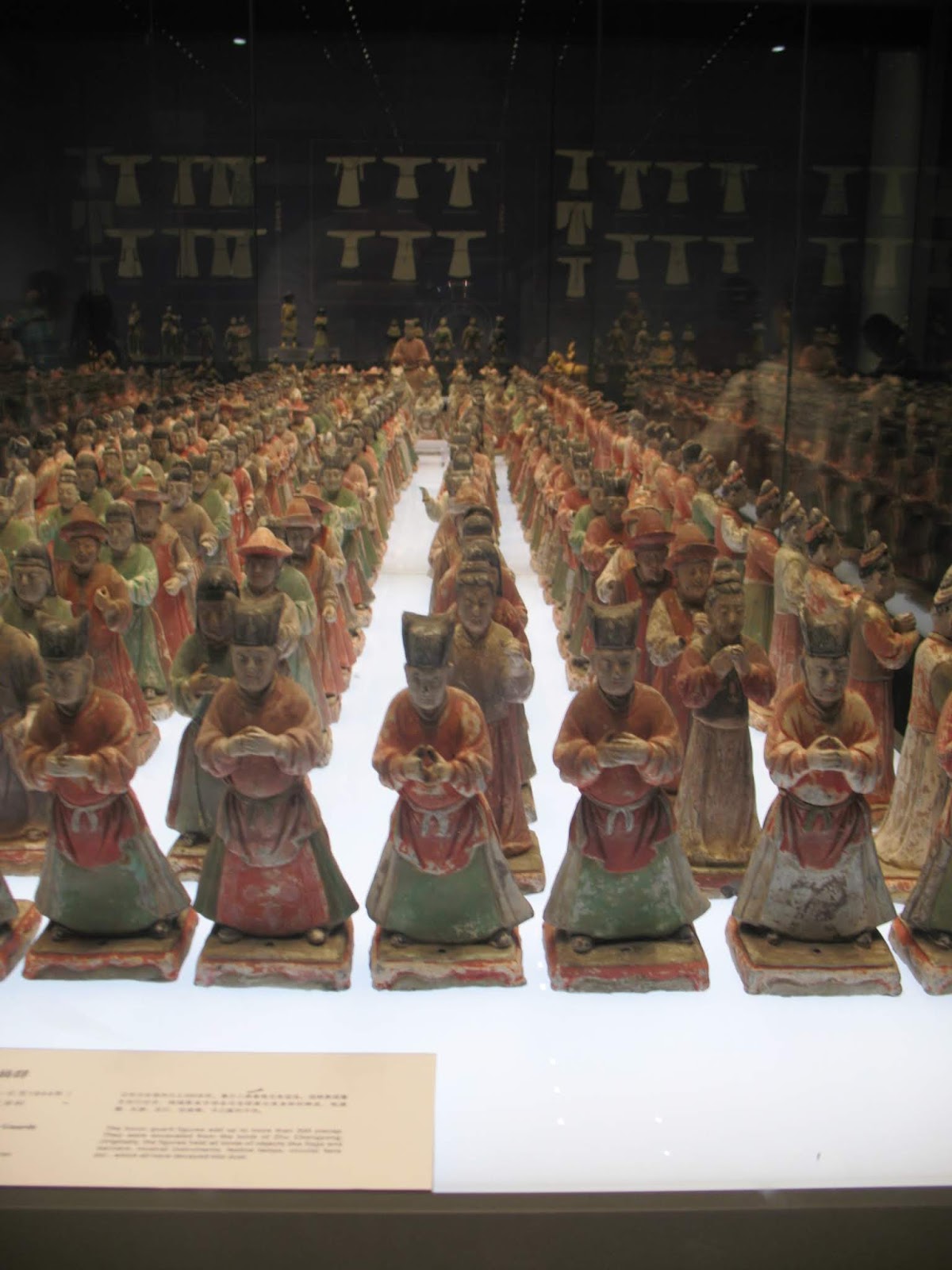
| There were just so many of them. |
When presented with the chance to travel to China, my top priority was visiting the Terra Cotta Warriors in Xi'an. The Great Wall, the Forbidden City: definitely worth seeing if I were here. But getting to see the immensity of the Terra Cotta Warriors first hand was the biggest reason for wanting to visit.
The Terra Cotta Warriors did not disappoint.
The Terra Cotta Warriors were found in a farmer's field in 1974. They date from 220 B.C., from the first emperor of the Qin Dynasty.
You may recall the "Qin" as being the original dynasty that unified China, hence its name was given to the whole of the country: China. (Q = "ch" phonetically here.) Strangely enough, it is the Han Dynasty, who came next, who ruled from 200 B.C. to 200 A.D., who gave their name to the ethnic label most Chinese use to describe themselves: "Han."
But the Han have nothing to do with the Terra Cotta Warriors. So let's focus back on the Qin.
The site is located about an hour northeast of Xi'an. And it is popular with the Chinese, especially school groups (of course).
There are three pavilions to visit. Pavilion 1 is the enormous pavilion, the size of multiple football stadiums. This is the one that you picture when you think of the Terra Cotta Warriors.
The crowds were thick.
And jockeying for position along the main photo wall, with the army facing you, was not for the polite.
It takes a while to take in the whole thing. The army goes on and on and on and on.
Same photo, but landscape if you prefer:
This corner is where the farmer originally discovered the Terra Cotta Warriors, while digging a new well. Just a couple of feet to the right and the terra cottas still would be undiscovered.
The walls between the rows of soldiers served an important purpose. The army was buried, along with the emperor whose tomb they were there to guard. The walls acted like a burial vault, so the "tomb" for these soldiers would not fall in on itself.
The Terra Cotta Warriors originally were painted. However, the paint used seriously degrades after just one week of exposure to air and sunlight. Thus, except for some bits of coloring on some of the soldiers, all of the army appears tastefully in plain terra cotta.
As you move along the sides of the main pavilion, you see the area where the restoration work is still "in progress." These are nearly completed soldiers, clearly identifiable as such, but they are still missing vital parts. A hand, a foot, or a head, for example.
Did I mention how hot and humid it was inside this pavilion?
Anyway, piecing together these figures from the fragments found must be a little like constructing a one trillion piece jigsaw puzzle.
The other two pavilions are much smaller. Let's have a wander over to Pavilion 2.
The restoration work here is far less advanced. The soldiers are far more fragmented.
I can see only one guy who has head on.
These statues were not lined up an impressive formation. These were more akin to milling about at the hospital ward.
Pavilion 2 was nice and small. Pavilion 3 was "baby bear" sized pavilion: not too big, not too small.
But not a lot of Terra Cotta Warrior happening here. This is more about professional archaeology being on display.
There is a lot of pain-staking work still being done 40-plus years after the discovery of this marvel.
But Pavilion 3 did have some displays with explanations.
This is a general.
You can tell by the shoes.
I believe this was a government official.
Soldier. With horse.
Note the detachable tail on the horse.
Again, crowded, but the air conditioning was nicer here.
There was a final building, not quite a "pavilion," that housed two full chariots. One was real and restored, the other was a recreation.
After more than two hours wandering around, it was time to head off for some lunch. This statute has nothing to do with the Terra Cotta Warriors, but it was on the grounds and it is nice.
It kind of has a "Frederick Remington" feel to it. And, finally, we conclude with the Emperor himself.
In statue.