Powered By Blogger
Showing posts with label villa de leyva. Show all posts

Tuesday, September 1, 2020

Phot-o' the Day; Inside the Paleontological Research Center; Villa de Leyva, Colombia


 A few years ago, they were building a road near one of the most beautiful little tourist towns you will find anywhere: Villa de Leyva, Colombia. And they found a giant fossilized skeleton of a kronosaurus. They kept the fossil intact and built a museum around it. The Museo del Fosil -- everybody's Spanish is good enough to translate that into English -- is on the other side of the highway. On this side of the highway is the Centro de Investigaciones Paleontológicas, the Paleontological Research Center.

Villa de Leyva, already having been a tourist town, was the perfect location for the two paleontology museums that sprung up as a result of this discovery. One museum features the star attraction, the kronosaurus. The other features the larger collection of smaller fossils found in this area, from before the time the three ranges of the Andes rose and cut this area off from the Atlantic Ocean and Caribbean Sea.

Villa de Leyva is accessible only by bus or car. It's about four hours north of Bogota. I visited in November 2017.

Tuesday, July 21, 2020

Phot-o' the Day: Plaza Mayor, Villa de Leyva, Colombia


Back in Black. And White.

This is the Plaza Mayor in Villa De Leya, Colombia, late morning on a hot November day. (It's near the equator, so there is no seasonal cooling in November. There's only rainy season and dry season and this is from the dry season.) Villa de Leyva is a fun little tourist magnet about four hours north of Bogota by bus (the only way to get there) (unless you have a car) (and I would not recommend driving in Colombia, especially anywhere close to Bogota) (the buses are clean, cheap and worry-free).

Villa de Leyva may be a tourist magnet, but it's not "tourist-y," because nearly all of the other tourists are from Colombia. Here's one of many travel rules: Tourist towns in foreign countries are huge fun when you're the only American tourist in town.

VdeL visited in November 2018.

Friday, June 19, 2020

Phot-o' the Day: Villa de Leyva, Colombia: After Dark


Late in the evening on the Plaza Mayor in Villa de Leyva, Colombia.

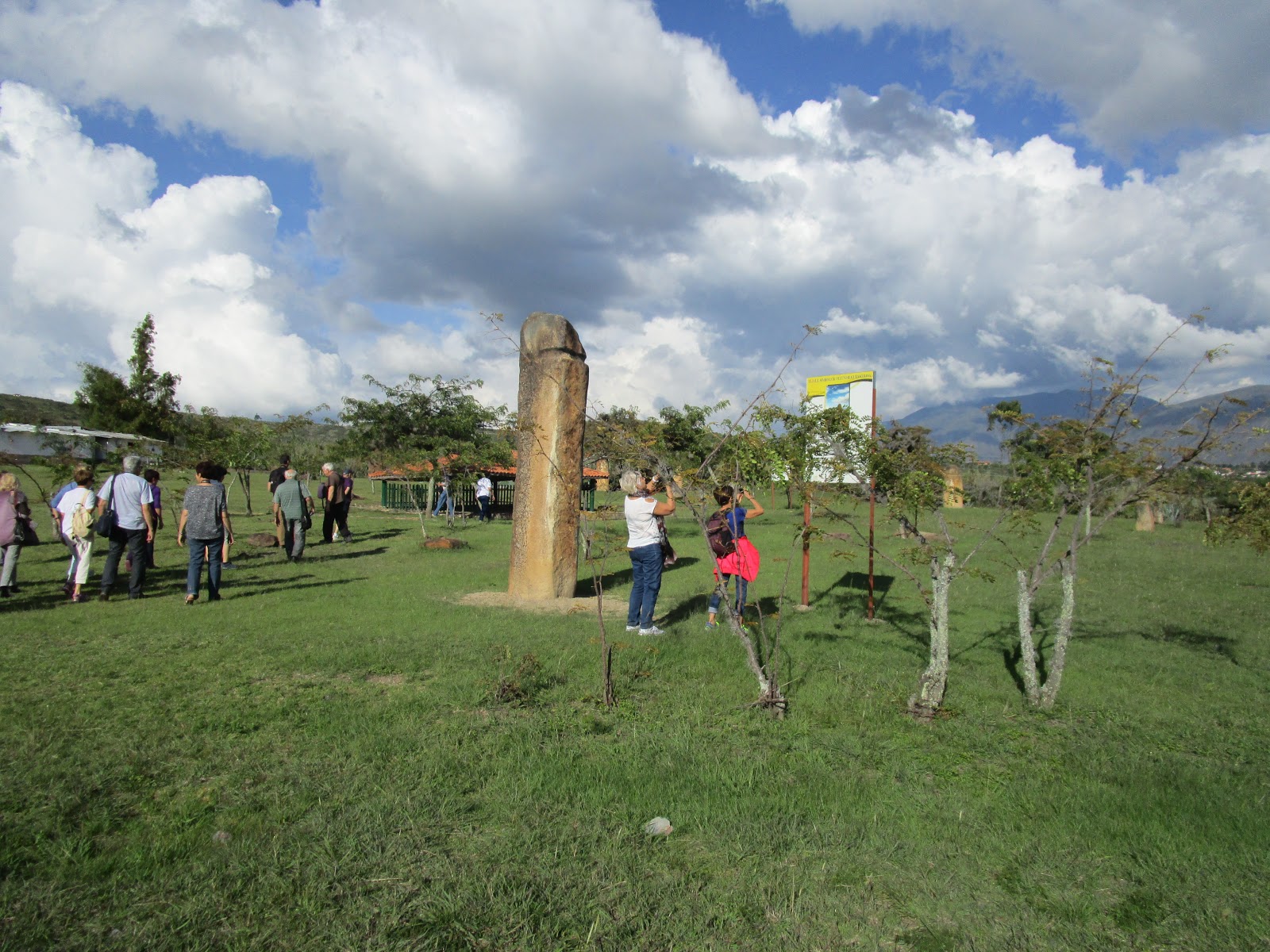
This was at the end of a long day visiting all of the sights worth seeing in the general area. And there were so many! The giant fossil and its two museums. The winery. The monastery. And, of course, the field of giant stone phalluses. (I had visited the Terra Cotta House the previous day.) Villa de Leyva is the perfect tourist town. And part of the charm is that all of the other tourists are Colombian, for the most part. U.S. tourists are very scarce. So it's not a "tourist-y" thing to go to a tourist town and see all the tourist sights when all the other tourists are local to that country. And even if it were "tourist-y," so what? It's a great place to go.

Visited November 2018.

Saturday, May 9, 2020

Phot-o' the Day: Casa Terracota; Villa de Leyva, Colombia


Casa Terracota in Villa de Leyva, Colombia, is a house ... made out of terracotta. Inside and out. It looks like what would have happened if Antoni Gaudi, the famous Spanish architect, had been hired to do set design for a Flintstones movie. I'm not sure of the purpose of prostrate mannequin in the foreground. It's art.

Villa de Leyva is a four-hour bus ride north of Bogota. It is so worth the trip.

Visited November 2017.

Sunday, February 9, 2020

Sunday Church Phot-o' the Day: Convento de Santo Ecce Homo, Villa De Leyva, Colombia


Sunday is the day to post photos of churches.  Today's Sunday Church Photo is from the Convento de Santo Ecce Homo, just outside Villa De Leyva, Colombia.  I visited there in November 2017.

The monastery dates back to 1620, the same year that the Pilgrims stepped foot on Plymouth Rock.  This is the monastery chapel.  It's a little more recent than that, but, I believe, only a little more recent.  It is a beautiful combination of ornate and simple.

The monastery grounds are one of the major historical sites in Colombia.  It is located on the road somewhere between the Vineyard Ain Karim and the field of giant stone phalluses (phalli?) that is politely referred to as the "Observatorio Astronómico Muisca," an "astronomical observatory."

Thursday, November 23, 2017

The $150,000 Tour of Villa De Leyva: Parte Cuatro: Descent into Hell

Yes, this is supposed to be exactly what you think it is.
Now stop you sniggering.
The final stop of the day:  El Infiernito.  "Little Hell."  So called because of the scandalous nature of the statuary found here.


The official fancy-fancy name is:  Parque Arqueológico de Villa de Leiva Observatorio Solar Muisca.  The Villa De Leyva Archeological Park of the Muisca Solar Observatory.  Some say it's a solar observatory.  Some say it's a field of giant phalluses.  To-may-to.  To-mah-to.


The front part of the park is more "solar observatory" like, with the stone columns lined up for some purpose.


"Solar observatory" for the indigenous Muisca people is a very plausible theory.  But the rest of the park isn't quite as "solar observatory" looking:


Ode to a Phallus:


Translation from the sign, rather obviously, is "The Phallus: Symbol of Male Fertility."


The Muisca weren't shy about showing what they were honoring.


When I saw this huge field filled with giant phalluses of multiple shapes and sizes, I was thinking: There were tall ones, short ones, fat ones, curved ones:


Just like the old song "Spill The Wine," only about giant stone phalluses.  And I do mean giant:


When the Spanish first discovered this field of phalluses, they were scandalized.  They named the place "El Infiernito," Little Hell, because in their mind that was where whoever was responsible for this most likely was now living.  This one was knocked over.


So, yes, while some of the phalluses are standing erect, some are just lying around.  Flaccid.


If this was a solar observatory, then it should be dubbed Phallus-henge, or maybe, Stone-Penis-Henge.


I was at the park at the same time as a group of French tourists (bus tourists) who were getting a guided tour.


The French are more sophisticated about this sort of thing.


And here is a car driving among the stone penes.  If it had been a sports car, say a Corvette, the metaphor would've written itself.


And it's time to bring the saga of the $150,000 tour of Villa De Leyva to a close.  I need a cigarette and a snuggle.


And the Villa De Leyva portion of this trip ends with a night time visit to the Plaza Mayor:


Tomorrow it is back to Bogota.


The $150,000 Tour of Villa De Leyva: Parte Tres: Heaven, then Hell

Courtyard inside the Convento del Santo Ecce Homo
Next stop on the $150,000 tour is a place that will take us a little bit closer to heaven, the Convento del Santo Ecce Homo in nearby Sutamarchán.


Santo Ecce Homo is a monastery consisting of a church, friar's quarters, and a cemetery, dating back to the 1600's.

Church first:


This is the altar:


And this is the chapel to the side of the altar:


And now heading back out of the church:


The monastery complex is under renovation, although it does look good for its age.


Courtyard:


Now to explore the friar's quarters.  This room is being used to store a lot of stuff.  Religious stuff.


Continuing:


I thought these yoked bulls were cute:


Confessional and chalices stored in another room:


Dining room:


This was a weird room.  It was filled with some weird stuff:


Such as this bit o' the creepy:


Again, more of the renovation:


Cemetery:


Considering that this place dates back to the 1600's, I was surprised how recent the graves were:


Exiting the cemetery.  To the light!


And then it was time to head off to the final destination of the day.


Wednesday, November 22, 2017

The $150,000 Tour of Villa De Leyva: Parte Dos: Viñedo Ain Karim

A photo shoot about to happen in the merlot field.
It's always the merlot field, never the shiraz.
The $150,000 COP tour of the surrounding environs of Villa De Leyva continue with a trip to a real, actual working vineyard and winery that produces drinkable wine:  the Viñedo Ain Karim in nearby Sutamarchán.

Joining me for the tour were these four ladies all originally from Cartagena de Indias, Colombia:


Actually, I joined them.  They volunteered to serve as my translators for the Spanish language-only winery tour.  They also bought me wine and cheese.  How could I say "no," or, to use the Spanish, "no."  Mil gracias!
 

This leg of the tour around Villa Del Leyva started with a drive up the winery driveway.


The tour started promptly because a big bus load of tourists was scheduled to arrive soon.  This bus tourism seems to have caught on big here in Colombia.


Our tour guide provided lots of information on the history of the winery, which my translators (on the left, above) were able to tell me about.

We saw the processing room where the grapes are crushed, using machinery instead of women's feet.  Women were the preferred grape crushers in years past because women weigh less and, therefore, were less likely to crush the seeds.


We visited the wine cellar:


The scale is much much smaller than those giant Port cellars I saw in September.

It was a short tour, even with the translating happening for me, maybe because of the impending deluge of bus tourists.  Soon we reached the point that is the highlight of every winery tour everywhere.


Tasting.  It was not bad.  The white had a nice tartness to it.  The cabernet was as good as any Three Buck Chuck cabernet, maybe better.  It won an award.  In Israel.  I know.  Israel hasn't been much of a player in the winemaking field since the Wedding of Cana.  But it was an award.  The white did win a silver medal in Brussels, which may be a little more prestigious.  Although Belgium is beer country.  Just sayin'.


Cheers!