|
| Nicolaus Copernicus, sphere in hand, stares down the Royal Route from atop his perch |
Warsaw is very evocative. We all have pictures in our mind of what Warsaw would be like. And those pictures, whatever they are, are wrong.
What are you images? Drab? Depressing? Oppressive? Dark? Destruction? Emotionless? None of the above!
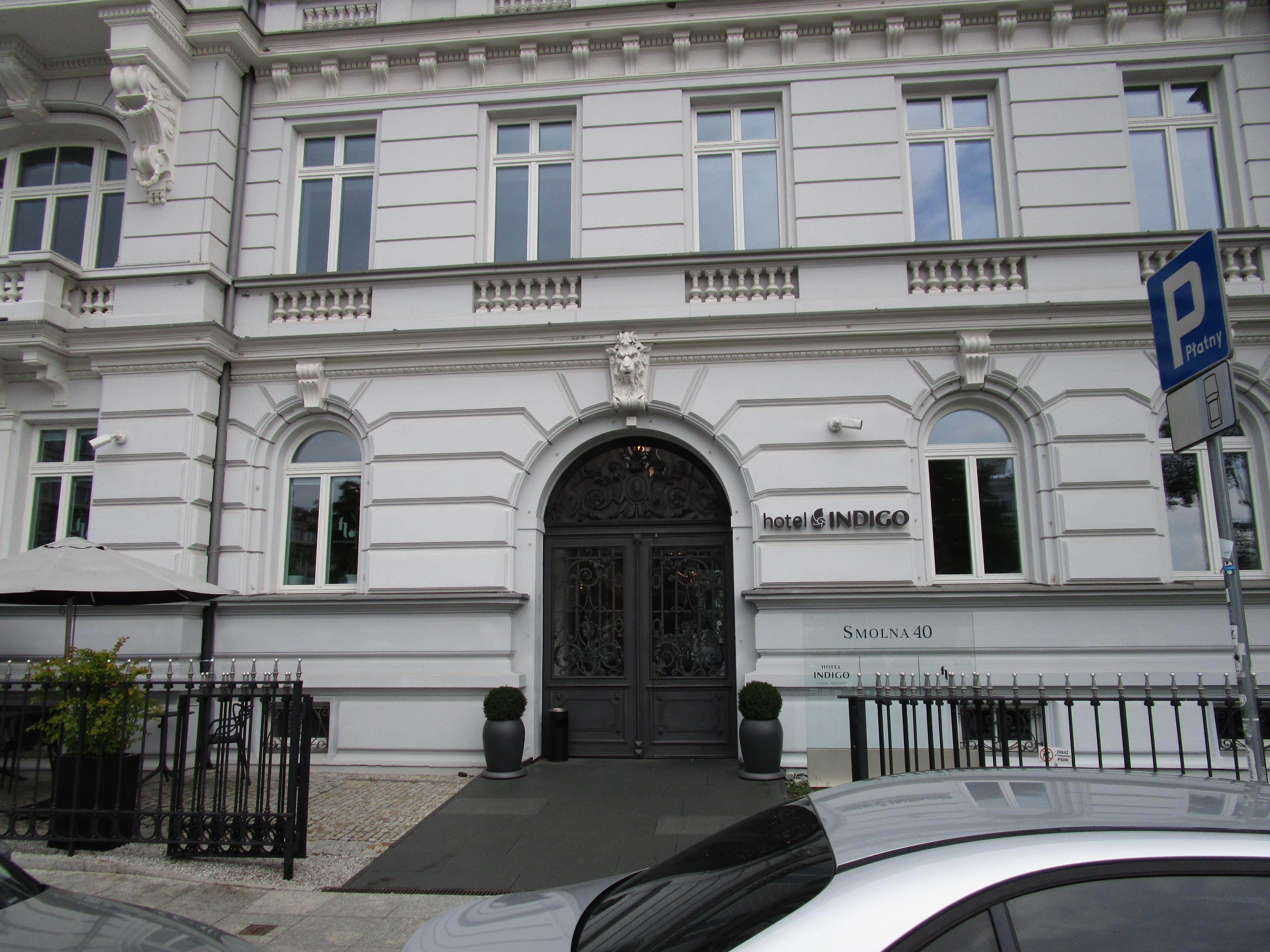
I am staying at the Hotel Indigo, which is an international chain of hispter business class hotels. I'm staying here not because I am a hip international businessman, but because of the central location, right on the Royal Route, a mile south of Old Town, but in the heart of international business Warsaw.
There is interesting statuary all over Warsaw, as I could see from my taxi ride in from the airport (named for Polish composer Chopin) and my short walk about town this afternoon.
August 1 was an interesting day to be in Warsaw:
Why were all these people (and a movie camera) at the intersection in front of my hipster international business chain hotel? It is an interesting intersection, as it has both the Jerusalem Palm:
This is a metal statue of a date palm created by a Polish artist to commemorate Warsaw's Jewish communities (and, as an aside, maybe no Jewish community anywhere -- not even in the Holy Land in Roman times -- has suffered like the Polish Jewish community in Warsaw), And, right across the street, Aleje Jerozolimskie (Jerusalem Avenue) is a big ol' Charles de Gaulle.
But that's not what was going on.
Lots and lots of police and police cars. The police seemed to be there "just in case," as opposed to reasons of crowd management, as there was no traffic, to speak of, on the streets. At precisely 5:00 p.m., at least at this intersection, the fun began. Loud amplified speeches (in Polish) (I have no clue what was being said) (it is a bit of an impenetrable language). And smoke cannisters releasing red and white smoke.
Red and white being the colors of the Polish flag.
And there were lots of flags on the streets. What was going on? Here is all I know. All of town, they were commemorating the 77th anniversary of the Warsaw Uprising. The Warsaw Uprising is a horribly tragic (and heroic) moment in Poland's World War Two fight. Guerilla fighters poured into the streets to fight the weakened Nazis, hoping that the nearby Soviet Red Army (camped across the river) would aid them in throwing the Nazis out of Warsaw. The Polish fighters were slaughtered. Then, after the Polish rebellion was quashed and the Nazis exhausted with their victory, the Red Army swept in and "liberated" Warsaw.
Let's talk about happier history. Copernicus,
I decided to take a stroll north of the intersection (not sure if there were Warsaw Uprising goings-on elsewhere in the city) (there were). This is the Copernicus Monument, on the Royal Route. He is in front of Staszic Palace. This was one of the only statues of Polish heroes not destroyed by the Nazis during their occupation of Warsaw.
The Nazis considered Copernicus to be German.
And lots of police on the Royal Route heading northward. This is the Church of the Holy Cross.
It was not open for a tourist look-see, due to the Uprising.
These are the gates of the University of Warsaw:
I met a young scholar sitting on a bench:
Who is he? Why is he there? Maybe I will find out on tomorrow's walking tour. And here are four burly beefy Polish men holding up a building:
Church and statue of religious figure:
But of course THE religious figure in Polish history is Saint John Paul:
This cross was erected in commemoration of Pope John Paul II's visit to Warsaw in 1979.
This is Pidulski Square. It is packed with monuments and memorials, such as this monument, the Pomnik Ofiar Tragedii Smoleńskiej 2010:
This is the memorial to the Smolensk Air Disaster, an incident in 2010, where the Polish President, Lech Kaczynski, and a large number of very high-ranking Polish officials were killed in a plane crash near the Russian City of Smolensk. They were attending ceremonies commemorating the 70th anniversary of the very notorious Katyn massacre when the Soviets 22,000 (give or take) Polish intellectuals and military leaders in the Katyn Forest.
There is a lot of tragedy in Polish history. A lot.
Getting back to happy thoughts, the square opens up into a very large park.
There was even a man making soap bubbles and lots of little kids running after the bubbles.
The square also contains Poland's Tomb of the Unknown Soldier:
But a tourist site nonetheless. Just like our Tomb of the Unknown Soldier in Arlington cemetery outside Washington D.C.
This is the statue of Adam Mickiewicz. Who's that?, you ask. You got google.
And there were a bunch of ping pong tables out on the street for people to play.
Was this a special "only today" or "only this weekend" thing? I'll find out. But who doesn't love a game of table tennis out in the open air?
I finally reached Old Town Square.
Full disclosure: Warsaw's Old Town is not old.
It was rebuilt after it was completely (as in "totally") destroyed by the Nazis in World War Two, It was rebuilt to look just like it did.
This is the famous Sigismund's Column, marking the entry into the Old Town.
And I believe these are castle walls. Let's have a look-see.
Why, yes, this would be the Jan Kilinski monument you see:
And this is the very famous statue of the Little Insurgent, a monument to the child-soldiers who fought for Poland throughout its history.
No surprise this would be a VERY popular gathering spot on a day like today.
Always have to photograph one of those when you see them. This was, surprisingly, the old hansom cab I saw in Old Town Warsaw. You would think the place would be lousy with them.
And, to end the walk, I went looking for the Warsaw Uprising monument. I found it.
I couldn't get close because of the thick crowd.
And this crowd (and the police presence around the monument) was a little different. The police had riot shields for example. I didn't think anything would happen, but if it did, it would happen instantaneously. And since this was the one place the police thought they needed to display riot shields, I thought it best not to linger.
So I visited this old gentleman:
It was now suppertime in Warsaw, my first night in Poland. What to eat?
It's Poland. So it's pierogis.
I couldn't decide between savory or sweet, so I had both. The savory were served first. This was an assortment. The best flavor? Forest mushroom, without a doubt. The mushrooms were incredibly flavorful.
I could not get an assortment for the sweet, as they only had blueberry.
The blueberries were a bit tart for me and I really like tart fruit.
So my first night in Poland is in the books. Poland is now the 34th country that I have visited. Country #33, the Netherland, also went into the books this trip because, on the flight here, I had a layover in Amsterdam's Schipol airport (and I count airport layovers, especially when there is a passport stamp, as there was here).