|
| Only a bit more run-down than the Coliseum in Los Angeles |
Next on the day's agenda was a walk through the guts of Rome's Colosseum.
The Colosseum is located in the southeast corner of the historic core. Construction began under the Emperor Vespasius in or around 69 A.D.
Precise dates are hard to come by. The Colosseum was built on the grounds of Emperor Nero's colossal estate (pun not initially intended, but intentionally kept) the Golden Palace, Nero was blamed for the massive fire that swept Rome during his reign and confiscating his estate to use the grounds for a public purpose was a way of appeasing the Roman masses during a period of de-Nero-ization.
Eventually all was forgiven with Nero because the Emperor Hadrian, in the early second century A.D., had a colossal bronze statue of Nero (depicted as the sun god Helios) placed next to the Colosseum. The name "colosseum" is derived from "colossus," referring not to the size of the ampitheater, but to the colossal statue, then the largest in the world, bigger than the Colossus of Rhodes, which was one of the Seven Wonders of the Ancient World.
Sports stadium tours are not usually my thing when on holiday, but I thought this warranted an exception. The tour includes a detailed tour of the "underground" section of the Colosseum, where all the interesting engineering and staging took place in ancient times, out of the view of the public.
The underground passages were underneath the main floor. It is here where gladiators and wild animals were moved around before suddenly appearing on the public stage. It is here where the waters were directed for the naval battle re-enactments they would stage on the mornings of game days. Think of this as an early version of Cirque du Soleil's "O."
This is one of the recently discovered channels that brought river water into the Colosseum underground.
I am guessing that the water channels had the added benefit of flushing out the joint since the underground passageways would transport hundreds of exotic animals brought in for display and battles during game days.
The entirety of the underground has only been open to the public in the last year. If you went on a Colosseum tour prior to 2021, you only got to see a small segment of the underground, the area under the recreated game floor, which is this area in the pic above.
This is the "elevator" that would be used to transport animals and gladiators to the main level. It was powered by a team of slaves.
This would seem to have been a particularly unpleasant assignment for a slave. Physically demanding work, in the dark, with poor ventilation, surrounded by hundreds of wild animals, enveloped by their stench and that of your fellow slaves. Awful.
Here is one of the passageways:
We eventually made it to the main floor of the Colosseum.
You can see the underground passageways now fully exposed to the Roman sun.
And here's me, resplendent in my modern-day tourist-gladiator ensemble.
You can see the section of reconstructed main floor at the left of this picture.
The area around the underground elevator would be under that floor.
The seats are all gone now. Most of the lower tier, the expensive seats, were marble and, therefore, were "repurposed" several hundred years ago in the medieval period.
The Colosseum held about 70,000 or so spectators. It was the largest sports arena in the world in its day. Speaking of "arena," fun fact. "Arena" is derived from the Latin word for "sand." It is a reference to the sand that spread around the main floor of the Colosseum to soak up all the animal and human blood spilled during the games.
And if you have a sports stadium seating 70,000, you must have restrooms, no? This was the men's room:
A Roman style "flush" toilet. This was no wilderness outhouse. There was continuous running water to wash away the waste. Where was the ladies' room, you ask? There weren't that many ladies in attendance, but those who were used the bushes outside.
Speaking of outside, this is Constantine's Arch, right outside the Colosseum.
Constantine is the emperor who legalized Christianity and, eventually, made it the official state religion.
This is Titus's Arch:
Titus was the emperor at the time of the destruction of the second temple in Jerusalem. This scene on the arch wall depicts the looting of Jerusalem.
Look closely and you can see a menorah removed from the temple. The other side of the arch depicts a different scene from Titus's career.
We are now in the historic Roman Forum. The bell tower in the background, attached to a nearby church, is not open to the public. Which is a shame. The views of the Forum would be spectacular.
This is the "Palatine Hill" area.
This well-preserved building, now abandoned, was repurposed as a church early in the Christian years of ancient Rome.
This is what is left of Julius Caesar's house off the Roman Forum, I believe.
I could be wrong. It was a long day.
This is the "Altar of Caesar," the site of Caesars funeral pyre.
I was going to add "after he was assassinated," but that goes without saying, no? We would have known if he had been cremated prior to his assassination by "Et tu" Brute and the other conspirators who thought they were killing a tyrant but, instead, were killing the Roman Republic and ushering in an era of dictatorial rule by emperors.
This is the exterior of the altar of Caesar. We then wind back through all of the Roman Forums and we come to this:
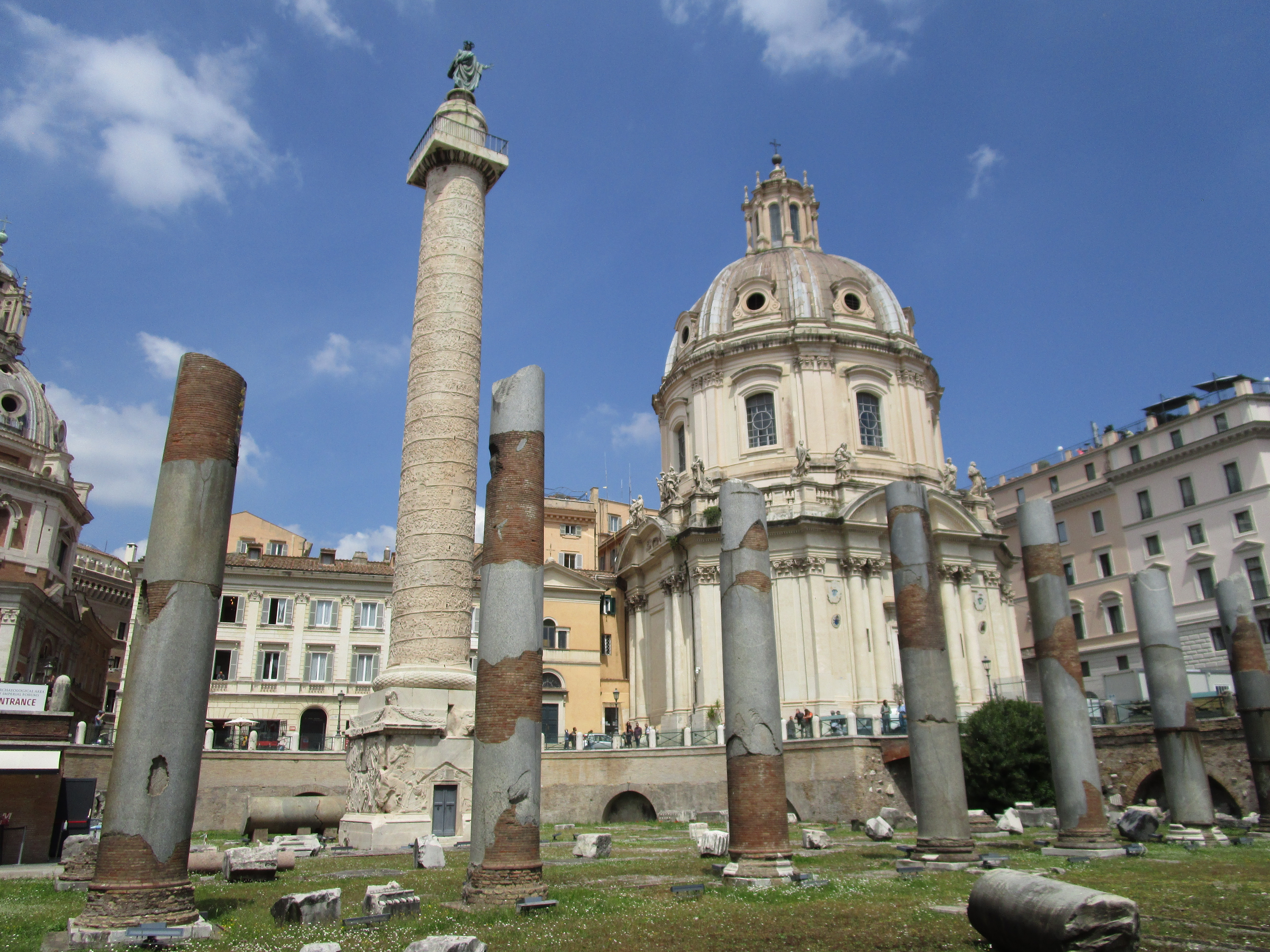
Trajan's Column, approached from the other side. Let's look at the top of the column through the magic of a telephoto lens:
Once a statue of Trajan himself stood at the top of his column. But that's not Trajan. I could tell by the halo over the statue's head. That's St. Peter. Instead of a Trajan.


.JPG)