Powered By Blogger
Showing posts with label victor emmanuel. Show all posts

Thursday, May 5, 2022

Giorno Tre, Prima Parte: the Pantheon

Arriving at the Pantheon in style, in a hansom cab. Well, someone did. Is wasn't me.

My third day in Rome and the first without an organized tour. Scratch that. I did sign up for one guided tour, but that is just a 45-minute English-language tour of the Pantheon.

It never rains in Rome this time of year. But it was a rainy morning in Rome. 


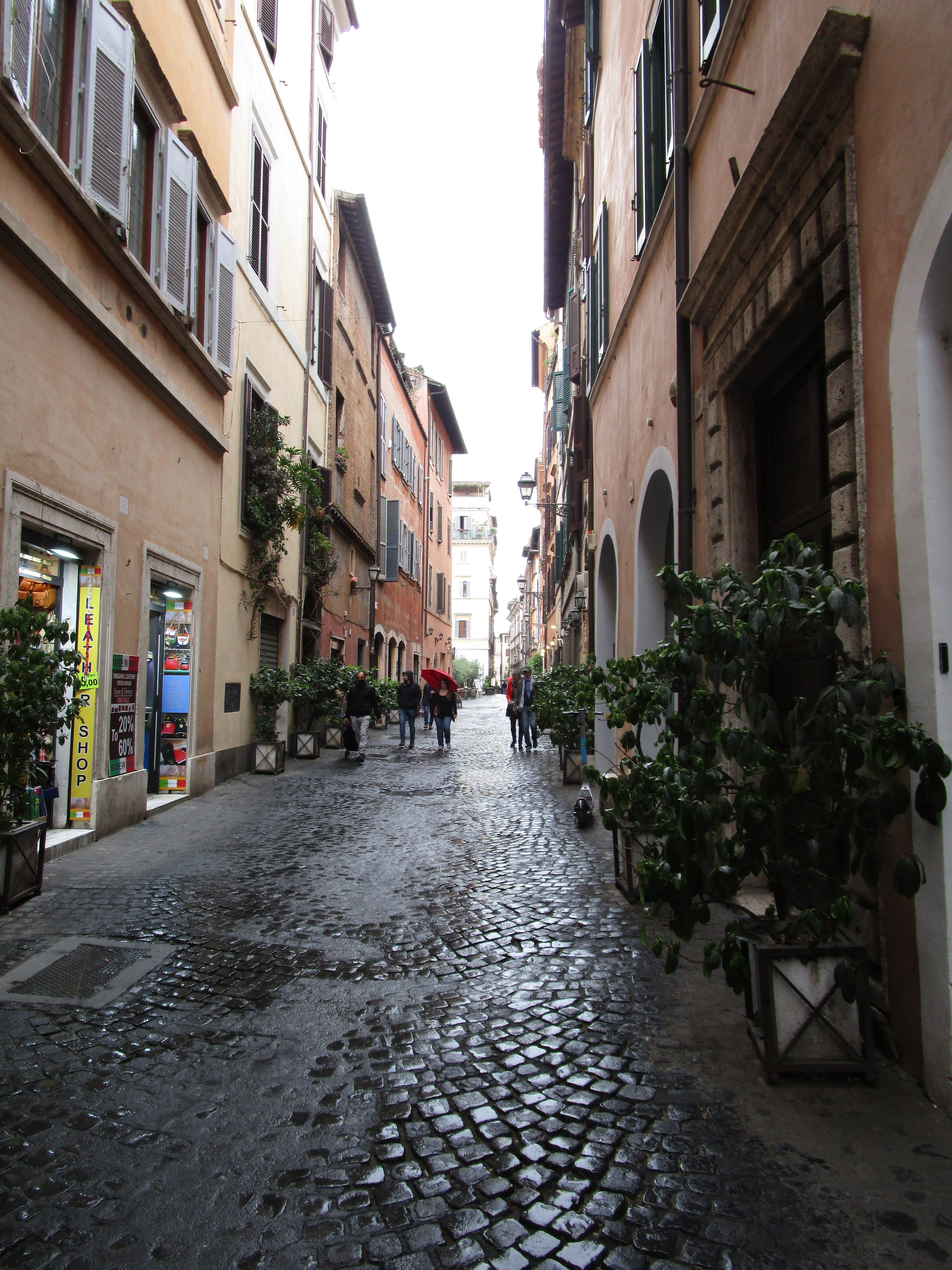
Those stones are even more slippier when wet. I hoofed it to the Pantheon (using my own hooves, not those of the horse and a hansom cab) and it was a surprisingly quick walk.


It too has an obelisk! Rome is lousy with obelisks and I approve. Unfortunately, when viewing the Pantheon from the front, you cannot see its most prominent feature very quickly. Let's look at it from the inside:


The most distinctive feature of Rome's Pantheon is the massive dome. The building is nearly 1800 years old. That includes what Rome bills as the world's oldest dome.


The Pantheon is -- far and way -- the best preserved building from the historic period of ancient Rome.
The interior has been redecorated. The old bronze from the structure built by the Emperor Hadrian (most famous for his wall along the English/Scottish border) is long gone, repurposed for many purposes many times over.


Pantheon means "all the gods" and this was once a temple to all of the Roman gods. Now it is a church to the one God.


The niches were once filled with statues of the Roman gods. Jupiter. Mars. Venus. They're gone. Replaced by religious iconography.

The Pantheon also houses the tombs of a few prominent inhabitants of the Rome of the more modern era. The artist Raphael is buried here. He died while painting the great works of art in the Raphael rooms in what is now the Vatican Museums. And here is the tomb of the first king of Italy, Victor Emmanuel.


He was the first king of a unified Italy since the fall of the western Roman Empire. And yet his name, officially, is Victor Emmanuel II. What's up with that? He reigned from 1861 until his death in 1878. He was succeeded by his son, the second king of Italy, Umberto I. Italy had only four kings until it reverted once again into a republic. Yet they used only two names: Victor Emmanuel II, Umberto I, Victor Emmanuel III, and Umberto II. Umberto I also is buried in the Pantheon, 180 degrees across from his father.


The Pantheon is used for Catholic mass on Saturdays and Sundays. It is closed to the public when mass is in session.


What was cool about the fact that it was raining is that some of the rain does come through the "oculus," or "eye" of the dome. 


There even are holes in the floor for drainage. There is four of them.

Which god was in this niche before?


I don't know. But the Pantheon is one single room, so a 45-minute guided tour was enough to see it all and learn everything about its backstory that I am capable of retaining. Time to move on to my next scheduled stop.


The crowd outside got bigger when I was inside. The tourism drought most definitely is over in Rome.

I wasn't very far from the Pantheon when I saw the giant landmark that would guide me to my destination. Straight ahead, just down the street ...

It's the gigantic Victor Emmanuel monument, off in a short distance, between the buildings on either side of the street (Via Del Corso, if you're keeping score). And we were just talking about him. My next stop is supposed to be behind that monstrosity.


Wednesday, May 4, 2022

Going 2000 Years (Or So) Back in Time: Part Uno: Walking to the Colosseum

Bridge over the River Tiber

Today I finally crossed the Tiber.


I know it's not as dramatic as Julius Caesar crossing the Rubicon, but the Tiber is a bigger river. (Apparently the Rubicon is a shallow creek even in Caesar's day. It was notable only because it was the boundary between Rome proper and what was then Gaul.)

I left St. Peter's in my rear view mirror (figuratively) (given that I was walking and had no rear view mirror). I passed the Castel Sant'Angelo, which is nearly 2000 years too. And I crossed the Tiber.


Rome straddles the Tiber. But just about all of the historic sites from the era of the Roman Republic and the Roman Empire are on the east side of the Tiber. The Vatican is the only notable tourist site on the west bank of the Tiber.


And the Tiber sits really low. They built Rome comfortably above the river because the Tiber, while it may be small in appearance, apparently floods like the Nile or Mississippi.


As an aside, when you walk along the Tiber, people are hawking river cruises. My impression is that this would be a terrible city for a river cruise, since the city sits so far above the river, I can't imagine seeing anything. It would be like floating along in the bottom of a well. But, then again, river cruises aren't my thing. Actually, no cruises are my thing.


Despite the streets of Rome being laid out somewhat haphazardly, I was able to chart a clear pathway to my first destination on my walk to the Colosseum. Piazza Navona.


Piazza Navona is known for three fountains, an obelisk, and plenty of great restaurants along its perimeter. I wasn't hungry. But I love a good obelisk. So let's enter the piazza.


At the south end is the Fontana dei Moro. Fountain of the Moor.


There is a lot more Moors in Rome than I expected. There's the restaurant I ate at last night, Quattro Mori. And there's this fountain. That's two. And that's a lot more in the way of Moors than I was expecting.


Next up, at the center of the piazza, is the Fontana dei Fiumi, which translates to "Fiumi Fountain."


This is a fountain, but the obelisk is the star of this show. Not the water.


And, speaking of water, the final fountain is the Fontana di Nettuno, which translates to the Fountain of Neptune.


I headed back of my path to the Colosseum and, much sooner than I expected, I reached the enormous Victor Emmanuel Memorial at Piazza Venezia.


Victor Emmanuel is the one who unified Italy into a single nation for the first time since, well, the Roman Empire.


The memorial is huge. Climbing it is possible. For others. Not for me.

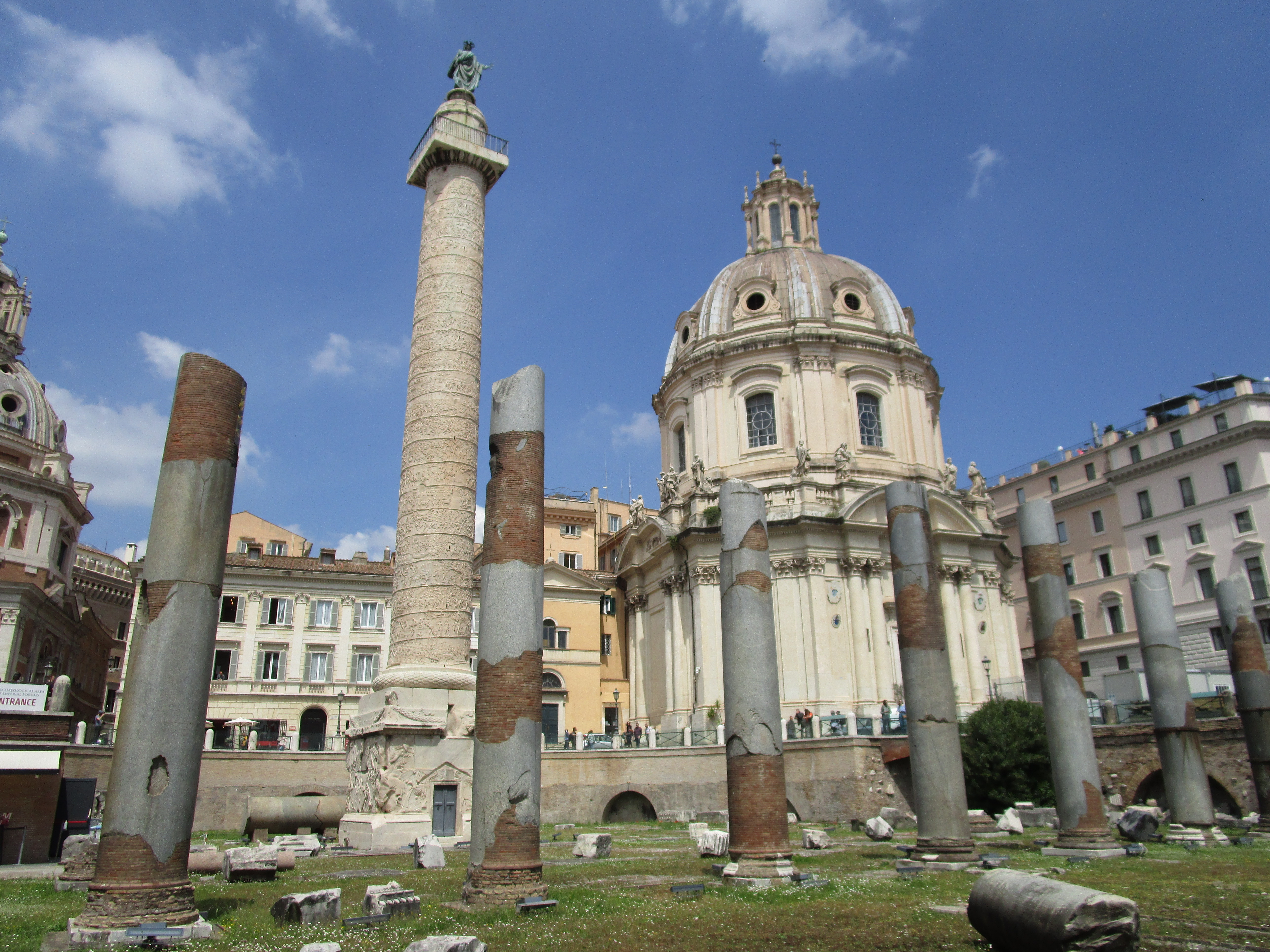
I thought I must be getting close to Trajan's Column and, sure enough, there it was.


Colonna Traiana. He was an emperor (I believe) (I could look it up) (so could you) in the second century A.D. The column was erected in honor of his conquest of Dacia, which is modern day Romania.


We are now in the Foro Traiano. Trajan's Forum.


The Roman Forum was slowly migrating in a northwesterly direction from the original Julius Caesar-era Forum.


The forums generally are in ruins.


It was a long time ago and this is earthquake country, after all.


It's even more interesting how much is still standing.
 

From Trajan's Forum you pass into Augustus's Forum, Foro di Augusto, to Caesar's Forum, Foro di Cesare, then, finally, to the pre-Ceasar Roman Forum.


All the monumental ruinization! (That's a line from a John Oates song among the Daryl Hall and John Oates songs.)


But, soon, I looked up, and there was the Colosseum.


I have arrived at my destination.