Powered By Blogger
Showing posts with label pantheon. Show all posts

Thursday, May 5, 2022

Giorno Tre, Prima Parte: the Pantheon

Arriving at the Pantheon in style, in a hansom cab. Well, someone did. Is wasn't me.

My third day in Rome and the first without an organized tour. Scratch that. I did sign up for one guided tour, but that is just a 45-minute English-language tour of the Pantheon.

It never rains in Rome this time of year. But it was a rainy morning in Rome. 
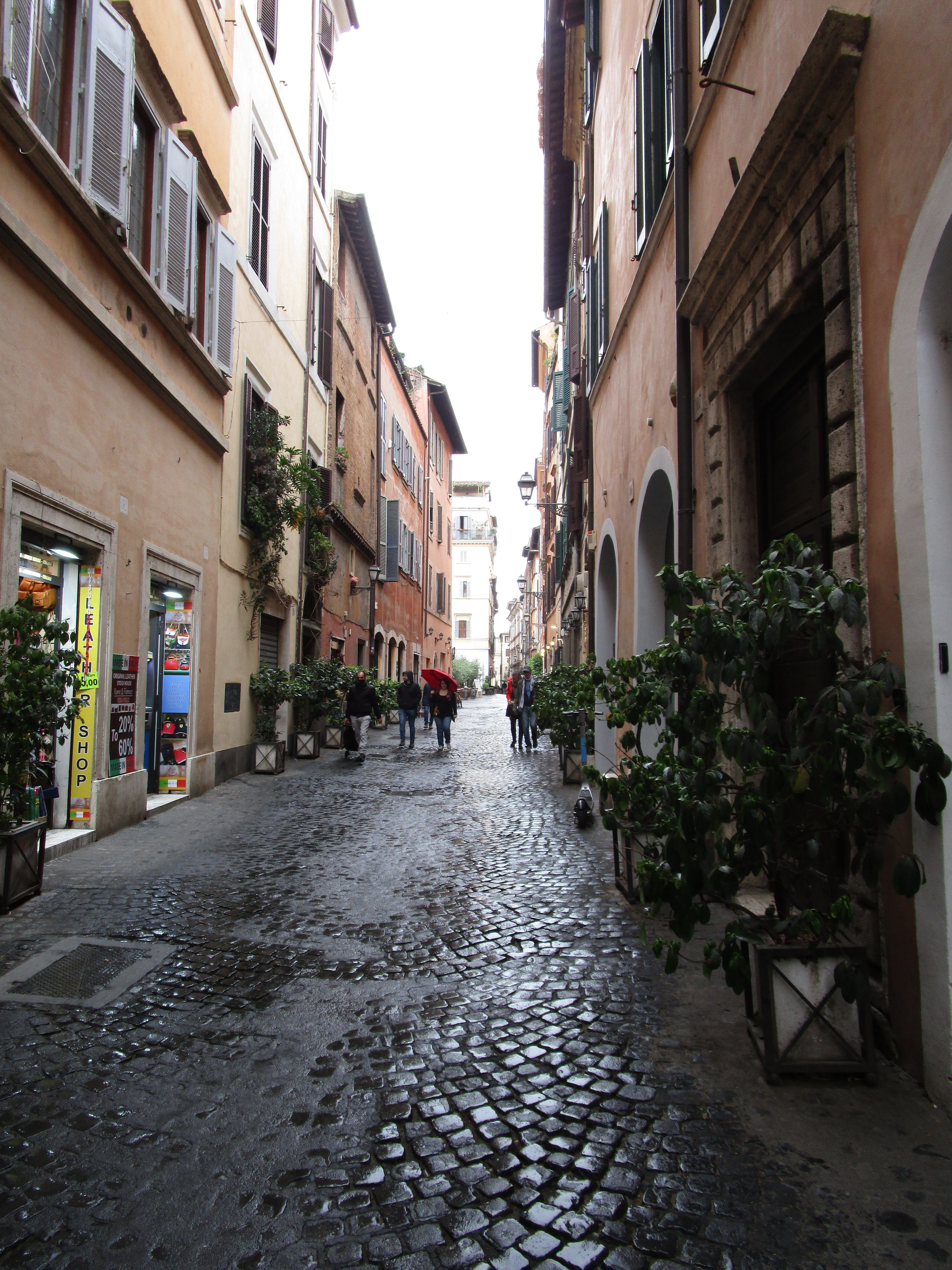

Those stones are even more slippier when wet. I hoofed it to the Pantheon (using my own hooves, not those of the horse and a hansom cab) and it was a surprisingly quick walk.


It too has an obelisk! Rome is lousy with obelisks and I approve. Unfortunately, when viewing the Pantheon from the front, you cannot see its most prominent feature very quickly. Let's look at it from the inside:


The most distinctive feature of Rome's Pantheon is the massive dome. The building is nearly 1800 years old. That includes what Rome bills as the world's oldest dome.


The Pantheon is -- far and way -- the best preserved building from the historic period of ancient Rome.
The interior has been redecorated. The old bronze from the structure built by the Emperor Hadrian (most famous for his wall along the English/Scottish border) is long gone, repurposed for many purposes many times over.


Pantheon means "all the gods" and this was once a temple to all of the Roman gods. Now it is a church to the one God.


The niches were once filled with statues of the Roman gods. Jupiter. Mars. Venus. They're gone. Replaced by religious iconography.

The Pantheon also houses the tombs of a few prominent inhabitants of the Rome of the more modern era. The artist Raphael is buried here. He died while painting the great works of art in the Raphael rooms in what is now the Vatican Museums. And here is the tomb of the first king of Italy, Victor Emmanuel.


He was the first king of a unified Italy since the fall of the western Roman Empire. And yet his name, officially, is Victor Emmanuel II. What's up with that? He reigned from 1861 until his death in 1878. He was succeeded by his son, the second king of Italy, Umberto I. Italy had only four kings until it reverted once again into a republic. Yet they used only two names: Victor Emmanuel II, Umberto I, Victor Emmanuel III, and Umberto II. Umberto I also is buried in the Pantheon, 180 degrees across from his father.


The Pantheon is used for Catholic mass on Saturdays and Sundays. It is closed to the public when mass is in session.


What was cool about the fact that it was raining is that some of the rain does come through the "oculus," or "eye" of the dome. 


There even are holes in the floor for drainage. There is four of them.

Which god was in this niche before?


I don't know. But the Pantheon is one single room, so a 45-minute guided tour was enough to see it all and learn everything about its backstory that I am capable of retaining. Time to move on to my next scheduled stop.


The crowd outside got bigger when I was inside. The tourism drought most definitely is over in Rome.

I wasn't very far from the Pantheon when I saw the giant landmark that would guide me to my destination. Straight ahead, just down the street ...

It's the gigantic Victor Emmanuel monument, off in a short distance, between the buildings on either side of the street (Via Del Corso, if you're keeping score). And we were just talking about him. My next stop is supposed to be behind that monstrosity.


Monday, August 10, 2020

Digitized Analog Phot-o' the Day: National Pantheon of Heroes; Asunción, Paraguay

El Panteón Nacional de los Héroes, the National Pantheon of Heroes, in Asunción, Paraguay. Many Paraguayan national heroes are honored and interred inside.

I visited Asunción in late 1997, just when Paraguay was emerging from the isolation and military dictatorships that had been its station since independence in the early 19th Century. Things might have changed over the last two decades, but the only person in all of Asunción I encountered who spoke English was the day shift front desk clerk at my hotel. But it was OK. I went to Paraguay specifically because I wanted to go somewhere no one else I knew went to. Twenty-three years later, I still think I'm the only one I know (in the sense of whether any of us truly knows one's self) who has been to Paraguay.

And I loved it.

Monday, June 13, 2016

Paris Arrival: the Long Walk to Dinner

July Column: Colonne de Juillet

I have arrived in Paris.

Counting "Countries Visited" via the Spretnak method,* France is Country #22 on my List of Countries Visited (counted via the Spretnak method).  Iceland was #21.

My room in the Hotel Des Mines is small.


How small is it?  I have to stand on the bed to get to the closet.


The room was VERY inexpensive.  The place is clean.  It's got that old, frayed look and feel of a place where someone struggling to write a novel in Paris would be found.  I like it.


Walking to dinner last night and quickly noticed how the building all seemed to look like Paris.


Up ahead, in front of the Romanian football fans (evidenced by the large Romanian flag and the fact that Romania had played France in the Euros in the national stadium just north of Paris the day before), is a building that looked interesting,


Turned out, it was.  This is the Pantheon, located within Paris's Latin Quarter,  We were walking through the Latin Quarter to get to a highly-recommended brasserie for an early dinner.  Restaurants are not open at the six o'clock hour.  That would be gauche.  Which you would think would be OK.  Seeing that I'm staying on the Left Bank (which you Francophones know as: rive gauche).


This is the Church of St. Stephen the Martyr, or the Eglise de Saint-Etienne du Mont in the local tongue.  I didn't know it when we walked past it, but I do now.  Jean-Paul Marat is buried in its cemetery.  Marat, as you know, was the guy from the French Revolution who was famously murdered in his bathtub.


Walking north, we soon reached the river.  This was interesting.  You can see hear that the Seine is still a little high and overflowing its banks at this point.  From the Pont de Sully, you can see how high the floodwaters got:


The river is set down below street level.  All that shrubbery along the side was underwater, as it is still caked with mud.  The level of the mud visible on the side wall is fairly high.

We soon arrived at our destination:  Bofinger.


Bofinger is a brasserie, started by a gentleman from the Alsace-Lorraine region of Eastern France,


Beautiful interior, especially under the skylight.


I had the crayfish bisque for an appetizer.  Mmm.  Mmm.  Just like New Orleans.


I had the traditional "sauerkraut" for a main course.  This was a selection of sausages and pork meat on a giant bed of sauerkraut.  This dish was very German, which makes sense since the food was "Alsace Lorraine" and not French per se.  Delicious,  Bur very filling,
__________
  * The Spretnak method allows countries visited only during a flight layover if there either was commercial interaction (i.e., you bought something in that country) or you were subject to law enforcement or needed approval of authorities to enter that country (i.e., your passport was stamped by passport control or border authorities).  This method allows me to include Switzerland (bought souvenirs, passport checked and stamped) and the United Kingdom (passport checked and stamped) among my countries visited.