Powered By Blogger
Showing posts with label maya. Show all posts

Saturday, August 24, 2024

Copan Ruins: the Reason I'm Here

Temple 16 in the Copan Ruins

I like visiting Mayan ruins.

Today's agenda was the primary reason for this mini-vacation: to visit the Copan Ruins in Honduras. These ruins are just over the border from Guatemala and are not really visitable from the major cities in Honduras (which aren't that visitable themselves). But the Copan Ruins are visitable as a day trip -- a long day trip -- either from Guatemala City or San Salvador, I've been to Guatemala City. And it's slightly longer, even though it involves crossing only one international frontier. So I opted to visit from a place I had not yet been to, but which I thought would be interesting.

So I booked a tour -- ended up being a private tour with only me and my driver/guide -- and off we went on a road trip to the Copan Ruins.


 Welcome to the Copan archaeological site, the best Mayan ruins in Honduras and the farthest east and south of the major Mayan sites,


By the way, Honduras is now in the books as my 41st country visited. Years ago, I set my sights on 50 countries visited as a realistic goal. I started internationally-traveling too late in life to get to a number much higher than that. Fifty will be a bit of a stretch, so topping 40 has me happy with that achievement. It took 50 years on the planet to get 10. Then another five to get 20, four to get to 30, them, because of the covidiocy (that's a real word, look it up), it took five to get to 40. That puts 50 in range for my late 60s. Do-able. But there are too many places I've been I want to go back to, so going to countries just to check off names on a list is getting less appealing.

But coming to Country #41 just for the Copan Ruins was really appealing.


Very green. It is the wet season.

That is not a hill in the picture below.


It is an as-yet still-unearthed pyramid structure from the Copan glory days. Those were around 200 A.D. to about 900 A.D., although things peaked around 700 A.D. and went into a decline after that.

You can tell this is a pyramid and not a hill because there are carved faces on some of the rocks tumbling down the hillside.


That's not natural.

This is my guide for inside the park: Juan Carlos.


He's a local guide. The driver who drove from San Salvador -- about a five-hour drive -- was resting a well-deserved rest back in the car. She'd been to Copan before, so it was cool.


This is what some Copan maps call "The Grand Plaza."


Some maps don't, so make sure which side of that divide the person with whom you are speaking is on, before you call this "The Grand Plaza."


One way to tell if a decorative feature is a restored original and not a re-creation (RE-CRE-a-tion, not REC-re-A-tion) is that the restored originals have a protective awning, while the re-creations are exposed to the elements because why not.


My guide is pointing out some Mayan numbering with pointed pointing stick. Again, for those of you new to the channel, in the first millennia A.D., the Mayans were one of only two civilizations on the planet with a zero in their numbering system. The other was India. Weirdly enough, the Mayan counting system was not base-10, like most of the cultures on this planet. It was base-20. Meaning: the Maya used their fingers and their toes both to count, not just the fingers.


Because it was a Saturday, there was something of a crowd here. But it was not "crowded." But it was not like my team in the pre-eminent Mayan ruins site -- Tikal in Guatemala -- during the Year of Our COVID 2021 -- when everything in the world still was closed. And I visited one of the few countries on the planet at that time -- Guatemala -- and when I got to some of the most impressive ancient ruins I've ever seen anywhere -- in the midst of this massive archaeological site -- there was only my guide and me. This was a little more crowded than that.


Stela!

Please read that in a Marlon Brando voice. (A "stela" is an upright stone memorial marker. A "stella" is the wife of a drunk guy played by a young Marlon Brando. Just so you know the difference.")

This is an altar honoring the line of kings who ruled over Copan:


It ends with the final king flanked by his father to his left, and the first king of Copan to his right.

These were the royal residences.


The king and the nobles lived right next to the temples and pyramids. The working class had to commute in from the mountain next door.


This is my guide pointing out an important detail with his feather-tipped pointer.


We're now maneuvering ourselves to walk through the tunnels that go through one of the pyramids.


The tunnels were carved out for the archaeologists who were exploring the interior of one of the pyramids after the Copan River suddenly changed course in the 1920s after a major earthquake. The result of the river changing course is that three pyramids were quickly destroyed -- they were not designed to withstand being in a river bed -- and other pyramids were threatened. Archaeologists from the Carnegie Institute -- which apparently was in Washington, D.C., and not Pittsburgh -- were called in to save the pyramids.


The walk to the tunnels reveals more ruinization.


And, again, you know this stela is the real deal and not a recreation because why? The tell-tale awning.


Time to enter the time tunnel.


That's a face.

The tunnels were narrow but not too claustrophobic.


For people prone to that sort of thing. Oh no not me. I love tight narrow confined spaces where you feel trapped as if you can't breathe. I live for that sort of thing.


Lots to see from the tunnel-eyed viewed.


It was a $15 U.S. add-on to the price of admission to get to take the tunnel tour. It was short, and I am a cheapskate, but I say this: if you are going to travel all the way to Copan to see the glorious ruins, you would be an idiot not to spring for the extra few bucks and take a tunnel tour. I wholly endorse the tunnel tour.

Impressive Mayan arch visible here:


Next, to the ball court:


The Mayans -- all Meso-American civilizations for that matter -- all people on planet earth even today in 2024 -- love their ball games. And the Maya of Copan were no exception.

There ball game was a little more reasonable than the variations played in Mexico around this time (which would have not only been pre-hispanic, but pre-Aztec). This was a variation of hacky-sack, only played with a heavy rubber ball. Using your shoulders, hips and thighs, the players had to keep the ball airborne. If the ball hit the ground, you lost a point. If you hit one of the six animal heads on either side of the ball court, you got points. Scoring would have been much easier here than in the Mexico variant, which required hitting a ball through a single small stone hope, raised high off the ground, that was barely larger than the circumference of the rubber ball.

You can see in this photo three of the six animal heads you're supposed to hit to win the kewpie doll.


Stela!


This was a stela honoring the deceased father of the Copan King who built this ball court. In other words, the father got a premier seat in the endzone.

This is the famous Hieroglyphic Stairs:


The hieroglyphics in this stairs functioned as a history book, telling the tale of the history of Copan. Are you having trouble reading them? That's because when the temple was rebuilt after a major earthquake, the stairs were arranged improperly. It's like reading a history text and the binding fell apart and you put the pages together randomly, so suddenly Abe Lincoln was in World War I and George Washington failed to have a plan to right the economy after the Stock Market Crash. But Grover Cleveland was a founding father and hero of the Revolutionary War.

Here's some numbers. Mayan numbers.


Stela! And an alter.


We move next to the Great Stela Plaza:


This one is real. It's under an awning.


This one is a recreation. Exposed to the elements.


And this is a scarlet macaw:


They are plentiful here and they are loud.

More from the Great Stela Plaza:


This is a stela and a giant stone tortoise:


And more stela:


And we end the tour of the Copan Ruins with a solitary cashew tree.


I did not cashew trees made it this far north. Or even north of the equator. But this one did.

Friday, August 23, 2024

First Day in San Salvador: Walking to Two Museums, Uphill

An illustration depicting anthropophagy in ancient tribes.
What's anthropophagy? Read on.

First full day in my 40th country visited. My mood for the day could be best described by those mellow rockers, the Eagles, when they were standing on a corner in Winslow, Arizona, with such a fine sight to see: Take it easy.

It was only a five-hour flight, non-stop, Las Vegas to San Salvador, but first day of a vacation, even in a mini-vacation such as this, requires taking it easy on Day One because (a) while the travel isn't that stressful when it's a five-hour nonstop, even if the seats on the Avianca flight did not recline, prepping for travel is stressful, and (b) I'm old. And don't forget (c): San Salvador is much hillier than it appears to be on google maps. On google maps, the city looks like it would be relatively flat. And while there are hillier cities, this is a hilly city. So two museums is all the touristing I can take for Day One.

This is my hotel for the next five days: the Barceló San Salvador. The neighborhood is upscale:


Modern architecture surrounds me.


As does greenery, befitting a hot, humid city in the tropical latitudes during wet season.

Since we are in the upscale side of town, west of the Centro Historico, the city's major museums are a close walk. And soon we reach the first of the day's two museums: the David J. Guzman National Museum. 


Nicely landscaped.


With some modern art out front:


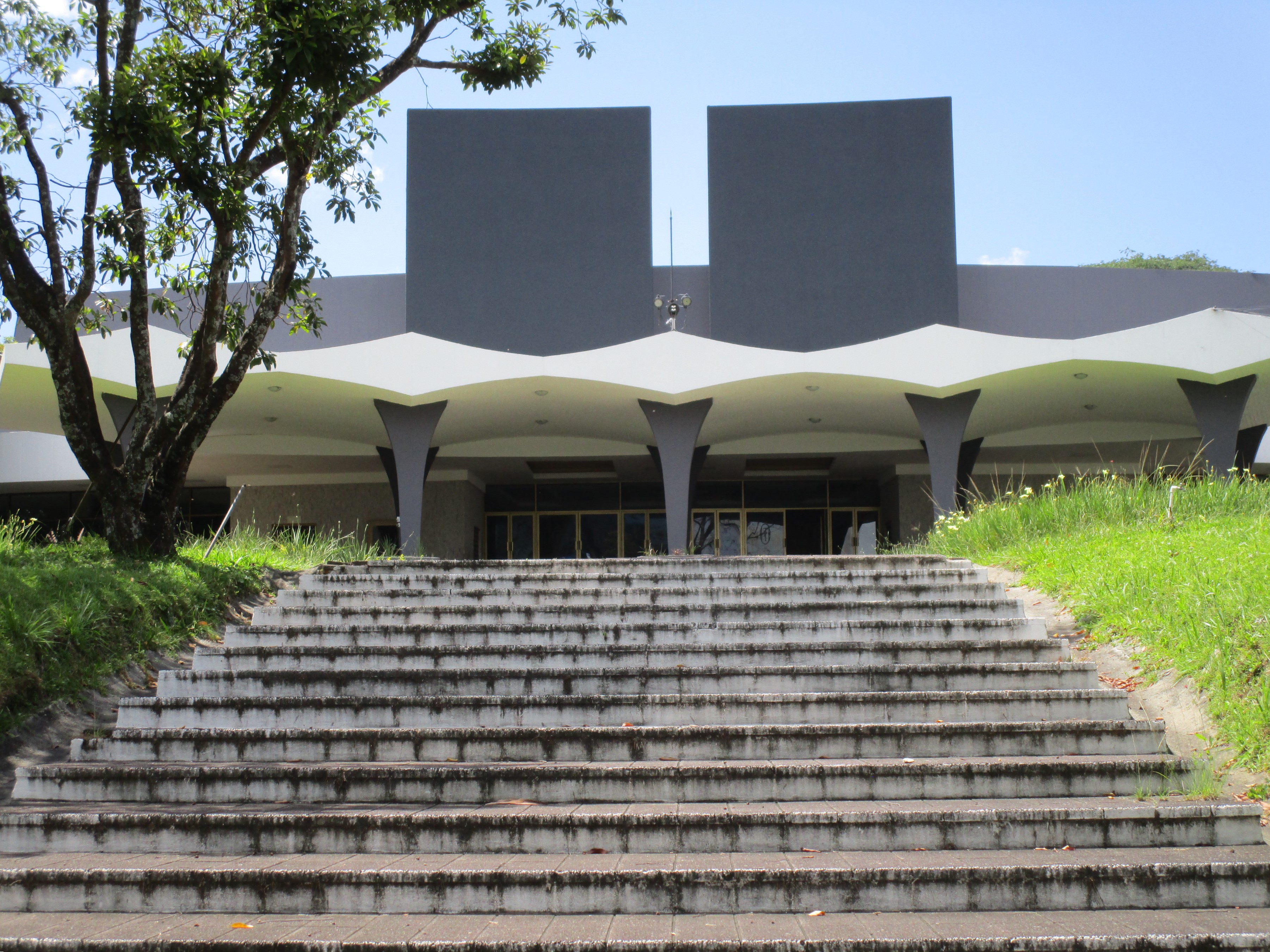
Befitting as the building exterior is quite starkly modern:


But the collection inside is decidedly not modern.


This is, for the most part, am archaeological / anthropological museum, albeit with a few unobtrusive displays of modernity:


More than offset by the archaeological / anthropological side of things:


Again, the modern murals are at a minimum.


Well, this next piece may not have direct archaeological / anthropological significance, but indirectly it does:


This is the original patron of the museum and the original curator of what will be found on this tour: Dr. David Guzman himself. Well, at least a bust of him.

And a bust of me:


Proof that it really is me at the David J. Guzman National Museum in San Salvador and not just me posting a bunch of pictures of San Salvador I found on the internets claiming I took them.


Sorry. The contrast with the bright sun behind this stela made it impossible to see any details.

This is an interesting juxtaposition of ancient and modern:
 

Except the "modern" piece behind the round stone pool is a modern recreation of something extremely important to the Maya:


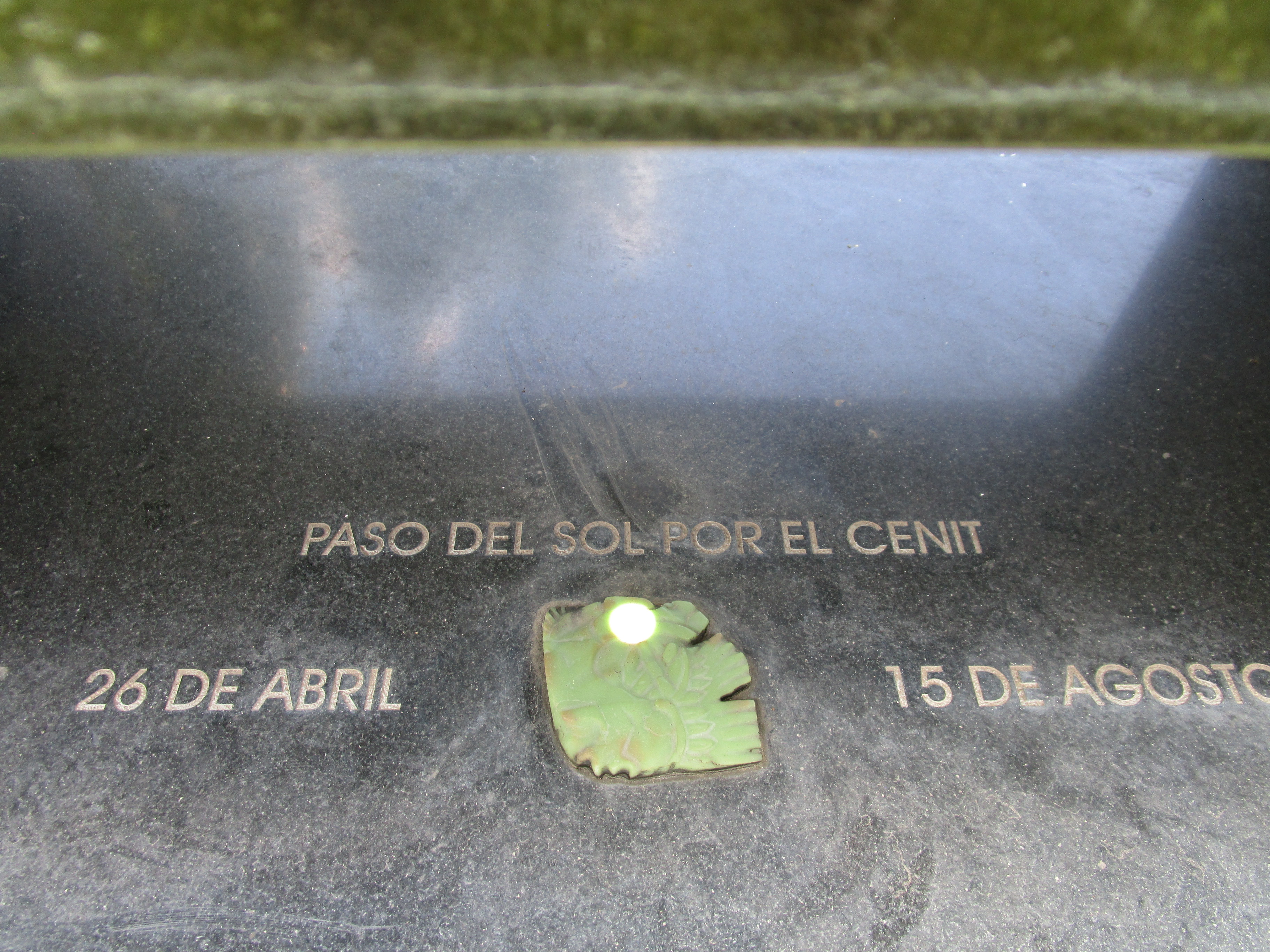
It's a solar calendar.

San Salvador is in the tropical latitudes, between the equator and the Tropic of Cancer. This means that twice a year the sun is directly overhead San Salvador and, between those dates, the sun in this northern hemisphere town is in the northern sky, not the southern sky.


And the key dates, as listed above, are April 26 and August 15, which means I just missed by eight days. To the Maya, these two dates were critically important. The first date? Planting season. The second date? Harvest season. The time in between? The wet season. If you look at the green leaf-like embossing above, you can see a pinpoint of sun still on the green, meaning we are still really close to that date when the sun was directly overhead San Salvador. See this:


There is no shadow on that protuberance standing straight up in the middle. Because it's noon. And below that is the hole that casts the sun circle on the green embossing below.

Back to the museum interior:


But the greenery in the exterior is very nice too:


Back inside:


Here's some jade jewelry:


Jade was very valuable to the Maya, figuring prominently in Mayan fashion and being important in the trade scene.

Now come the illustration of the less savory side of Mayan life.


Above is an illustration depicting human sacrifice. As the exhibit explained, humans were put on this planet to serve the gods and human sacrifice was the way to serve them right back.

Here is an illustration of a line of skulls:


These are the skulls of the sacrificed, pierced by wooden stakes so that can be lined up ... lined up after some anthropophagy. Which means: consumption of human flesh. The people of ancient meso-America did some things of which their progeny prefer not to discuss. But the David J. Guzman National Museum is open about it!


And above is the burial rituals of Nahua people in the post-classical period, which I believe is the later period of the time when years were still only three digits long, but it could be the middle of that first millennium A.D.

And after all this talk of the meso-American dead:


A funerary urn.

And creepy masks:


But then again, masks are always creepy.


Even warthog masks.


And this one may not be a mask, but it is creepy:


Not sure why it's in a dark room with a red light. Perhaps to enhance the creepiness factor.

And less us end our tour of the David J. Guzman National Museum with a modern mural juxtaposed with a more ancient stone carving.


Time to walk uphill:

Plaza Colombia, just southeast of Plaza Italia:


And that's General Santander, who has a couple of states in Colombia named for him. So he must be worthy of a bust in a plaza.

And at the top of the hill we are walking up is this: the Monumento a la Revolucion.


It's sealed tight, but visible in full glory from a distance.

And this is what we walked uphill to see:


The Museum of Art of El Salvador.

And we are greeted by a lady with one horror-movie style rake-hand:


And there's this bit of giant stone:


Again, but only this time with the Google building in the background:


The Museum of Art of El Salvador is the world's preeminent art museum focused on artists from El Salvador. And you didn't know there was such a thing. But without this museum, where would this be found:


"El cipitío," by the artist Salvador Salazar Arrué.


Is it the Louvre? I'll let you be the judge. But national art museums tend to fall into three categories: (1) great museums with some of the world's greatest art, (2) national museums of countries that do not have the art history of France or Italy but were curated by a rich patron who was able to second and third tier works by first tier artists, and (3) national museums focused on the art and artists of that nation and only that nation. This was Category 3. And worth the uphill walk to get there.

Next door to the museum was the Teatro Presidente:


And once the walk finally took a downhill trajectory, here is a chapel in a traffic circle:


Iglesia La Capilla. "Capilla" means "chapel," so this translates to: the Chapel Church.

I spent the rest of the afternoon relaxing the hotel spa, but soon enough it was suppertime.


I chose what I thought would be a brew pub in a neighborhood packed with what were being advertised as brew pub:  Roots Food Artisans.


I should have known by that name it was not going to be a brew pub per se. Are real brew pubs "food artisans"?


It was a nice upscale coffee shop that served alcohol, including a decent beer selection, with upscale variants on bar food. This is the hamburguesa de la amama, which translates to: Amama's burger.


The french fries, lo siento, las papas fritas, were very good, The burger was loaded with "cebolla morada curtida," which after I saw the burger I correctly translated to "pickled red onion." With a parmesan cheese bechamel sauce. Upscale and tasty. $18.15 -- that's U.S. dollars because El Salvador uses the U.S. dollar as its currency -- which is not bad for an upscale gourmet burger washed down with a big ol' German red beer. But I think I'll try some of the more "brew-pubby" brew pubs in the neighborhood next time.

But, as far as my first full day in El Salvador has gone: so far so awesome.