Powered By Blogger
Showing posts with label opera. Show all posts

Wednesday, November 8, 2023

Free Walking Tour of Santiago

Fuente Alemana in Parque Forestal, a gift from the people of Germany (Alemana in Spanish) to the people of Chile.
Just for being themselves. 

Add Santiago de Chile to the list of cities where there are free walking tours. You walk the tour and you tip the tour guide what you think is fair. Sounds socialistic. We will get to that on our walking tour.

First of all, before I begin, let me say this: I was lied to about Santiago de Chile. What you read about Santiago on the internets? Lies. Lies. Lies. Yeah.

This is the Museo de Artes Visuales, or MAVI, or, en ingles, the Museum of Visual Arts. It's right next door to my hotel. I like the entrance. 

Getting back to the lies. On the internets, everyone says that Santiago is dangerous, not safe at all, and there's nothing to do. So I listened to what everyone said and booked just two nights in this city. I am kicking myself (not literally) (I'm not flexible enough to do that) that I did not schedule more time here. It's a beautiful city. Friendly. Clean (except for graffiti everywhere) (but no litter anywhere ever). Relatively inexpensive. This part of the city is quite safe. And there is a lot more to do here than my short amount of time here would allow. 

Anyway: Free Walking Tour is today's topic. And to start the free walking tour, I was to meet the tour guide in the Plaza de Armas. Not here, where this fountain is.

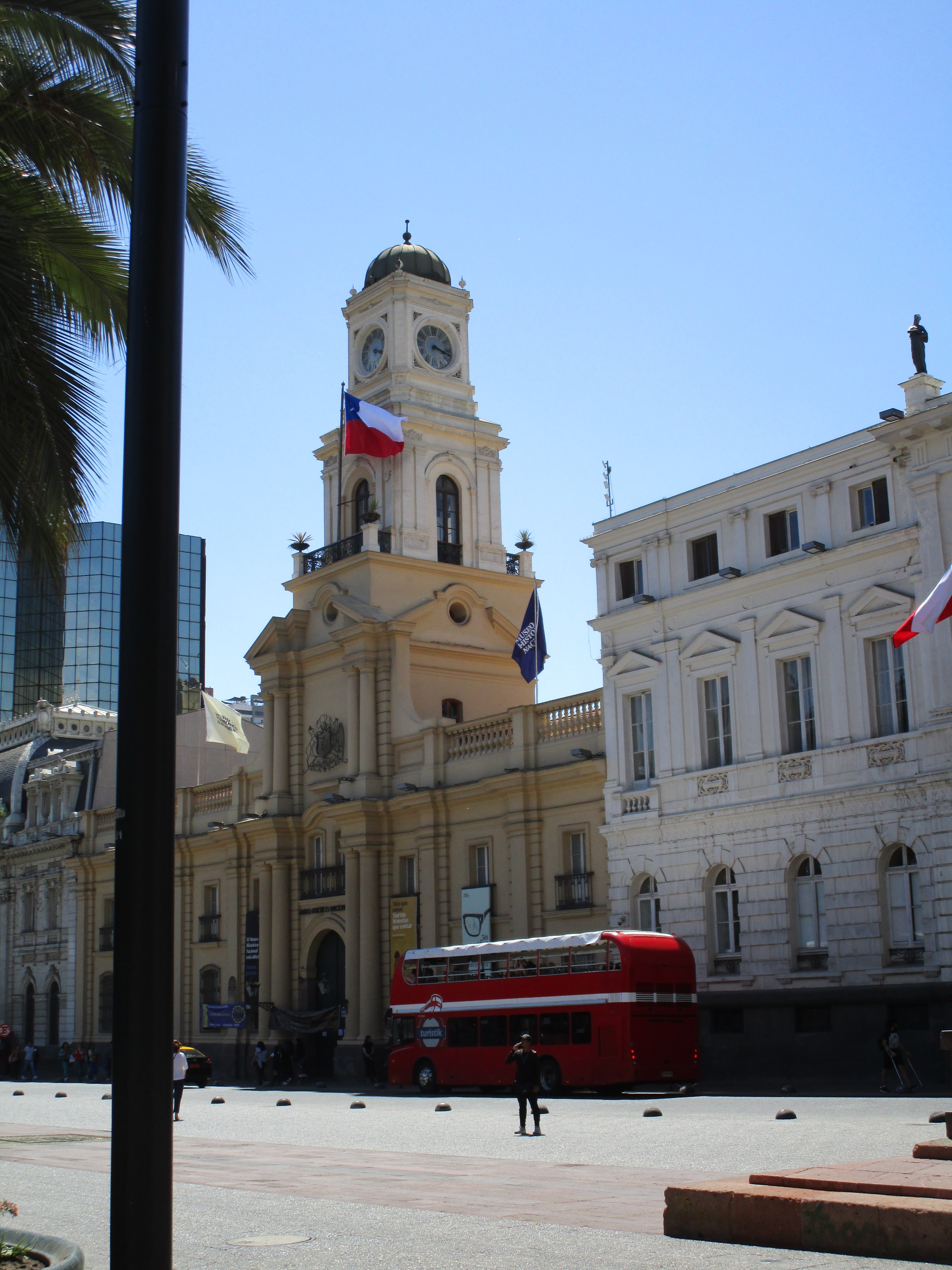
And not in front of the cerrado Museo Histórico Nacional which, as we learned yesterday, is closed due to a strike of museum workers. There is a new black banner in front with some feel-good message about being closed for the good of all. Well, how good can it be for me when I've got just two days in town and the museum workers are on strike both days? What about me? What's in it for me?
Let's begin the tour, shall we?

The tour properly began on the north side of Plaza de Armas, with the city maps embedded into the pavement. This map is from the early years of Spanish conquest. This child is standing in the middle of Mapocho River. In crocs.

The city was built alongside the river, but not because the river is navigable. It's not. It's shallow. Hence the child being able to walk in the river in crocs. But it is a water supply in an otherwise desert climate, so that river water was valuable, even if it was not an early highway in and out of town.

We went into the cathedral, which I did yesterday, and started walking west.

To the Cámara de Diputados, or "Chamber of Deputies." It's now a state government office, but it has served many other governmental purposes over the years.

Case in point: the old city gallows are on the property. You have been warned.

Next we come to Plaza de La Constitución and, across from it, Palacio de La Moneda.

The Palacio de La Moneda, again a governmental building that has been repurposed multiple times throughout its history, now serves as the offices (but not the home) of the Chilean president.


Lots of statues, lots of police, guarding Plaza de La Constitución.


The barricades are temporary because of some event on the grounds of Palacio de La Moneda because of some international women's athletic event in town.

Right next to Palacio de La Moneda, in Plaza de La Constitución, is a statue of this recent, controversial figure.

Recognize him? Clue:

Chile just marked the 50th anniversary of the coup that deposed this gentleman as president of Chile and replaced him with the only military dictatorship in Chilean history, that of Agosto Pinochet. This is Salvador Allende. Both he and Pinochet are still divisive figures in Chile, both still have their supporters in-country, although there are no statues of Pinochet anywhere that I know of. Allende was an avowed socialist, hence the reference to socialism several paragraphs back. He may have been farther left than that. We don't know for certain. He may have been plotting to take over the government permanently. We don't know that either, although we do know that was a justification given for the coup at the time. But Allende's star is on the rise in Chile right now, with a left-of-center government having been recently elected.


Less controversial topic: this is a beautiful building with a green dome, right next door to Palacio de La Moneda.

And this, I believe, is El Monumento al Presidente Manuel Bulnes Prieto


He's astride a horse, so we can guess his presidency is much farther back in Chilean history than that of Allende and Pinochet.


I looked it up. This attractive building with the green dome is a Santiago municipal building.

And this is reverse side of Palacio de La Moneda.

 
Fewer flags. So we know this is the reverse side and the side facing Plaza de La Constitución is the obverse.


Another attractive building with a green dome.


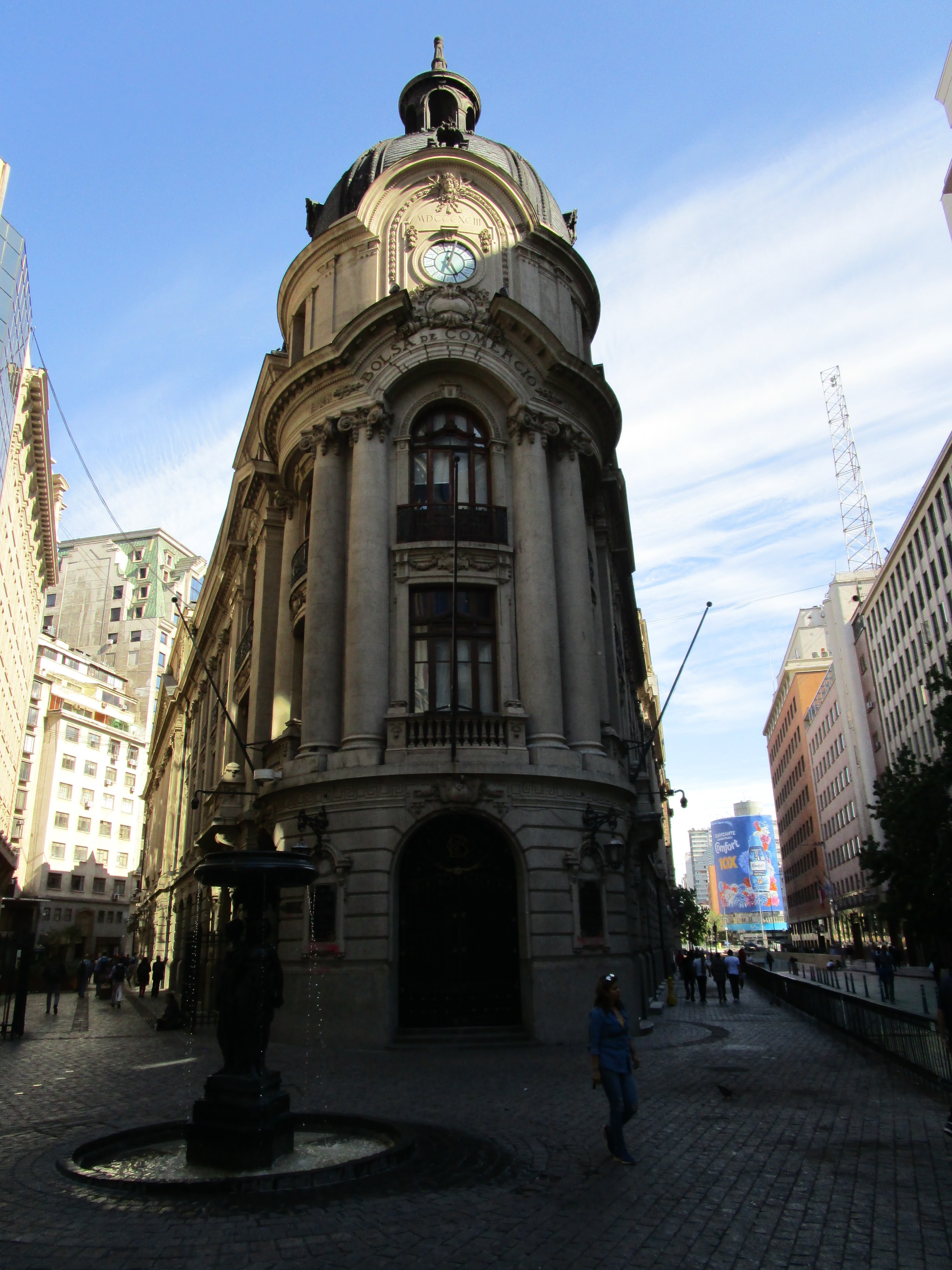
This is the Edificio de la Bolsa, the building housing the Santiago stock exchange.


This was the second stock exchange in the Americas, after New York. Could be the third, but I think we were told "second." This is a testament to the long-standing strength and stability of the Chilean economy. 

This part of town is called "Barrio Nueva York".


With the stock exchange and all, this is supposed to be a touch of New York deep into South America.

This is the Opera Santiago:


Santiago's Opera House. Much of the building is below ground, so the performing arts space is much much larger than it appears above ground.

We next venture into Parque Forestal.


This is the municipal park along the banks of the Rio Mapocho.

This is a monument to Nicaraguan poet Rubén Darío, who was an influence on Pablo Neruda, the renowned Chilean poet and Nobel Laureate. Neruda, interestingly, died in 1973, several days after the coup that toppled the Allende government and ushered in the rule of General Pinochet. Neruda died, as they say, under "suspicious circumstances" at age 69.


Rubén Darío died in 1916. So you can't blame Pinochet (or Allende) for that.


 Santiago is a city with a lot of parks and a lot of green space. I approve.

Across the street from Parque Forestal is this building:


Every Latin American capital has one. And, wherever one is, it is controversial and a focal point for protest and political activity. What is it? Well, it's no longer what it was. And what it was was the Embassy of the United States of America. The U.S. embassy recently moved to larger, more defensible quarters in an upscale part of Santiago.

And here, we end our walk, at the Fuente Alemana:


It's covered in graffiti because this is the university district. Everybody's got to protest something and the Germans provided the focal point. Even with the U.S. embassy no longer being across the street, the tradition lives with this being a focal point for protest and expression.

But we will end the walk with this:


What is that muddy creek? It's the Rio Mapocho. Santiago's "river." And, keep in mind, this is November which, in the southern hemisphere, is spring run off season. After particularly snowy winters, the run-off water can start climbing the sides of the channel. But this is it. There is so much about Santiago that is impressive. The river is not among them.

Monday, April 13, 2020

Phot-o' the Day: Pink Rabbit outside the Wiener Staatsoper; Vienna, Austria


It's the Easter season. Moving over to the secular side of Easter, I present a pink bunny rabbit.

It's not the Easter Bunny. Not even close. This picture is from December 2018. It's a sculpture of a giant pink rabbit outside the Wiener Staatsoper, the Viennese State Opera House, in Vienna. Austria. Not Virginia. I don't believe the Vienna in Virginia has a State Opera House. Well, at least it didn't when I lived in Northern Virginia. But that was more than a quarter of a century ago. The place has changed. So I could be wrong.

Tuesday, December 4, 2018

Vienna After Dark: Christmas Market Edition

The hot punch drinks at the Viennese Christmas markets is served in Santa head mugs
The sun has set on Old Vienna.  I set out for the Christmas Market in front of City Hall.  They have Christmas Markets scattered all over town, but the one in front of City Hall is supposed to be the biggest and the best.


All journeys in Vienna lead past the giant Opera building.


Past the decorated streets full of shoppers.


Christmas lights everywhere.  Maybe I should take a tram ride through the Christmas lights.


I did not make it to City Hall as the Christmas Market onm Maria-Theresien-Platz, between the Kunsthistorisches Museum and the Natural History Museum looked like too much fun.


I ate my supper.


A brat and a beer.  It's like I'm in Wisconsin.  I wanted to eat supper at a brew pub near my hotel before heading out, but the place was absolutely packed.  On a Tuesday night.  Again, given how crowded Vienna is in December, I'm scared of thinking how crowded it must be in peak tourism season.


I bought a Christmas tchotchke at that booth.  A Christmas ornament.  That looks like Simone The Cat.


For dessert, I had the orangenpunsch.  Orange punch.  Served hot in a Santa head mug and feeling like it had a higher alcohol content than the advertised five percent.


At 9:00 p.m., the joint shuts down.


Time to go back to the hotel.  The day is over.

Three Churches, One Afternoon

Horse-drawn carriage parked outside St. Peter's
The walking tour done, next on the agenda is checking out some church interiors.  The free walking tours I've been on do not involve going inside the buildings you're seeing.  So let's see some churches.


First up:  St. Stephen's.  This is the giant.  The walking tour ended at this point on building's west side.  It once was among the tallest buildings in the world, at 444ft in height.  The ornate spires reminds me of Sagrada Familia in Barcelona.  (Yes, St. Stephen's is much older.  So, technically, it would be correct to flip it say that the spires of Sagrada Familia remind one of St. Stephen's)


Note the black stone.  This is not the natural color of the rock.  The building is made of sandstone, which absorbs pollutants like a sponge.


The building apparently is under a perpetual state of restoration.  So, this too is like the perpetually under construction Sagrada Familia in Barcelona.

It is difficult to get a good angle because of the height, and with a real city packed around it.  So maybe this view will work:


Nice of them to include a miniature.


From the south side you can get a decently comprehensive angle:

Let's go in.


One last look at St. Stephen's, framed by its neighbors.


And, look, there's a horse-drawn carriage.


Instead, I'll walk to the next destination.


Michaelskirche.  On Michaelerplatz.


This isn't austere, by any means, but it was far less opulent that St. Stephen's.


I lit a candle and placed it off by itself.


This is my art photo, with the candle I lit being in the foreground.


Out of Michaelskirche and back into the streets of Tourist Vienna.  Like most streets in Vienna, this is an upscale shopping street.  This one, Kohlmarkt, appears to be a very upscale shopping street.


There are so many statues and monuments it's hard to keep track.  Basic rule, if it's not obviously an homage to Mozart, then it is almost guaranteed to be Hapsburg related.


I looked it up.  (Imagine!)  It's the Wiener Pestsäule, a memorial to plague victims in Vienna, built in the late 17th Century (which means it was built by Hapsburg money) (so I was sort of tangentially correct with my Hapsburg comment above).

The name sounds too much like "pustule" to me.  I know that seems to be somewhat childish, but the bubonic plague epidemic did involve pustules appearing on the body, so, no, it's apropros.

Speaking of apropos, next up is the third church on this Three Church Afternoon.


Kirche St. Peter's.  On Petersplatz.


Handsome church and a hansom cab.  The interior falls comfortably in between St. Stephen's and St. Michael's on the ornate scale.


And when I walked out, there was a horse drawn carriage.


I looked at those two horses, both beautiful white, out in the rain, pulling tourists around a crowded city for just oats a day.  And I couldn't help thinking that one of those horses would've said to the other:  "I coulda been a Lippizaner.  I coulda been somebody,"


Rains are getting stronger.  And it's past time for my afternoon.  I walk past the Opera.


I'm not sure why the pink rabbit is hanging out in front of the Opera, but why not.


Trams!


Vienna is absolutely lousy with tourists on a Tuesday in December.  I don't even want to imagine what this place must be like in summer peak tourist season.