Powered By Blogger
Showing posts with label beethoven. Show all posts

Friday, May 23, 2025

Return to Mexico City: After the COVID

La Iglesia de San Hipólito y San Casiano.
Or, for us English language speakers: Church of San Hipolito.
Why San Casiano gets dropped from the bill when the name is translated to English, I do not know.

I am back in my favorite country that shares a land border with the United States. Given that only two countries share a land border with the USA -- and one of those being the smug land of and unearned and misguided sense of superiority to our immediate north -- the hurdle is low for Mexico. But clear it, it does.

This is my second time in Mexico City. My first was in 2021, during the height of lockdown-mania. Mexico then was one of the few countries open to tourism. Mexico City was generally open, although some of the nicer restaurants were closed or had very limited hours. The smaller, informal places were opened because those are the type of places where the owners and employees could not have afforded to have been shut down.


I'm staying in the Barceló México Reforma, just to the west of the El Centro Histórico de la Ciudad de México, the historical center of Mexico City.


Barceló is a chain that has locations in other Latin American cities, Spain, maybe, too. I've stayed at the ones in Guatemala City and San Salvador and loved them. The hotels there were luxury, but with a bit of that fraying, decaying feel to it. Which, to me, is what a grand hotel in a Latin American capital should feel like. This one is just plain luxury. But the room rate was quite reasonable, comparable to lower-to-middle end chain hotels on the interstate in the United States.


I got in late and ate way too big of meal last night. At a restaurant connected to my hotel. I couldn't help it. The various salsas (four of them) and a hot cheesy bean dip where way too good not to require every damn corn chip in the basket on the table. Food with flavor! What's up with that?


So I slept in and got a late start. I wandered the neighborhood in search of a good 1:00 p.m. morning cup of coffee that was not Starbucks. (Mexico City, generally and fantastic food city with a minimal amount of fast food, is ridiculously over-infested with Starbucks. At a "Seattle in the mid 1990s" level.)


I did get properly caffeinated. So it was time to head off to the National Museum.

Along the way, I saw a statue of Cuban Jose Martí. Mexico is a soft spot for communists, so it was nice to see a statue honoring a decidedly non-communist Cuban hero.


Right in front of the Jose Martí Cultural Center. What an amazing coincidence!

En route I end up Alameda Central, the oldest municipal park in Mexico City.


There are lots of fountains in Alameda Central. Let's start with a very unassuming one.


The maps just call this fountain "Fuente cercana a Metrobus hidalgo." Fountain near the Hidalgo Metrobus. The northern perimeter of the park is Avenida Hidalgo." 

Bigger fountain. Bigger name. Fuente de las Náyades. Fountain of the Naiads. Naiads are fresh water water nymphs.


And here they are in the fountain enjoying a dip in cool, refreshing, non-saline water.


Continuing with the fountain tour of Alameda Central: Fuente La Dama. I don't know who the dame is. (Mujer is Spanish for woman. I am presuming "dama" is Spanish for "dame.")

Then there is one of the higher-profile fountains in the park: Fuente de Neptuno. The Neptune Fountain. 


I remember seeing the Neptune Fountain on my COVID-era visit to Mexico City. It -- and all the other fountains in Alameda Central -- were drained dry. Now Smokey Robinson may say that "ain't too much sadder than the Tears of a Clown." I'll go one better on Smokey. There's some sad things known to man, but ain't too much sadder than Neptune in dry cement. (Or Poseidon, if you prefer your gods Greek.)

The Benito Juarez Monument was walled off when I was here in 2021. I was hoping that whatever construction that was happening would have been completed three and a half years later.


Nope. Still behind walls.

And this the Fuente Mujer Con Flores: the Fountain of the Woman (Mujer = Woman) with flowers.


Then comes the weirdest monument in the park: Monumento a Beethoven. The Beethoven Monument.


There is nothing unusual or noteworthy about Beethoven Monument. Schroeder surely would approve. And it is next to the Palacio de Bellas Artes, the opulent performing arts venue for the finest of the fine arts in Mexico City. But it's not very evocative of Beethoven.


Sorry for the "shooting into the sun" distortion, but I wanted to get the head-on view of the monument. If that's supposed to be Beethoven kneeling before an angel, then that is the buffest Beethoven in history. It's not insulting. It's not -- worse yet -- abstract expressionism like the poor ultra-modern, ultra-postmodern monument to Sebelius in Helsinki. A buff angel with even buffer dude kneeling before him is much more honorable and complimentary than an abstraction of pipes for a composer who didn't even compose for the church organ.

A block or two -- let's call it a block and a half -- down from Alameda Central is the National Museum of Art.


The National Museum of Mexican Art. Mexico, thankfully, has thus far missed the worst of abstract expressionism, modernism and -- the most evil of all -- post-modernism. The museum is filled to the brim with real art, from real Mexican artists, with actual, tangible talent.

Let's briefly look at some of the highlights of the collection.

After you pay your 95 peso admission fee -- just a nick under $5.00 U.S. -- plus an extra 5 peso fee for photography (just one quarter) (a bargain!) -- "sin flash" of course -- the first collection you get steered toward is occult art. Not my thing, of course, but it beats the devil out of abstract expressionism.


This work by the artist Leonora Carrington, called "The Seance," I found really interesting. Mostly because, sitting at and around the seance table, are the most demonic looking parrots I've ever seen. Truth be told, I don't think I've even seen a demonic looking parrot before. They're generally friendly looking, although -- like me sometimes -- they talk too much. That was one weird seance scene.


That was another work in the occult section. What are the chances that a culture that celebrates "Day of the Dead" on All Souls' Day would have an occult wing in its national art museum? If you know what the above is, let me know in the comments. There was no discernable ID card that went with it.

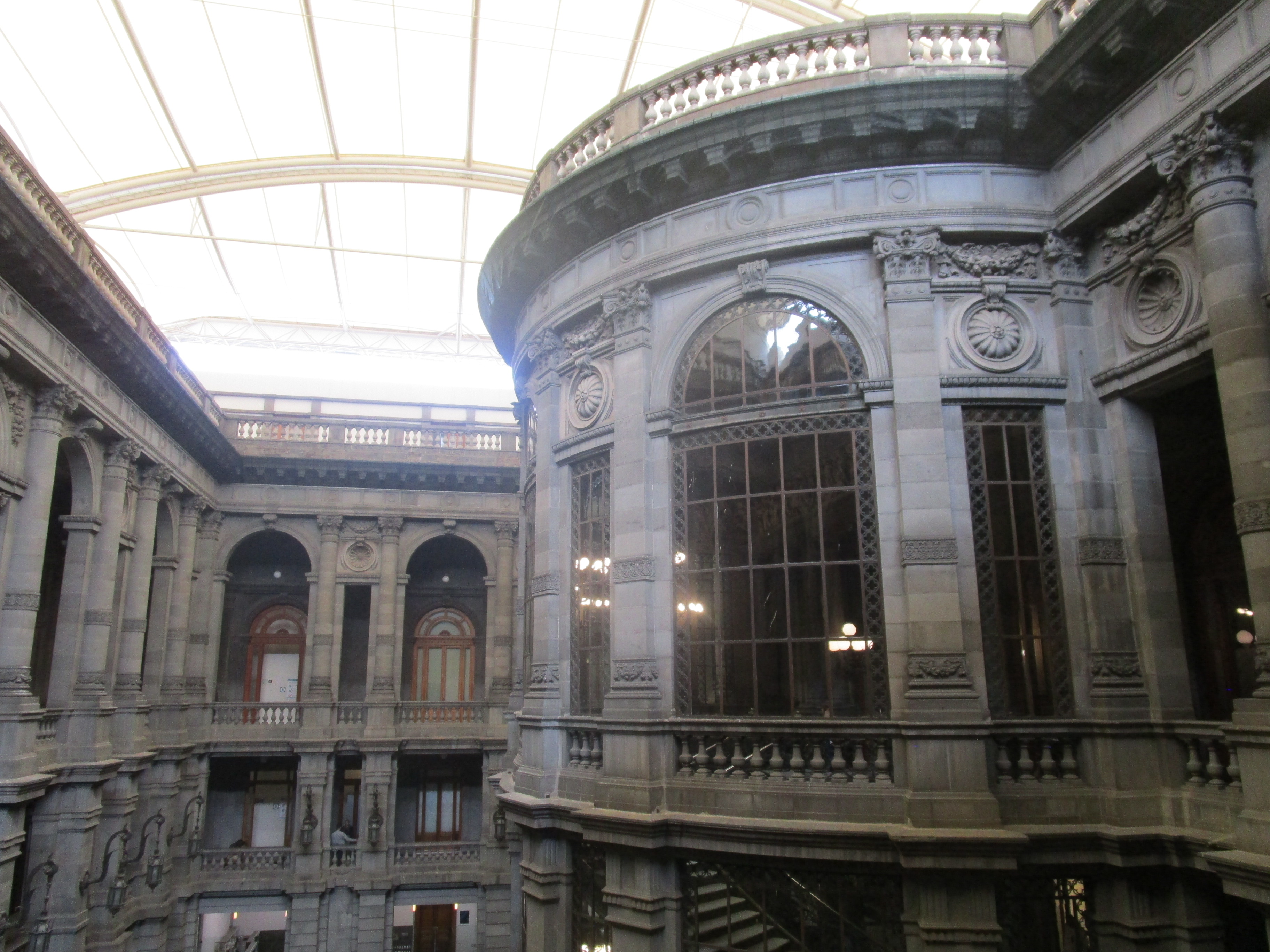
The building itself is one of the most beautiful works of art on display inside.


Leaving the occult wing for the main lobby and this:


Aprés l´orgie. (Or, in Spanish, Después de la orgía.) Artist? Fidencio Lucano Nava. "After the orgy" suits this one right. Ain't no party like a Diddy party.

Again, the interior is one of the greatest sights to see in here.


Brass lions in a staircase handrail. That is attention to detail.

And this is the animal we share with Mexico. The Eagle.


You can tell it's a Mexican eagle and not a U.S. eagle because of the snake in its feet claws.

And here is something/someone else with whom we share culturally with Mexico.


Columbus. Unashamedly. This is the great explorer and uncontested discoverer of the New World disembarking after his long sea journey. Artist unknown.

This next one is Mexico specific. And it has a known artist.


The sculptor is Manuel Vilar y Roca. This is from 1851. The long title is "Tlahuicole, general Tlaxcalteca en el acto de combatir en sacrificio gladitorio." Translation: Tlahuicole, Tlaxcalteca general, in combat in an act of gladitorial sacrifice." Perhaps it wouldn't have been sacrificial if he gone to battle wearing something more protective than a leaf.


There is definitely quite a Roman feel to this sculpture exhibit.


Quite.

Leaving Rome for the countryside, I loved this one.


"Yunta con cargo de maíz." Translation: "A couple of oxen with corn." Artist: Mardonio Magaña. Medium: wood sculpture. Abstraction expressionism was the fertilizer that fed that corn that those two oxen are hauling to market.

This is another one I liked. "El puente de San Antonio en el camino de San Ángel junto a Panzacola." "The San Antonio Bridge on the way to San Ángel, next to Panzacola." Artist: Eugenio Landesio.


I liked for a superficial reason. It looked like something Jean-Baptiste Camille Corot would have painted. And I love me some Jean-Baptiste Camille Corot art. 

Finally, we reach the pinnacle of 20th Century Mexican art:


Diego Rivera. "Las Tentaciones de San Antonio." Translation: "The Temptations of Saint Anthony." Apparently St. Anthony was tempted by extremely phallic looking root vegetables. He's a saint, so he obviously did not succumb to that particular temptation.

Another interior shot. This time higher up.

Why the trendy people love Diego Rivera's marginally talented wife (the unibrowed Frida Kahlo), while the significantly greater talent Mr. Rivera is drifting into obscurity outside Mexico (and Detroit) (they love Diego Rivera in Motor City) is something I do not understand. A marketing assist from Salma Hayek? 
 

Back to the Barceló. In front of the hotel are about a dozen flags, most from the Americas. But, in addition to Spain, there was one other flag blowing in the late-afternoon (obscured, once again, by the need to shoot into the face of the sun). The chequy of Croatia. There's got to be a story behind that.

Wednesday, December 5, 2018

Third Day in Vienna? Third Man in Vienna!

At no point on this ride did I threaten to kill Joseph Cotten
My third day in Vienna sees me take in some Third Man sights.  Let's set the mood with the biggest hit record from 1950, with 11 weeks at #1, Anton Karas's Third Man Theme.


Of course, all of my walks through Vienna take me past the Opera.  This being the first sunny day in Vienna -- maybe the first sunny day of the trip -- and everything photographs better in the sun, this warranted yet another picture of this massive structure.

I took the U1 metro line to Praterstern, which I caught at Karlplatz station just south of the Opera.


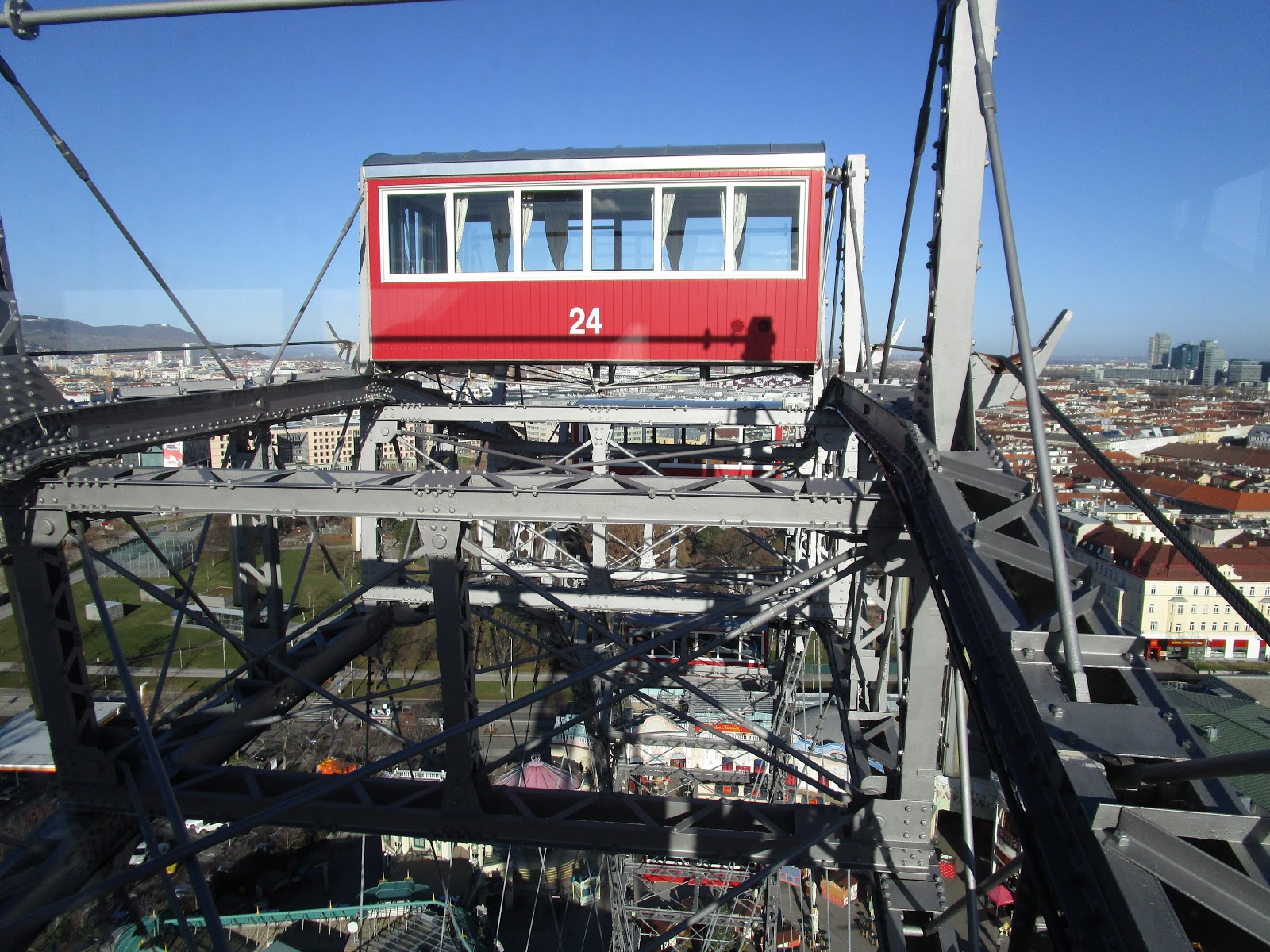
And there was the giant Ferris Wheel, known in Vienna-speak as the Wiener Riesenrad, or Vienna Giant Wheel.


If you remember the scene from the movie, with Orson Welles's Harry Lime riding the Riesenrad with Joseph Cotten's Holly Martins, the two calmly discussing whether Lime should off his best pal Martins, the wheel turns very slowly.  And the cars are the size of a Viennese hotel room.


Did I mention my hotel room was small?


On a cold, but sunny, Wednesday morning in December, there was a small line to buy tickets for the Big Wheel.  I bought my ticket and got on board for a ride.


The Riesenrad turned slow, so I wasn't worried about motion sickness.


And, being in an enclosed box, feared of heights did not kick in.  Maybe if the box hadn't been so stable, that would've been a problem.


I sound like a wuss.  Motion sickness!  Fear of heights!  Fear of enclosed spaces!  Like Charlie Brown in "A Charlie Brown Christmas," it's like I've got pantophobia: the fear of everything,


Actually, the views from the top of the circle were quite nice.  You could even see the spires of St. Stephen's.


 Yes, I really am in the car.


 And this is the point where you look down and think of the dialog from the scene in "The Third Man" where Harry Lime compares the people below to dots and asks Holly Martins that if he offered 20,000 pounds for each of the dots, would he keep his money or "calculate how many dots you could afford to spare ... free of income tax."


And that part isn't even the best part of the whole scene at the Riesenrad, which would be the famous Orson Welles "cuckoo clock" speech, maybe the greatest monologue in the movies, which you can click here to hear.

In Italy for 30 years under the Borgias they had warfare, murder, terror, bloodshead.  And, for this morning, I have the rest of the Prater to explore.


You don't pay to be admitted to the park.  You buy a ticket for each ride.  This being winter, a lot of the rides appeared to be closed.


A lot of the attractions seemed to be "haunted house" themed, too.  There is no human selling tickets to this haunted house.  Only some sort of animatronic evil spirit.


This rollercoaster seemed to be down for the season.


This ride, the Sombrero, seems to be all sorts of politically incorrect.


There was a Las Vegas themed bar on the premises.  I think this was added after "The Third Man" was filmed here in 1949.


The bumper cars were up and running:


But I came to Prater to ride the wheel.  The wheel had been ridden, so it was time for my next "Third Man" destination.


The U3 line to Simmering, then it's catch the #71 tram to my next stop:


Zentralfriedhof.


Vienna Central Cemetery.


Two important points in "The Third Man" take place here:  the opening and the closing.  The opening scene is the burial of Harry Lime in Zentralfriedhof.  I'm not sure exactly where in the cemetery it was that Lime was buried, but there's no point in checking that out because (a) the movie is fictional and (b) the burial in the fictional movie was fictional as Harry Lime was not actually dead at the movie's opening.

So instead let's find Beethoven's grave.  And here he is:


Right next to him was Schubert.


And in the same section, sadly underappreciated with an underwhelming number of flowers, is Brahms.


Go to sleep, Johannes Brahms, go to sleep.


This is the composer section of Zentalfriedhof.  The above is a memorial statue to Mozart.  But Mozart is buried back in Vienna.

Across the way was this interesting looking tomb:


This actually is the most interesting cemetery I've ever seen.  The headstones are not universally traditional by any means.

Moving on, meet Austrian physicist Ludwig Boltzmann, whose equations on the property of atoms were scorned in his day.  He committed suicide in disgrace, the scientific consensus thought he was a fool, but after his death, he was exonerated,  His theorems were proven true.


His tomb bears the equation of S = k log W.  The formula for entropy.  Living my life as a gradual descent into chaos and disorder, I thought a graveside "selfie" was in order.


Next up was the artist's section.


That is the grave of the artist Franz West.  Below is a gravestone that took the form of a white cloth draped over a piano:


Multiple interesting headstones in this "honors" section of the cemetery.


This was my favorite.  I think it's the most beautiful "gravestone" I've ever seen.


I looked at the plaque to see who it could be:


Actress and inventor, the beautiful Hedy Lamarr.  I didn't even know she was buried here or that she was Viennese.

Selfie with Hedy?


Interesting tombstones all around in this neck of the cemetery woods.


The final one, the fat cat above, is Austrian artist Manfred Deix.  Don't feel inferior if you have not heard him, his wikipedia page is only in German.


There are two things in this cemetery you will see in "The Third Man."  First, are the green domes visible throughout the cemetery.


You will see them lurking in the background in a number of shots.  Second, there are the cemetery walkways.


I don't know which one is THE one where the famous final scene was shot, the landscaping being different, but that final camera shot, linked here, is one of the great movie-ending scenes, where at the scene of Harry Lime's real funeral, Joseph Cotton's Holly Martins waits for the beautiful Anna as she approaches from a distance and ... then ... walks right past him without a glance.

I'm walking in this section of the cemetery looking for the grave of ...


The Pride of Austria!  Vienna's own Falco!  Still well remembered even more than 30 years after his major U.S. hits.  Which was your favorite?  Pick one as your musical accompaniment here:  (1) the dark, brooding Der Kommissar, where Falco makes German a great language for rap;  (2) the international dance smash Rock Me Amadeus, which made Falco an international superstar;  or the jaunty fun of Vienna Calling.

This interesting tombstone was right next door.


But there are only so many interesting tombstones one can view in a day.  Back on the tram!


Back to Karlplatz.


And here I find the Third Man Museum.


I thought it was opened on Wednesdays, but it is only open Saturday afternoons.  So I went to a nearby coffee shop, for a coffee, a (gluten free) Esterhazy schnitte (very very hazelnut), and a vanilla macaron.


A civilized way to rest my barking dogs.  And what was the music playing in the coffee shop?  It wasn't Falco.  It wasn't Christmas music.  But it was awesome.  It was THIS.